Saves instantly, no account needed. Already a member? Sign in.
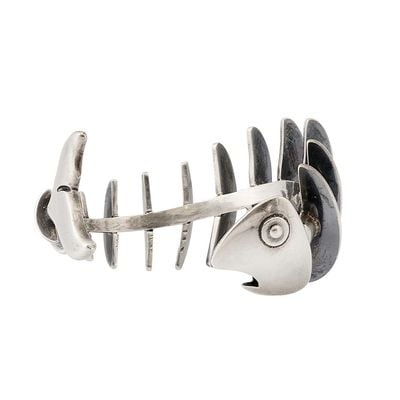
The fish skeleton, reduced to spine and ribs and wrapped around the wrist, gives this cuff its structure: Antonio Pineda turning a natural form into a piece of articulated silver architecture. It is recorded in Gobi Stromberg's Silver Seduction (p. 150, plate 198), and the existing record notes its .970 silver marks, placing both the design and its material on solid ground.
The form belongs to Pineda's most sculptural vein. He apprenticed under William Spratling at Las Delicias, learning from the master smiths Mondragon and Navarrete (Stromberg, p. 29), and built a taller in which he conceived designs while master smiths executed them in silver (Stromberg, p. 81). A skeletal fish cuff is exactly the kind of demanding open form that collaboration allowed.
The .970 mark signals the higher-purity silver Pineda favored, above ordinary sterling's 92.5 percent (Stromberg, p. 79). The fish skeleton recurs across his cuffs, a motif he returned to in silver alone.
For a collector, a documented fish skeleton cuff is among Pineda's most recognizable sculptural ideas, the natural world rebuilt as wearable structure.
Record data: Stromberg, Silver Seduction: The Art of Mexican Modernist Antonio Pineda, p. 150, fig. 198, documents this cuff and supplies the 970 silver standard, a date of 1953 or later, and a width of 7.1 cm; all three are entered as structured fields and the reference is listed under References. The Form field previously read "cuff" and has been normalised to Bracelet so that the record sorts with the rest of the collection. Place of manufacture is Taxco.
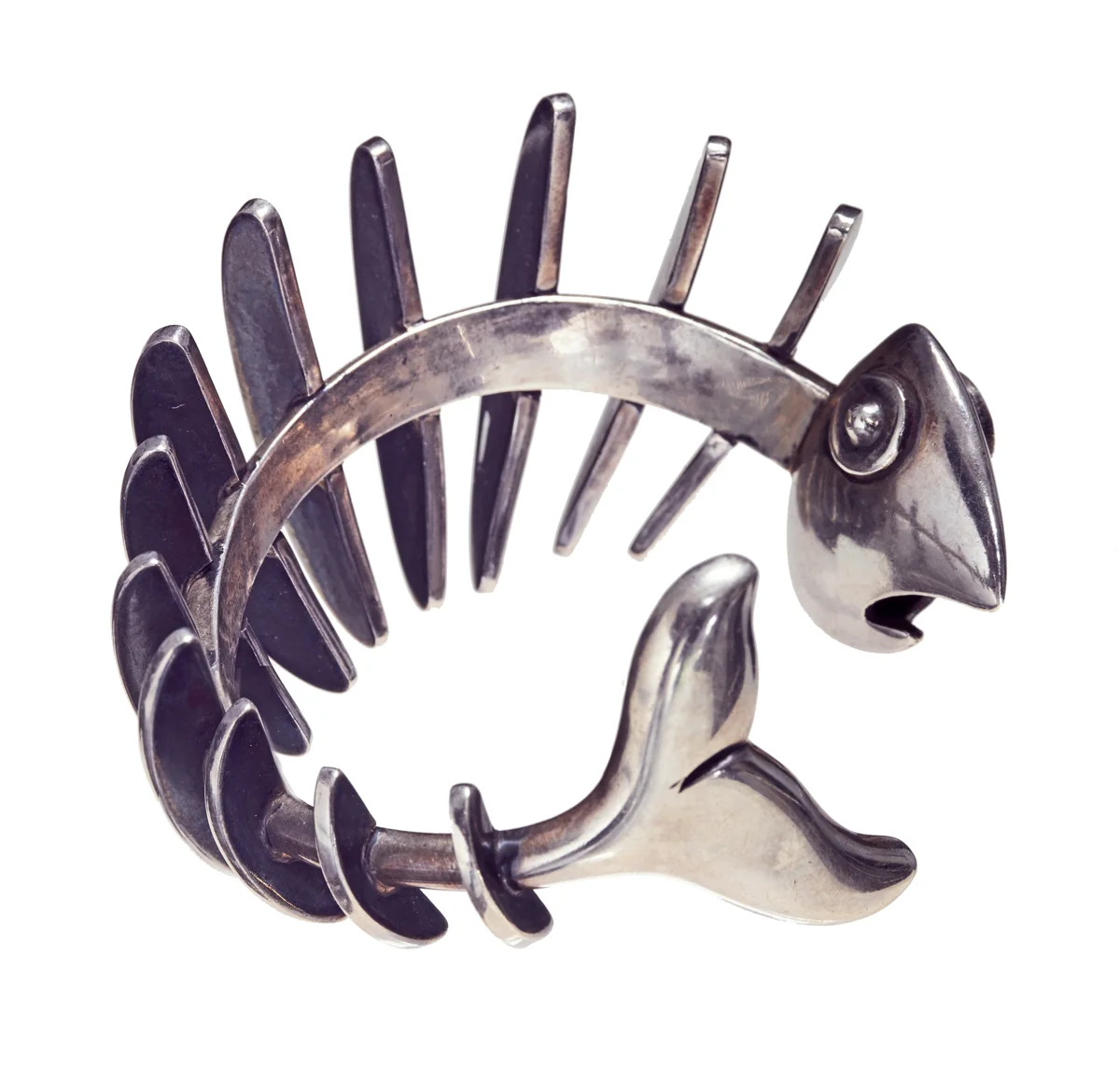
Fish Skeleton bracelet, 1950-1959
Accession 2021.25.221. Official museum record Photo: The Wolfsonian-FIU.
Verified against each institution's own collection records. All museum collections
Antonio Pineda (1919-2009) Fish Skeleton cuff bracelet 1 3/4"w x 6 3/4"l (inner length, approximately); opening width: 1"w
Toomey & Co. Auctioneers · 2021-06-09
A MEXICAN SILVER FISH BANGLE Antonio Pineda, Taxco, Mexico, circa 1955 Marks: ANTONIO TAXCO (in crown), SILVER, STERLING MEXICO, 920, (eagle 17) 1-1/2 x 2-3/4 x 2-1/2 inches (3.8 x 7.0 x 6.4 cm), (wrist opening) 2.1 troy ounces
Heritage Auctions · 2009-11-10
Museum of Mexican Silver. “Sculptural Fish Skeleton Cuff Bracelet.” Catalog no. MoMS-001942. https://museumofmexicansilver.com/pieces/pineda-sculptural-fish-skeleton-cuff-bracelet
See something wrong with this record? Suggest a correction and the piece details fill in automatically.
Antonio Pineda
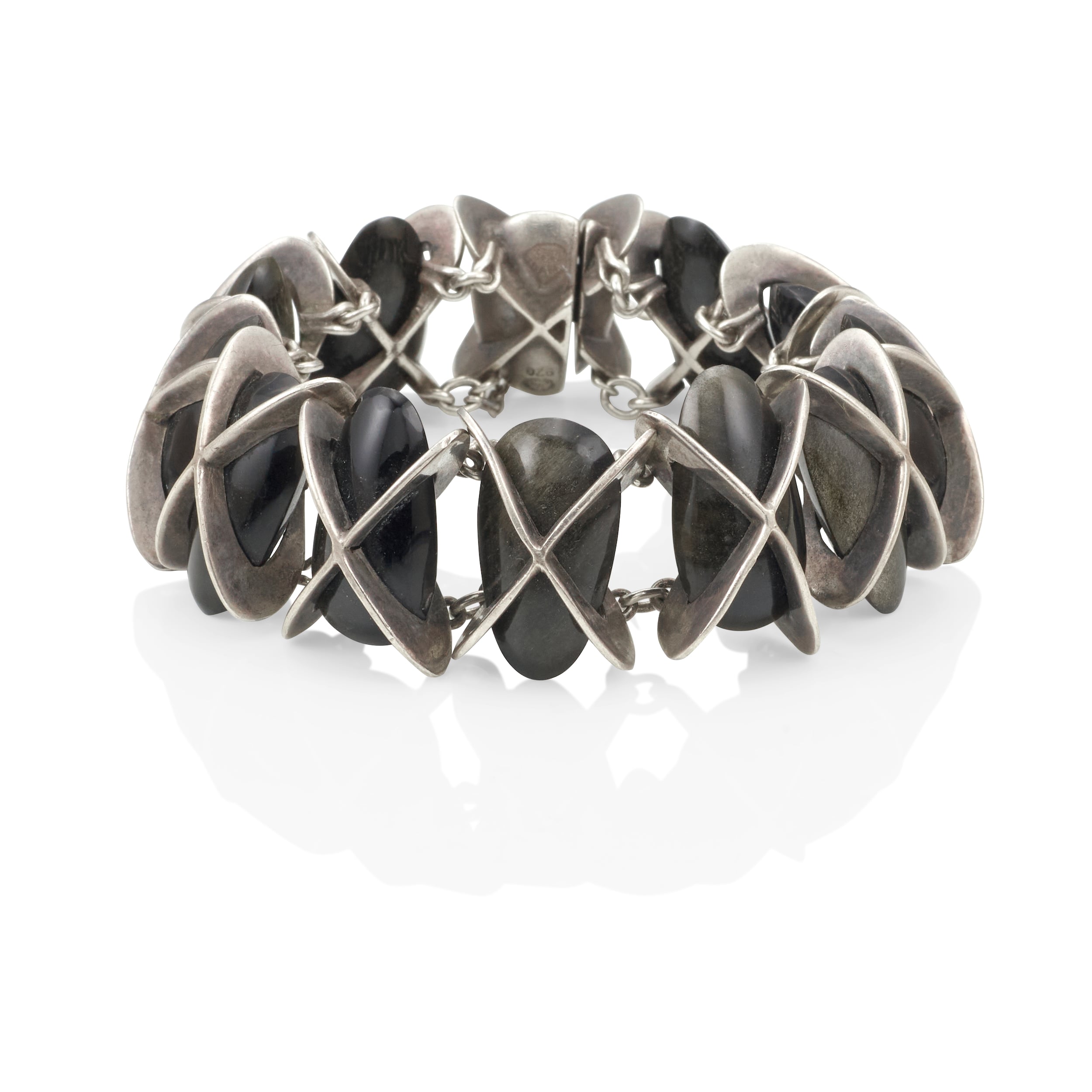
Bracelet with Obsidian Eggs in Intersecting Silver Discs
c. 1955
Sterling silver