Saves instantly, no account needed. Already a member? Sign in.
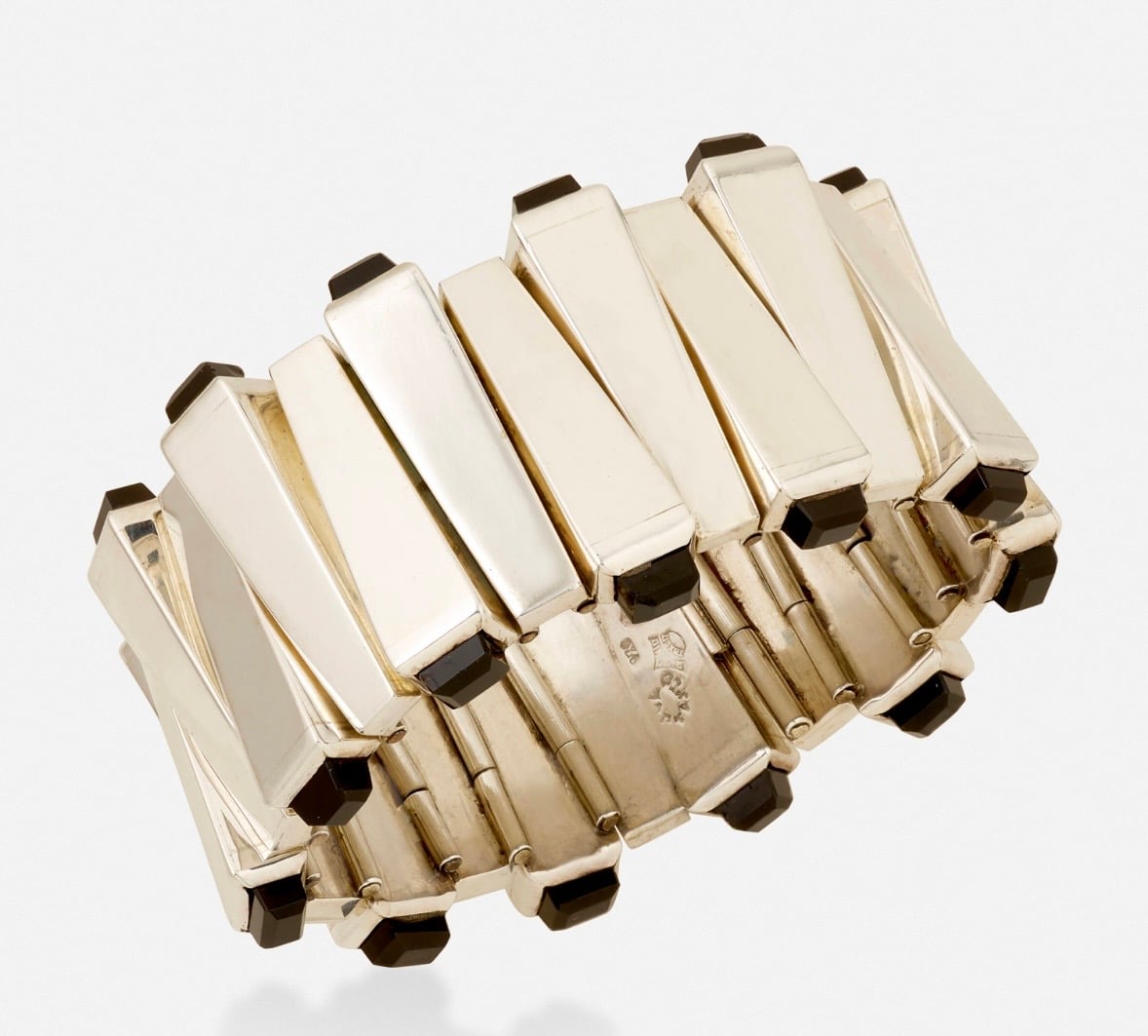
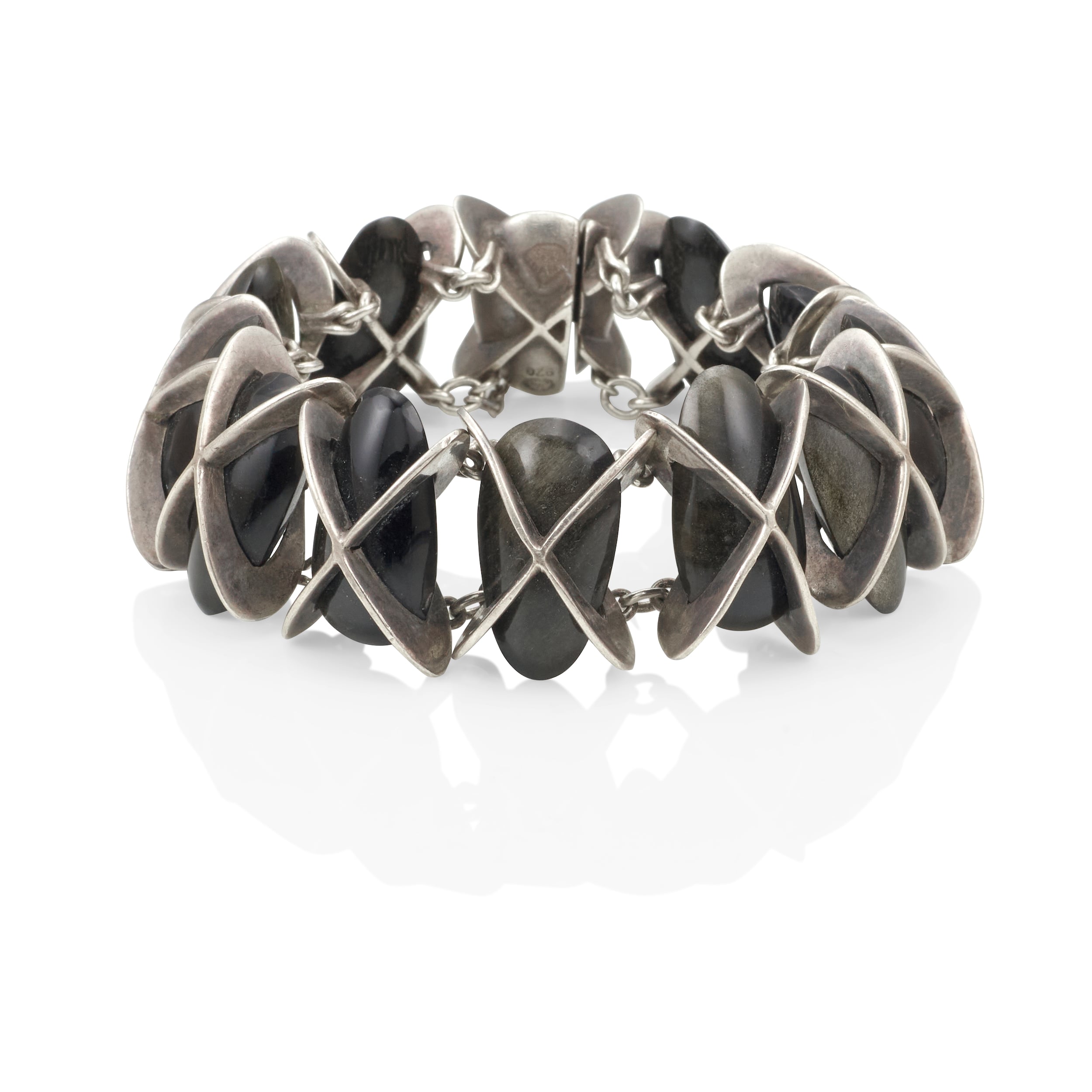
The eye goes immediately to the lattice: a repeating crosshatch of sterling bars laid over paired rows of large obsidian cabochons, each stone pooling with deep volcanic darkness against the silver grid. This is bracelet-making as architectural thinking — the diamond-shaped voids and overlapping planes drawing on a language of abstraction that Antonio Pineda was refining at the height of the Taxco school's modernist moment, circa 1955.
Obsidian carries its own cultural weight in Mexico, a stone worked for millennia before the Spanish arrival and central to pre-Columbian craft traditions. Pineda's choice of it as a foil for modernist geometry is characteristic of the Taxco school's double axis: Stromberg (2008) documents how the silversmiths of this period fused "aesthetic elements of Mexico's past and of modernism into a new version of modern silver design." The lattice does not simply decorate the obsidian — it frames it structurally, the silver acting like architectural tracery rather than a conventional bezel, so that stone and metalwork read as a single interlocked surface.
Morrill (1996) documents that Pineda developed "an appreciation for working with powerfully formed but simple shapes in silver" during his formative apprenticeship in Mexico City, and the lattice bracelet embodies exactly that discipline: the geometry stripped to its essentials, the obsidian allowed to carry the chromatic weight. The bracelet's substantial width and the rhythmic repetition of the unit read as sculpture worn on the wrist, consistent with what Stromberg describes as the "boldness and superb craftsmanship" that defined Pineda's contribution to the Taxco school.
Examples from the mid-1950s represent the workshop at its most assured.
Museum of Mexican Silver. “Bracelet with Obsidian Eggs in Intersecting Silver Discs.” Catalog no. MoMS-001941. https://museumofmexicansilver.com/pieces/pineda-silver-and-obsidian-lattice-bracelet
See something wrong with this record? Suggest a correction and the piece details fill in automatically.
Antonio Pineda
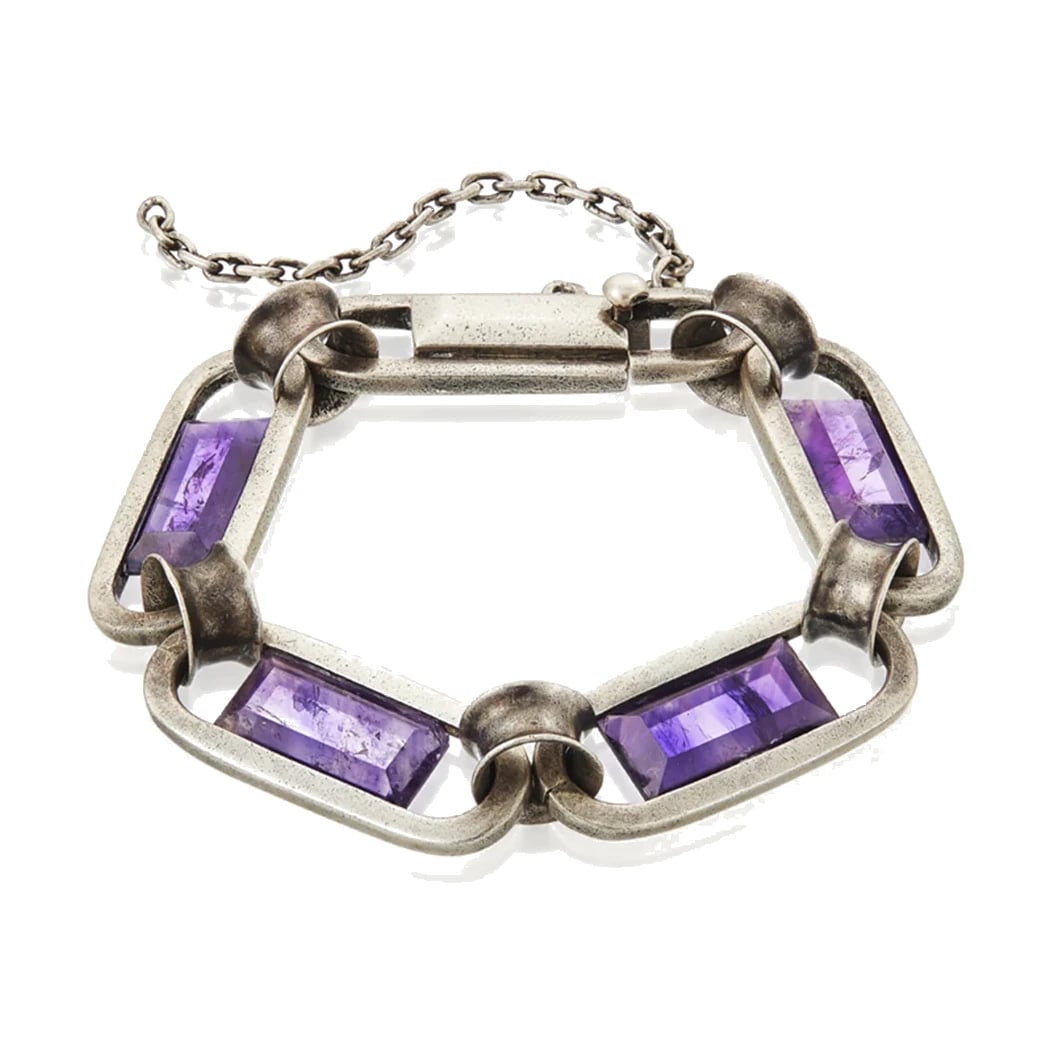
Amethyst and Silver Oval-Link Bracelet
Silver