Saves instantly, no account needed. Already a member? Sign in.
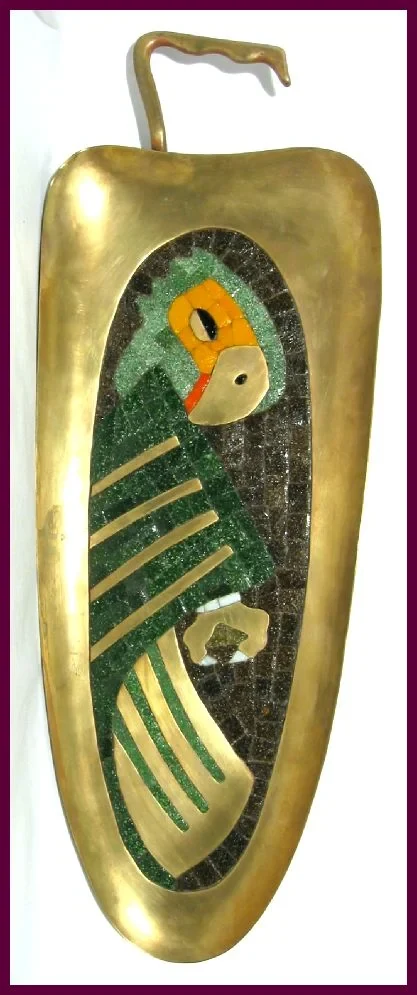
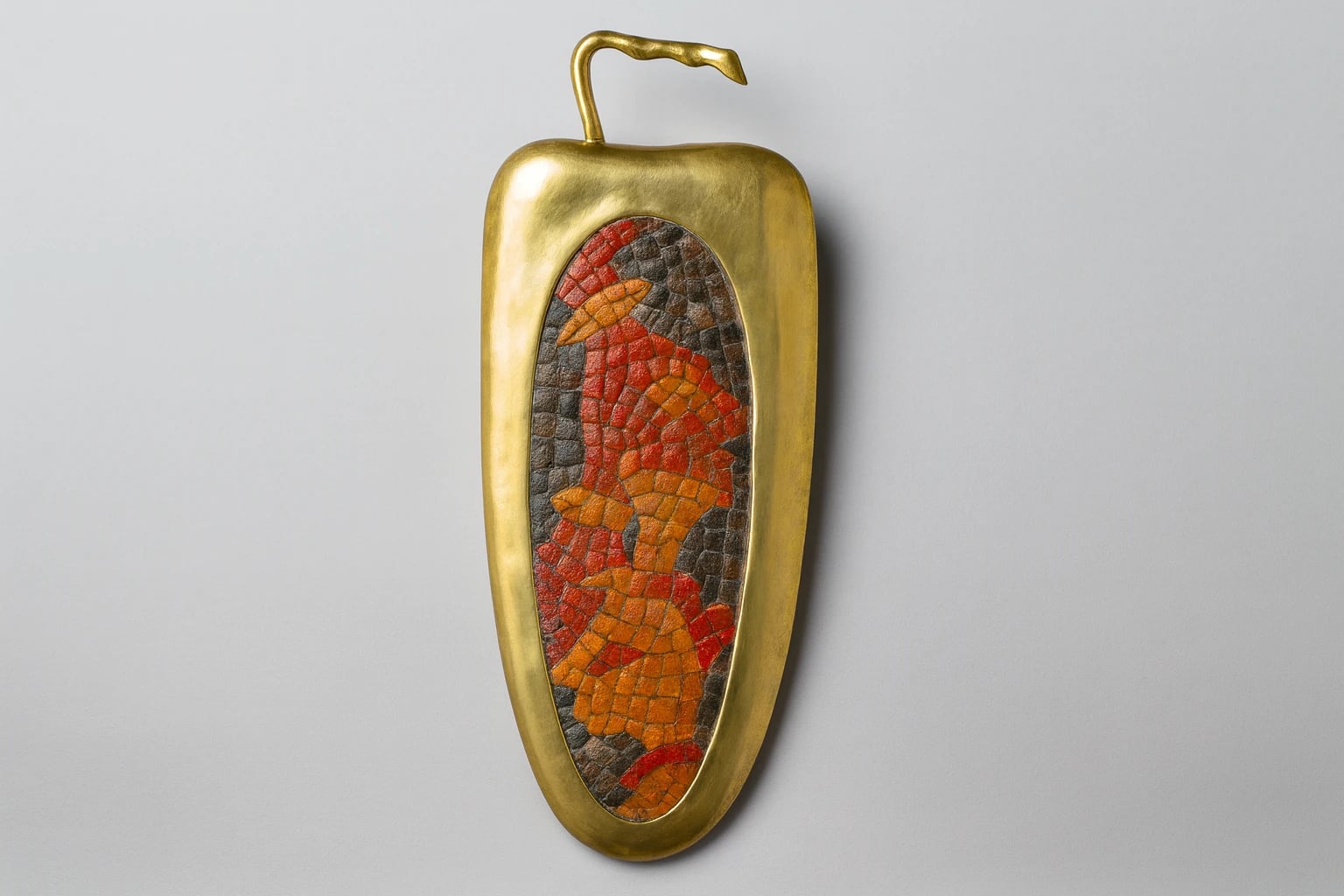
The long brass form gives Salvador Teran’s mosaic work the scale of a domestic object and the vertical presence of a wall plaque. Measuring 22 by 8 inches, it is marked Salvador in script, handwrought, Mexico, with design number 418, a number consistent with Teran’s practice of stamping inventory or design numbers on his work. Hougart records variations of the Salvador script signature, including marks used on brass, and notes that Teran pieces were usually stamped with design or inventory numbers. The date supplied for this example, the 1950s, places it in the period after Teran left Los Castillo and developed his independent Mexico City workshop, where brass, mosaic, jewelry, and larger decorative objects became part of a single design language.
The object is organized around a narrow oval field of cut glass mosaic set into a hammered brass foundation. The brass surround is not a passive frame. Its broad, rounded edge swells slightly at the sides, narrows toward the lower end, and rises above the mosaic like a shaped metal rim. At the top, a curved projecting element gives the piece a handle or hanging presence, turning the tray form toward sculpture. Within the recessed field, small irregular tesserae build two opposing African heads in red, orange, amber, and grey. The figures are made from color rather than line. Red and orange carry the profiles forward, while the grey ground absorbs and breaks the light around them. The glass surfaces catch illumination unevenly, so the image changes from a readable figural composition into a field of flickering facets as the viewer moves.
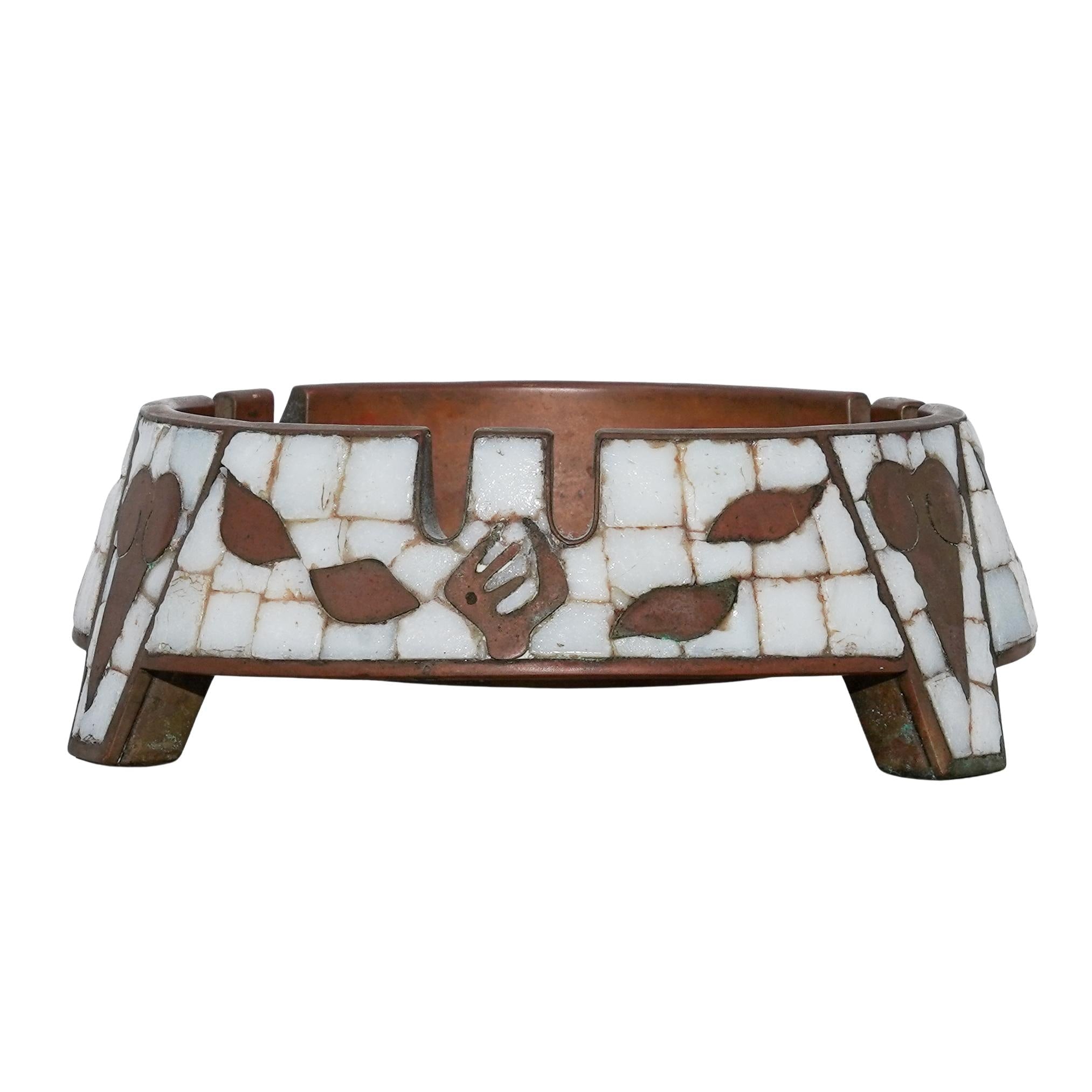
Teran’s use of mosaic was not an isolated decorative experiment. Penny Morrill records that he worked with several media and was especially interested in stone mosaic. She cites Mary Davis and Greta Pack on his combination of metal with mosaic in a workshop producing boxes, trays, and other decorative objects. Morrill also notes that Teran’s large scale mosaic interests had developed before he left Los Castillo, including his mosaic interior for Reveriano Castillo’s shop, a nonrepresentational band of cloud and star forms that survived in the shop for decades. This tray or wall hanging belongs to that same wider field of experiment: the metal object becomes a support for color, texture, and figure, while the mosaic prevents the brass from reading only as polished surface.
The work also clarifies Teran’s position within the Mexican silver renaissance. Morrill describes Salvador Vaca Teran as an outstanding designer and technician, one of the early workers at Spratling’s Las Delicias, then a major presence at Los Castillo before he established his own taller in Mexico City in 1952. His biography matters here because the object carries forward lessons learned in the taller system without repeating them in silver. Los Castillo had made color a structural problem through married metals, inlay, and related techniques. Teran’s independent brass and glass pieces extend that concern into a different medium, less precious than silver but no less deliberate in its handling of surface, contrast, and designed production.
Museum of Mexican Silver. “Opposing Heads Brass Tray with Glass Mosaic.” Catalog no. MoMS-002329. https://museumofmexicansilver.com/pieces/salvador-teran-sculptural-tray-or-wall-hanging
See something wrong with this record? Suggest a correction and the piece details fill in automatically.
As a museum object, this piece is valuable because it places Teran’s mosaic work beside the better known silver jewelry and hollowware of Taxco modernism. Its materials are modest in comparison with sterling, yet its ambition is architectural. The form can be read horizontally as a tray, vertically as a plaque, and sculpturally as a metal body containing an image. That shifting status helps explain why the Mexican silver renaissance cannot be understood only through jewelry or through silver alone. In Teran’s hands, brass and glass mosaic became part of the same modern design culture: workshop made, materially experimental, and alert to the movement of light across the surfaces of everyday objects.
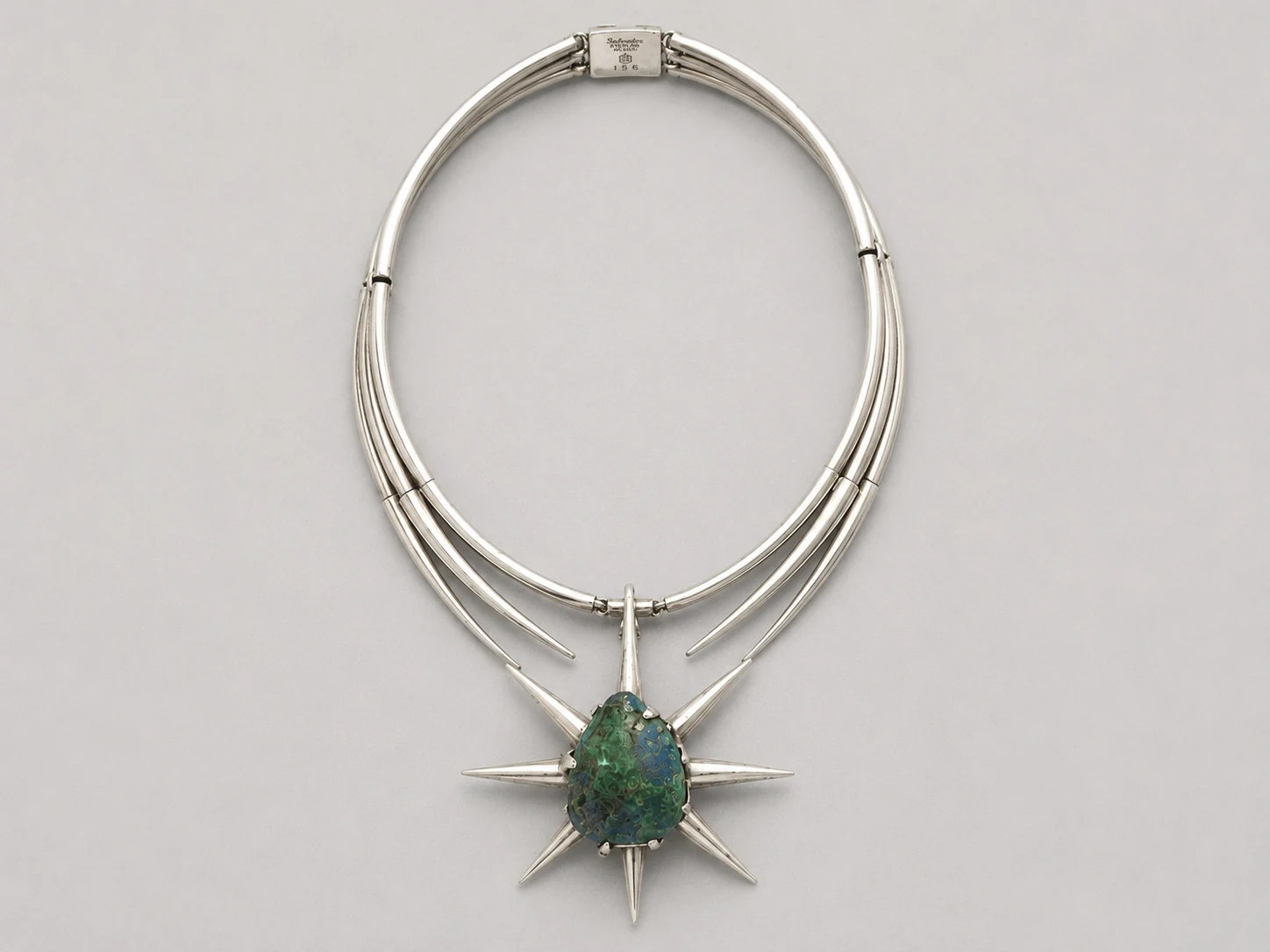
Salvador Terán
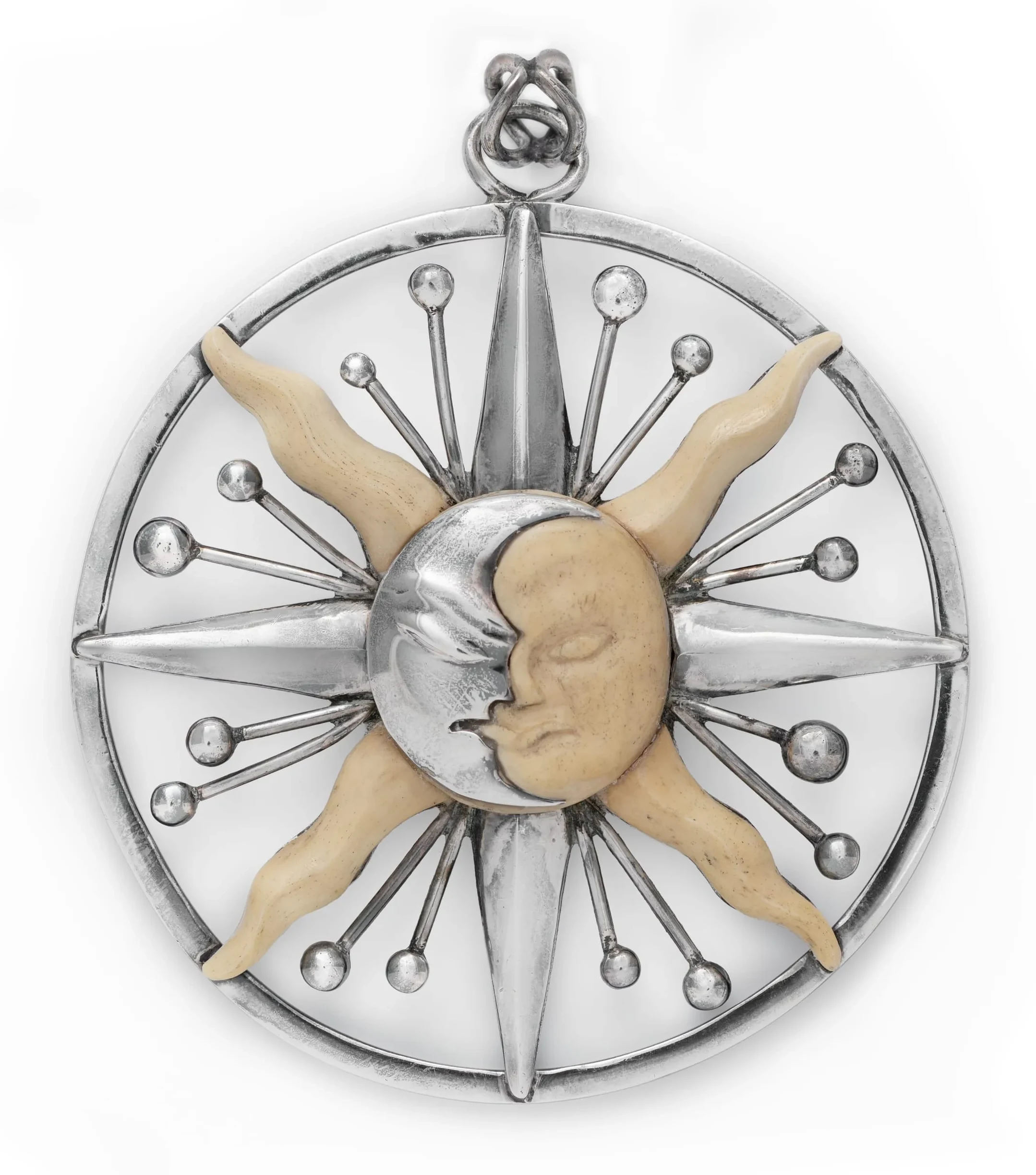
Atom Starburst Necklace, Design No. 156
after 1952
Sterling silver