Saves instantly, no account needed. Already a member? Sign in.
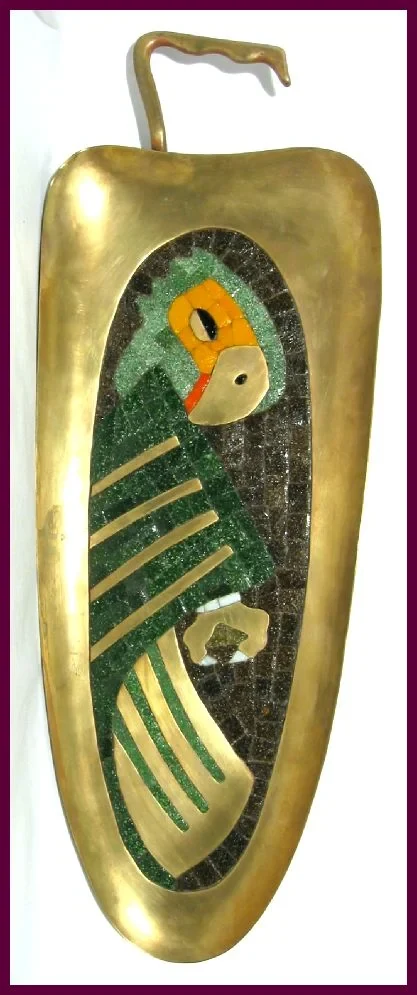
The elongated tray gives Salvador Teran’s mosaic practice an unusually sculptural format. Its raised, golden metal surround narrows toward the base and widens softly at the shoulders, enclosing the parrot as if the bird were set into a shallow architectural niche. The object is marked Salvador in script, handwrought, Hecho en Mexico, with design number 409, and measures 23 by 8 1/2 inches. Those markings place it within the independent production Teran developed after leaving Los Castillo in 1952, and the design number belongs to the inventory system used by his workshop.
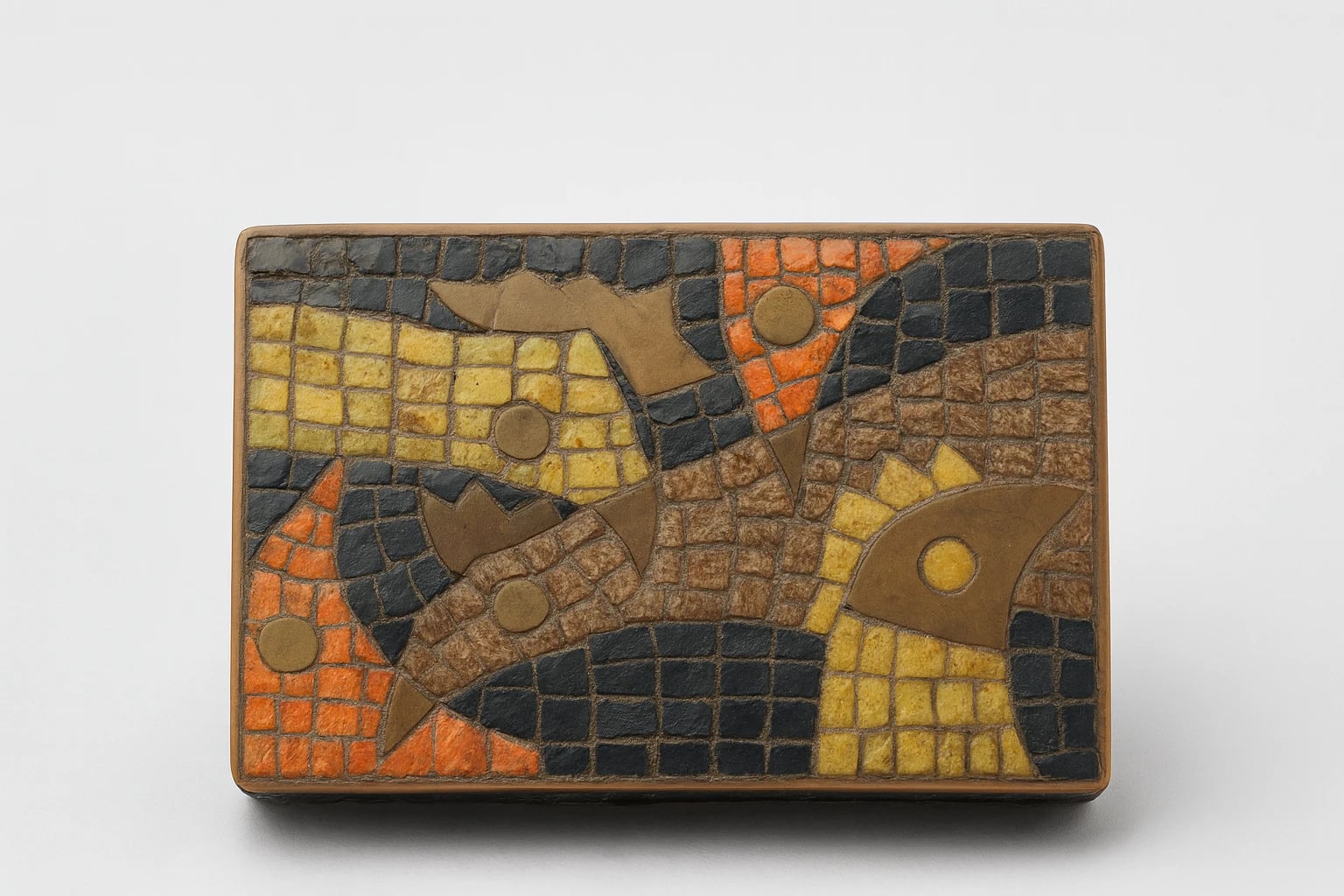
The parrot is built from small cut glass mosaic tiles in greens, oranges, white, black, golden brown, and deep brown, with cut brass used for the beak, claw, eye, and wing accents. Teran does not simply draw the bird on the surface. He breaks the body into nested fields: the dark oval ground, the arched green body, the orange facial block, the pale beak, the striped wing, and the claw suspended against the surrounding brown. The brass strips across the wing create a second rhythm within the mosaic, while the lifted hook or branch at the top extends the tray beyond ordinary hollowware. If hung on a wall, the piece reads as a compact mural. If held as a tray, it retains the shallow, handled format of domestic design, but the image remains frontal and emblematic.
Teran’s command of this hybrid language was not incidental. Penny Morrill records that Salvador Vaca Teran was among the early apprentices at William Spratling’s Taller de Las Delicias, left in 1939 to join his Castillo cousins at Los Castillo, and worked there for thirteen years before establishing his own Mexico City taller in 1952. Morrill also emphasizes his standing among his peers as an outstanding designer and technician, and notes that his independent workshop pursued mosaic objects including boxes, trays, and other decorative forms. Hougart’s hallmark reference further records that Teran used a script Salvador mark, that there were variations for sterling and brass, and that his pieces were usually stamped with design or inventory numbers.
This tray belongs to the part of Teran’s work that moved beyond silver jewelry while remaining deeply connected to the Taxco School’s experimental culture. The cut glass mosaic gives color a granular, light-catching surface, while the brass gives the bird weight, contour, and metallic warmth. The result is not a secondary craft object derived from his jewelry, but a related expression of the same design intelligence: overlapping planes, compressed animal form, and a controlled balance between ornament and structure. Within the Mexican silver renaissance, it shows how designers trained in metalwork extended modernist design into table objects, wall pieces, and domestic interiors, carrying the language of the taller into a wider material field.
Museum of Mexican Silver. “Parrot Tray in Glass Mosaic and Brass.” Catalog no. MoMS-002349. https://museumofmexicansilver.com/pieces/salvador-teran-sculptural-tray-or-wall-hanging-2
See something wrong with this record? Suggest a correction and the piece details fill in automatically.
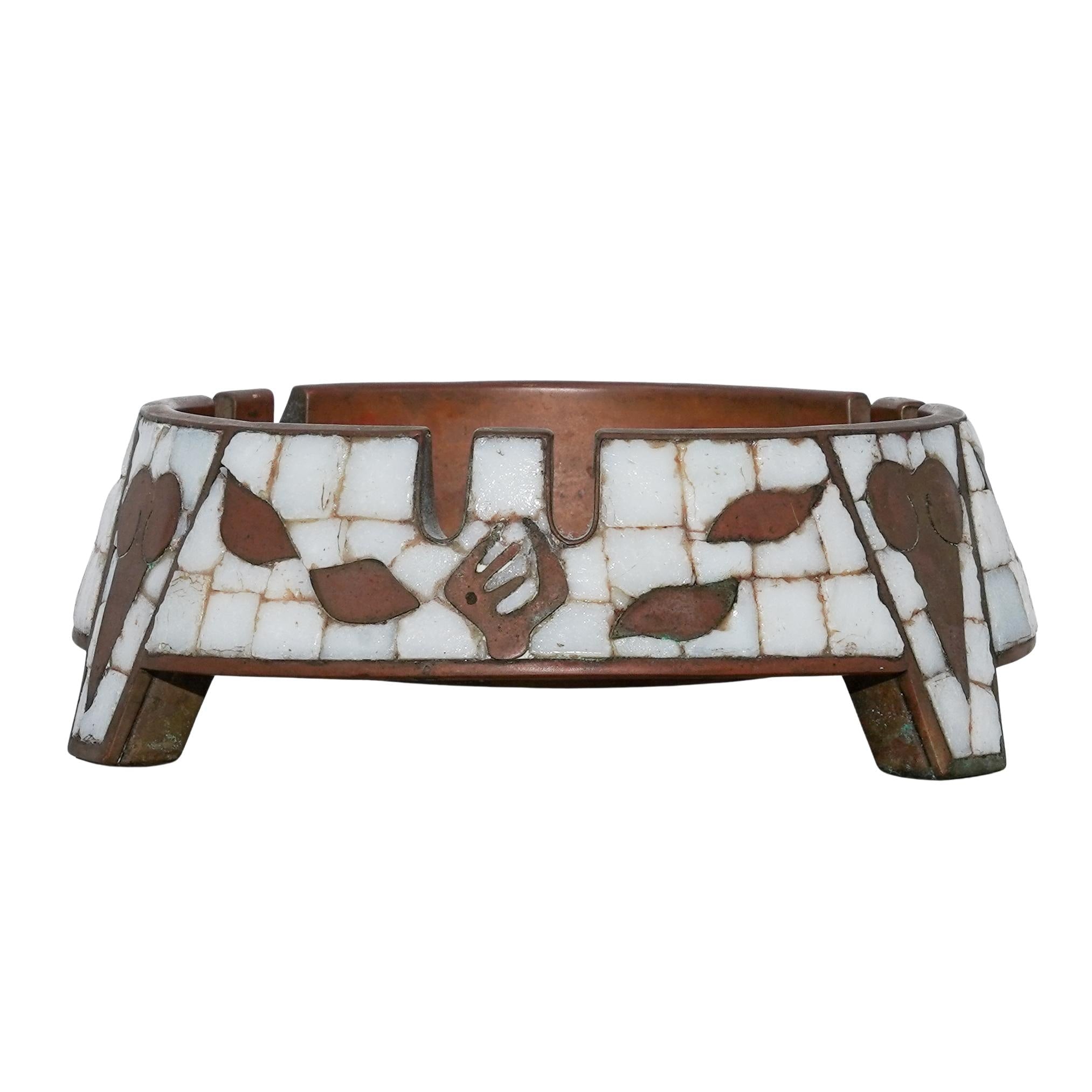
Salvador Terán
Mosaic Brass Footed Bowl
1952-1974
Brass