Saves instantly, no account needed. Already a member? Sign in.
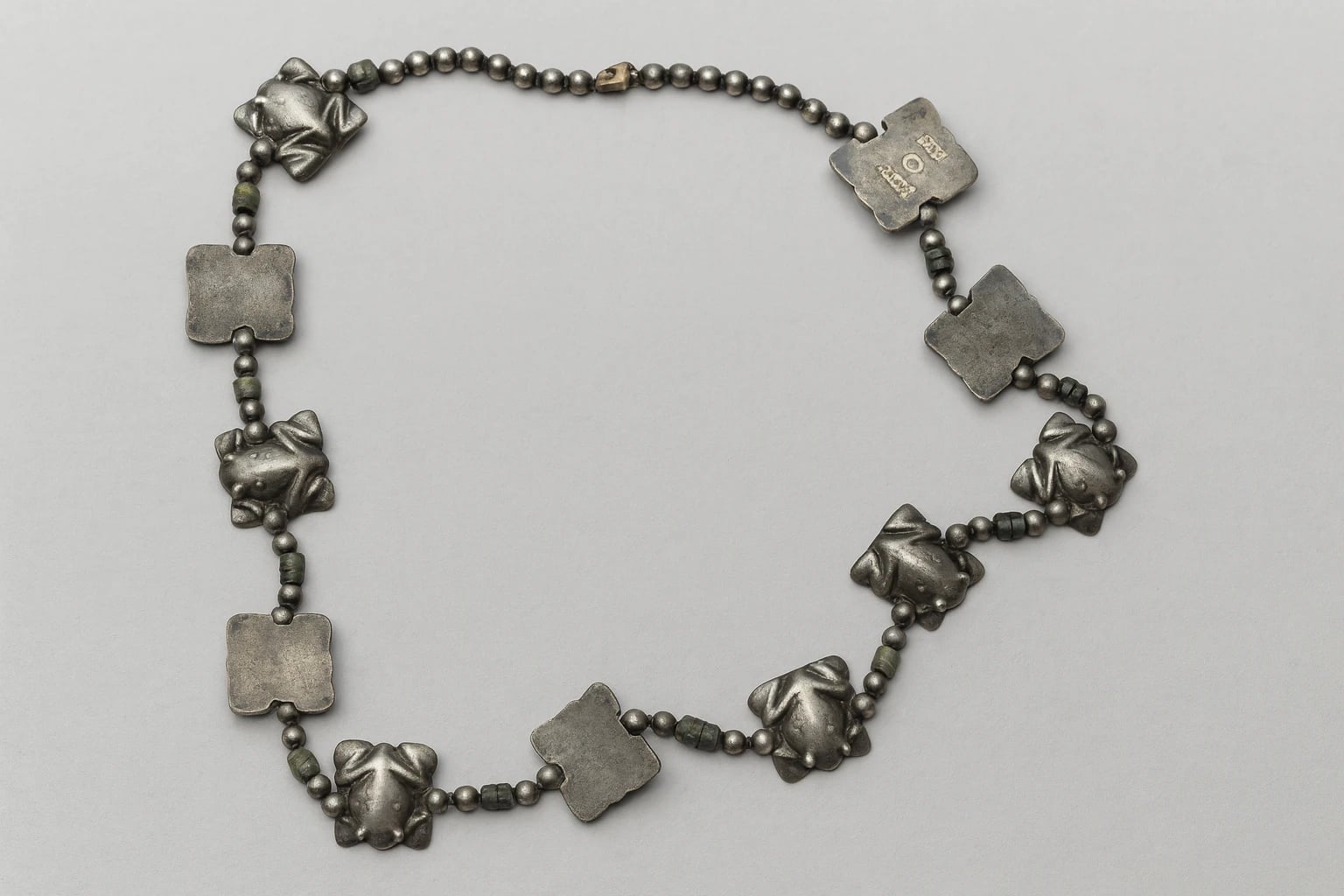
Eleven cast silver frogs, strung with intervals of silver and turquoise beads, make up a necklace whose subject reaches back to ancient Mexico: the frog was a Zapotec and Mesoamerican motif, and Spratling drew his frogs from carved pre-Columbian originals he knew at first hand. The repetition of the small creature around the full length, punctuated by the blue-green stone, gives the piece both rhythm and a clear narrative source.
The necklace dates to the First Design Period, 1931 to 1946. Spratling's method in these years, as the literature describes, was to take motifs from Pre-Columbian design and translate them into a style accessible to a modern audience (Morrill, p. 27), and the frog necklace is a direct case: an archaeological form reissued as wearable sculpture. The turquoise, a stone with deep Mexican and Southwestern associations, reinforces the indigenous reference.
Narrative figural necklaces of this scale were more demanding to produce than his geometric chains and survive in correspondingly small numbers.
Museum of Mexican Silver. “Turquoise Frog Necklace.” Catalog no. MoMS-000198. https://museumofmexicansilver.com/pieces/spratling-1821
See something wrong with this record? Suggest a correction and the piece details fill in automatically.
William Spratling
Carved Pre-Columbian Necklace
First Design Period: 1931 - 1946
Silver