Saves instantly, no account needed. Already a member? Sign in.
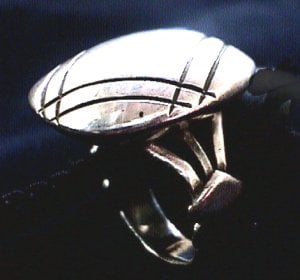
This ring centers on a vertical rectangular hollow button, incised with two lines across each corner, set on a wide shank whose terminals carry applied diamond-shaped pieces and whose remaining surface is worked with pairs of incised lines. It is a study in geometry, the rectangular boss balanced against the angular accents of the shank.
The piece belongs to the first design period, 1931 to 1946, when Spratling's Taxco workshop was establishing the vocabulary of modern Mexican silver. The hollow construction of the button keeps a substantial-looking ring wearable.
The incised line work, repeated across button and shank, is a quiet unifying device, the kind of disciplined detailing that distinguishes early Spratling from its many imitators.
Museum of Mexican Silver. “Incised Rectangular Button Ring.” Catalog no. MoMS-000160. https://museumofmexicansilver.com/pieces/spratling-2271
See something wrong with this record? Suggest a correction and the piece details fill in automatically.
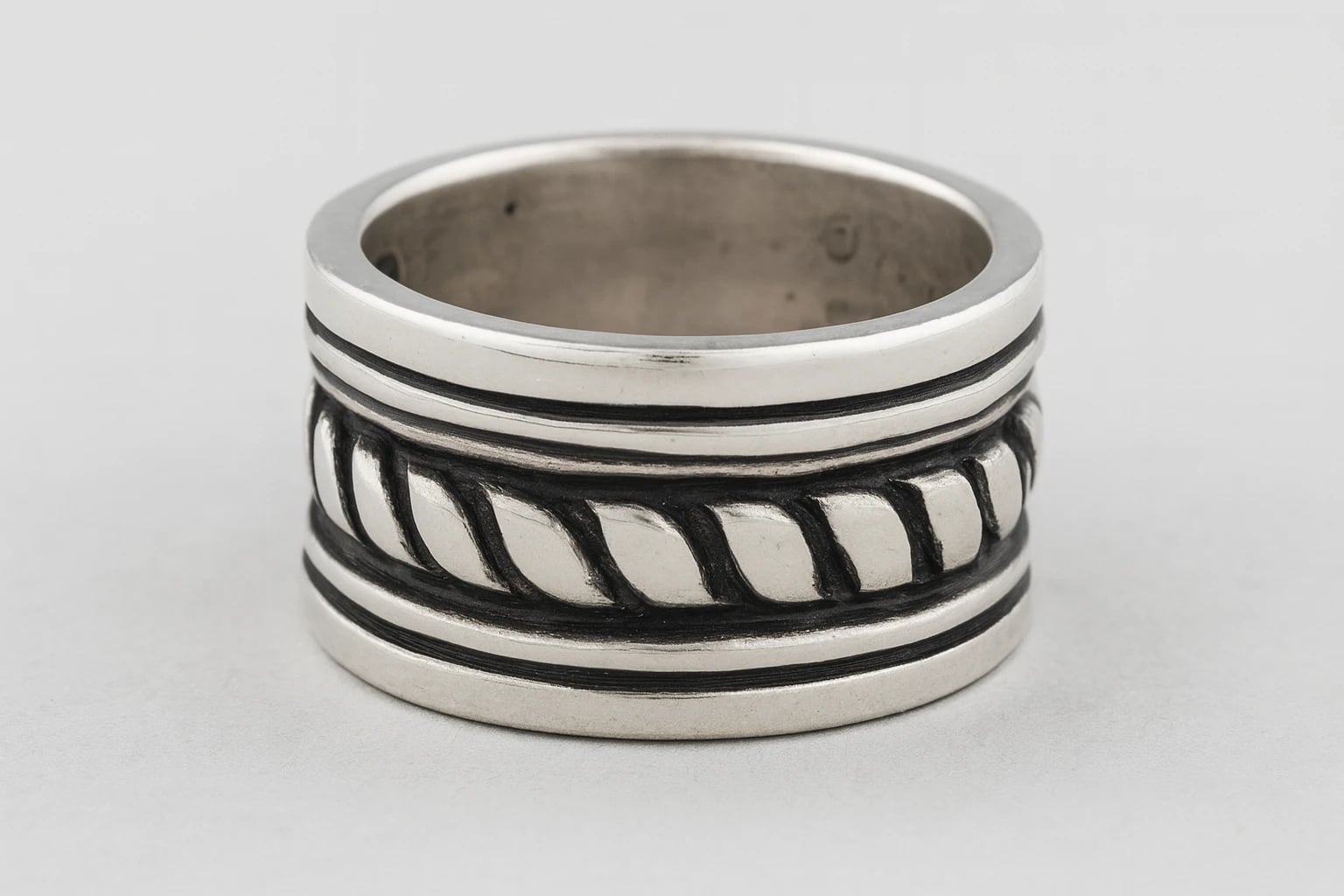
Rope Design Ring
First Design Period: 1931 - 1946
Silver