Saves instantly, no account needed. Already a member? Sign in.
Antonio Pineda is remembered first as a silversmith, the figure who pushed Taxco's .970 silver toward a sculptor's sense of mass and balance. That makes an object like this one unusual: a ring worked not in silver but in fourteen-karat yellow gold, a material Pineda turned to only rarely and which appraisers handling his gold today describe as extremely rare and, in the words of one Antiques Roadshow valuation of his gold jewelry, "very, very special." The piece sits at the edge of his recognized output rather than its center, and that is precisely where its interest lies. It shows a maker known for democratizing modern design in silver applying the same compositional instinct to a precious metal, on the intimate scale of a single finger.
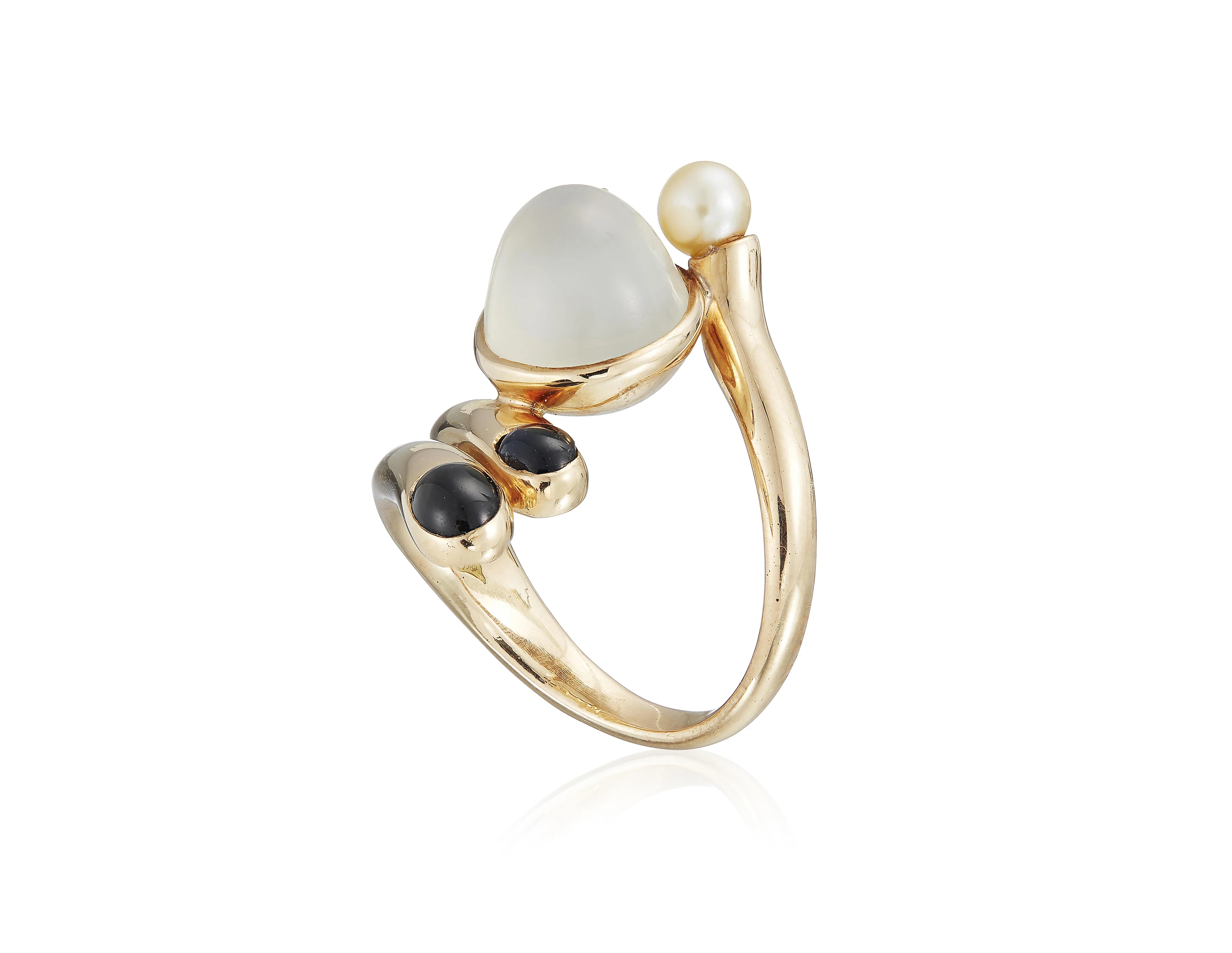
The design is a crossover, or bypass: the shank divides and the two ends pass one another rather than meeting, a form Pineda exploits to set his stones in motion across the hand. The dominant element is a tall, domed cabochon moonstone, its glow answered at the upper terminal by a small cultured pearl and, at the lower, by a cabochon sapphire paired with a cabochon onyx. The pairing of a milky, light-bearing moonstone against dense black onyx is a juxtaposition that recurs across Pineda's work; the published literature documents his cartouche-and-moonstone designs of the mid-1950s and records the place of black onyx in his and his Taxco contemporaries' vocabulary (Morrill, "Silver Masters of Mexico: Héctor Aguilar and the Taller Borda," 1996, p. 181, p. 211). Here those familiar materials are recomposed for gold and for the hand, the cabochons left smooth and unfaceted so that color and form, not brilliance, carry the design.
The marks place the ring firmly in Pineda's authenticated production. It is signed ANTONIO TAXCO with the crown, the hallmark Gobi Stromberg catalogues as the "Antonio-Taxco Crown" that ran from the early 1950s onward (Stromberg, "Antonio Pineda," 2008, p. 81, p. 48). Tellingly, the silver-purity marks that accompany that crown on his sterling, the eagle assay stamp and the "970" fineness, are absent, replaced by a "14K" stamp, exactly what one expects when the workshop set the same signature into gold rather than silver. The result is a substantial yet wearable ring in a US size 6¼, measuring 2.8 centimeters at its widest point.
What gives the ring its standing is the rarity of its medium within a celebrated body of work. Pineda's silver is widely held and steadily sought; his gold surfaces far less often, and when it does it draws particular attention precisely because so little of it exists. A small, finely composed gold ring like this one, carrying the unambiguous Antonio-Taxco crown, is an uncommon chance to hold the design language of one of Taxco's defining modernists in the form he used least.
Museum of Mexican Silver. “Domed Moonstone and Onyx Gold Ring.” Catalog no. MoMS-002091. https://museumofmexicansilver.com/pieces/antonio-pineda-multi-gem-gold-ring
See something wrong with this record? Suggest a correction and the piece details fill in automatically.
Antonio Pineda
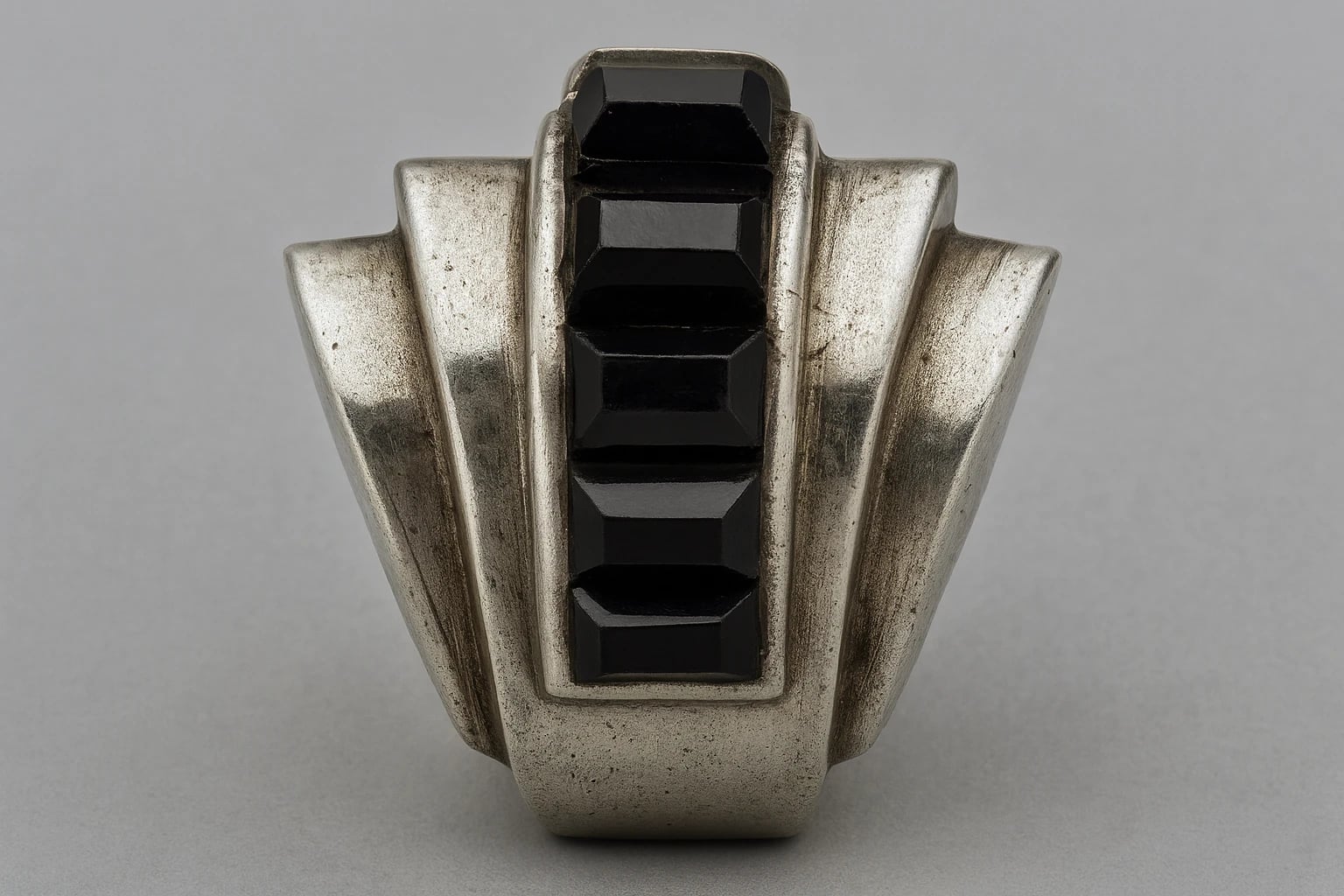
Ring with Silver Wave and Onyx Bars
1953 or later
Silver