Saves instantly, no account needed. Already a member? Sign in.
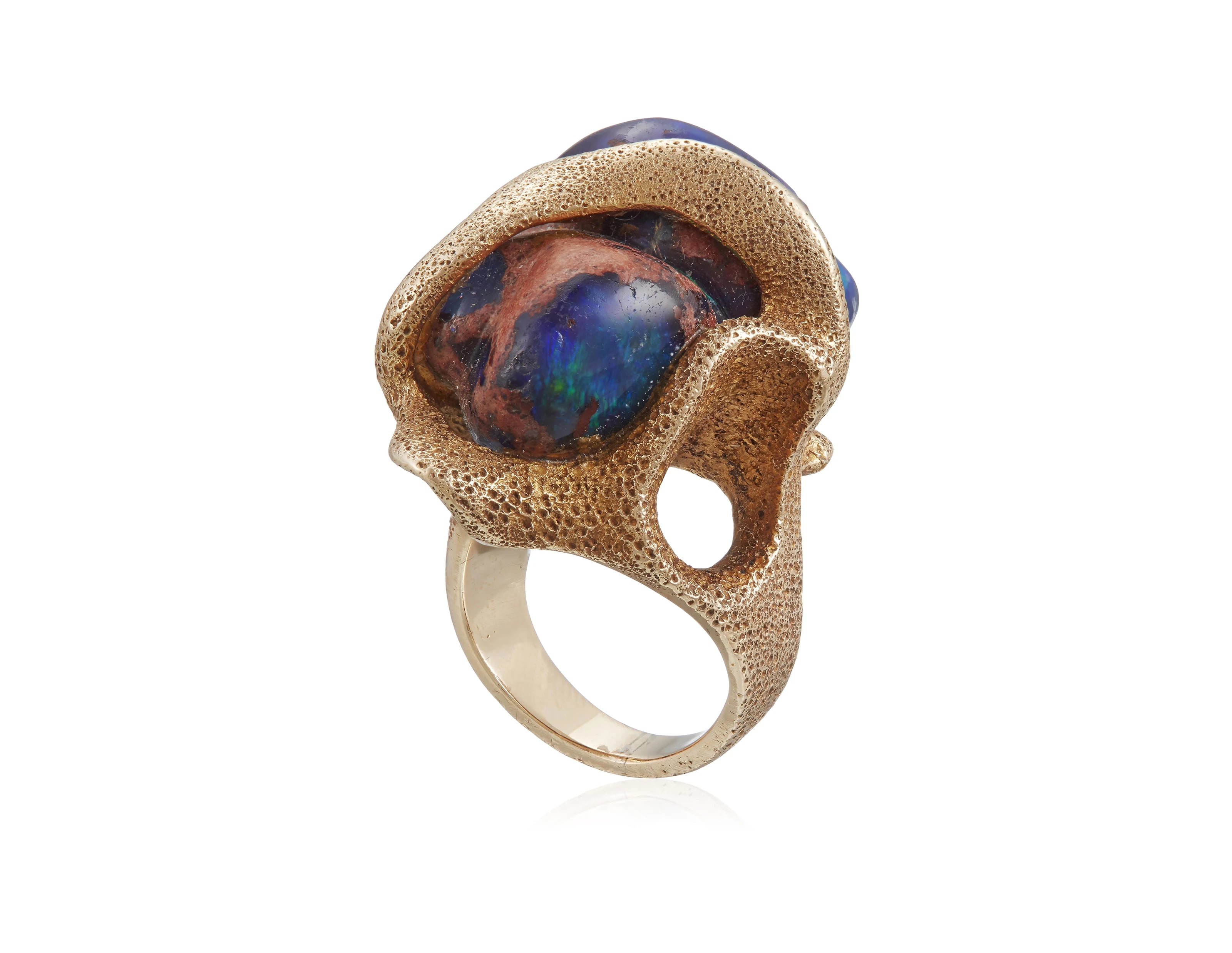
A gold ring stands apart in Antonio Pineda's body of work. He was, first and last, a silversmith, and the overwhelming majority of what left his Taxco taller was wrought in silver. The pieces he chose to execute in fourteen-karat gold are scarce and were clearly reserved for his most considered, jewel-like statements. This ring belongs to that small, deliberate group. Its sculpted gold bezel, pitted and textured like coral or weathered ore, folds and curls asymmetrically around a single boulder opal whose blue and green fire flashes against the warm metal. It is a fully three-dimensional object rather than a flat setting, and the pierced negative space cut through the gold shoulder shows the same instinct for openwork and floating gemstones that runs through Pineda's strongest designs.
The interior of the band carries the signature that confirms the hand: ANTONIO TAXCO beneath a crown. In Pineda's hallmark system this crowned "Antonio-Taxco" device is the maker's mark proper, the personal stamp that identifies his taller's output, here accompanied by the 14K fineness mark for the gold. As the literature records, Pineda was the designer who conceived the forms while master smiths in his workshop, men such as Fortino Mota and Filiberto Gómez, executed them, sometimes adding their own marks alongside his (Stromberg, Antonio Pineda, 2008, p. 81). The piece reads as classic mature Pineda: the sleek, sculptural modernism for which he became known from the 1950s onward, where metal is shaped into organic, biomorphic volumes and the stone is given room to be the event. Pineda apprenticed as a boy in William Spratling's Las Delicias taller and opened his own workshop young, but by mid-career he had left behind the Neo-Pre-Columbian idiom in favor of this confident abstract vocabulary (Stromberg, Antonio Pineda, 2008, pp. 29, 45).
The choice of a boulder opal, with the host rock left visible behind the play-of-color, suits a designer who liked to let a stone's natural character dictate the form around it. Pineda's gold work in particular is prized precisely because so little of it exists. Pineda's broader achievement was recognized in the 2008 Fowler Museum retrospective Silver Seduction, which traced his evolution from the 1930s through the 1970s and singled out his ingenuity in setting gems with as little metal as possible. A gold ring of this scale and finish is among the rarer pieces from the workshop of one of Taxco's defining modernists, and a fine instance of how Pineda translated that floating, sculptural sensibility into his most precious material.
Museum of Mexican Silver. “Opal and Gold Ring.” Catalog no. MoMS-002095. https://museumofmexicansilver.com/pieces/antonio-pineda-opal-and-gold-ring
See something wrong with this record? Suggest a correction and the piece details fill in automatically.
Antonio Pineda
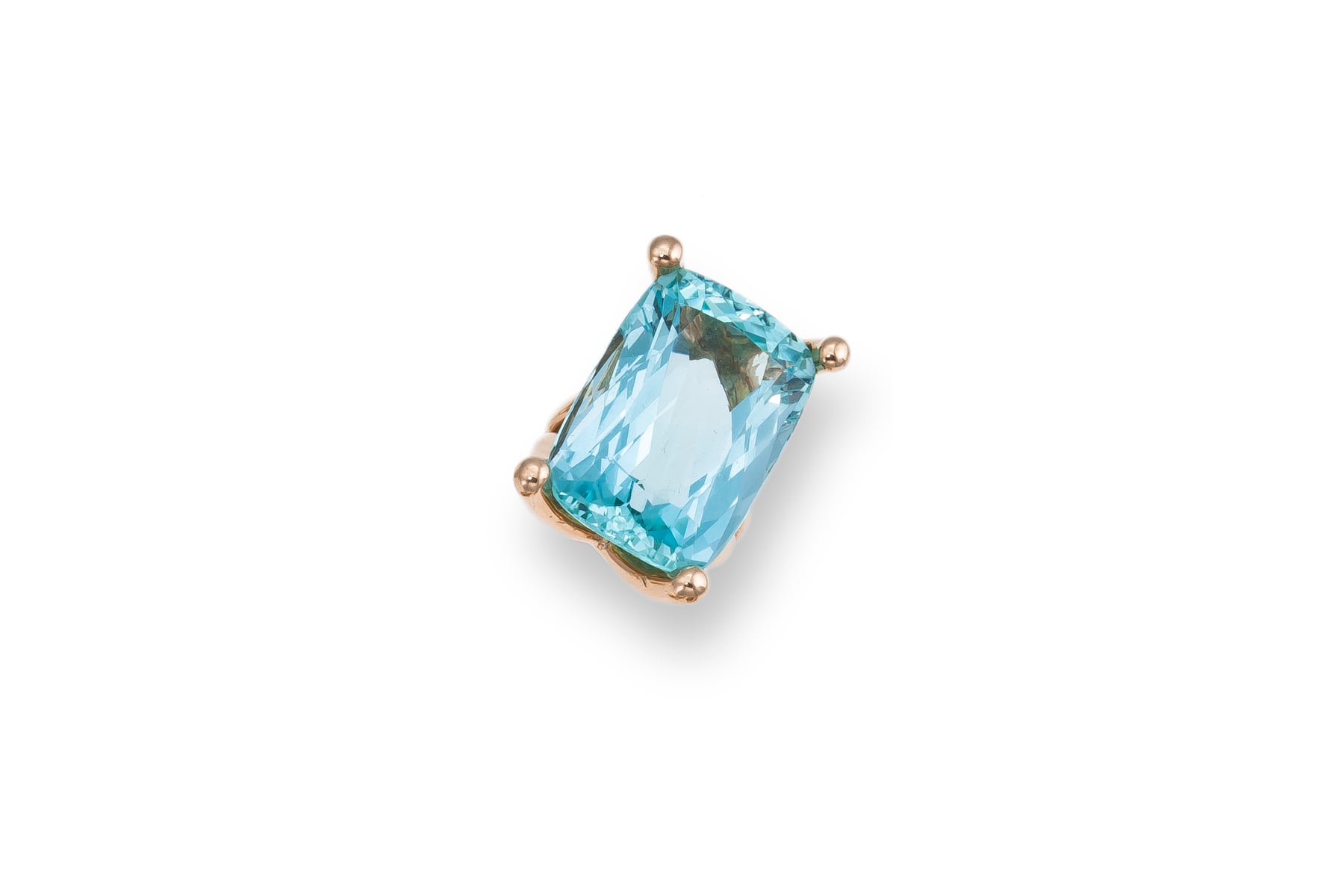
Silver and Aquamarine Ring
Silver