Saves instantly, no account needed. Already a member? Sign in.
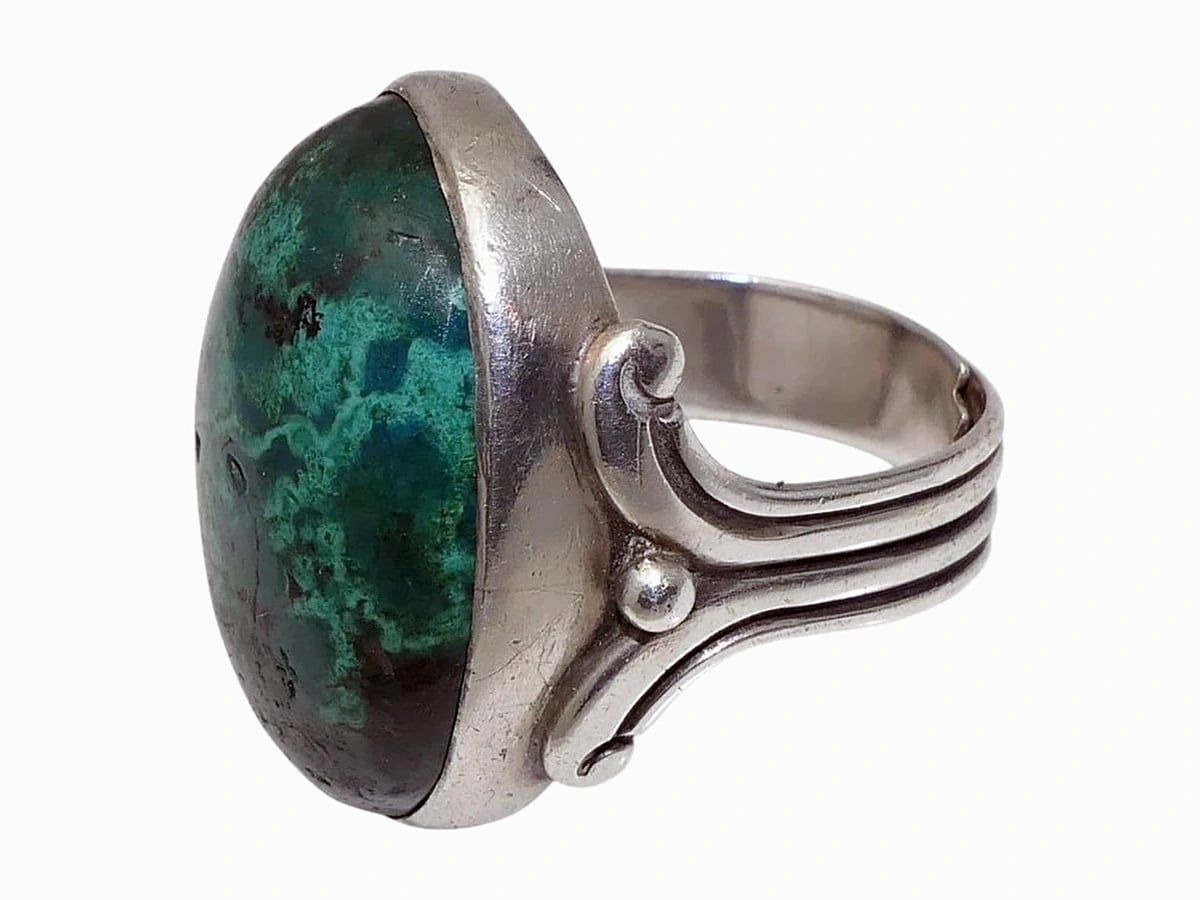
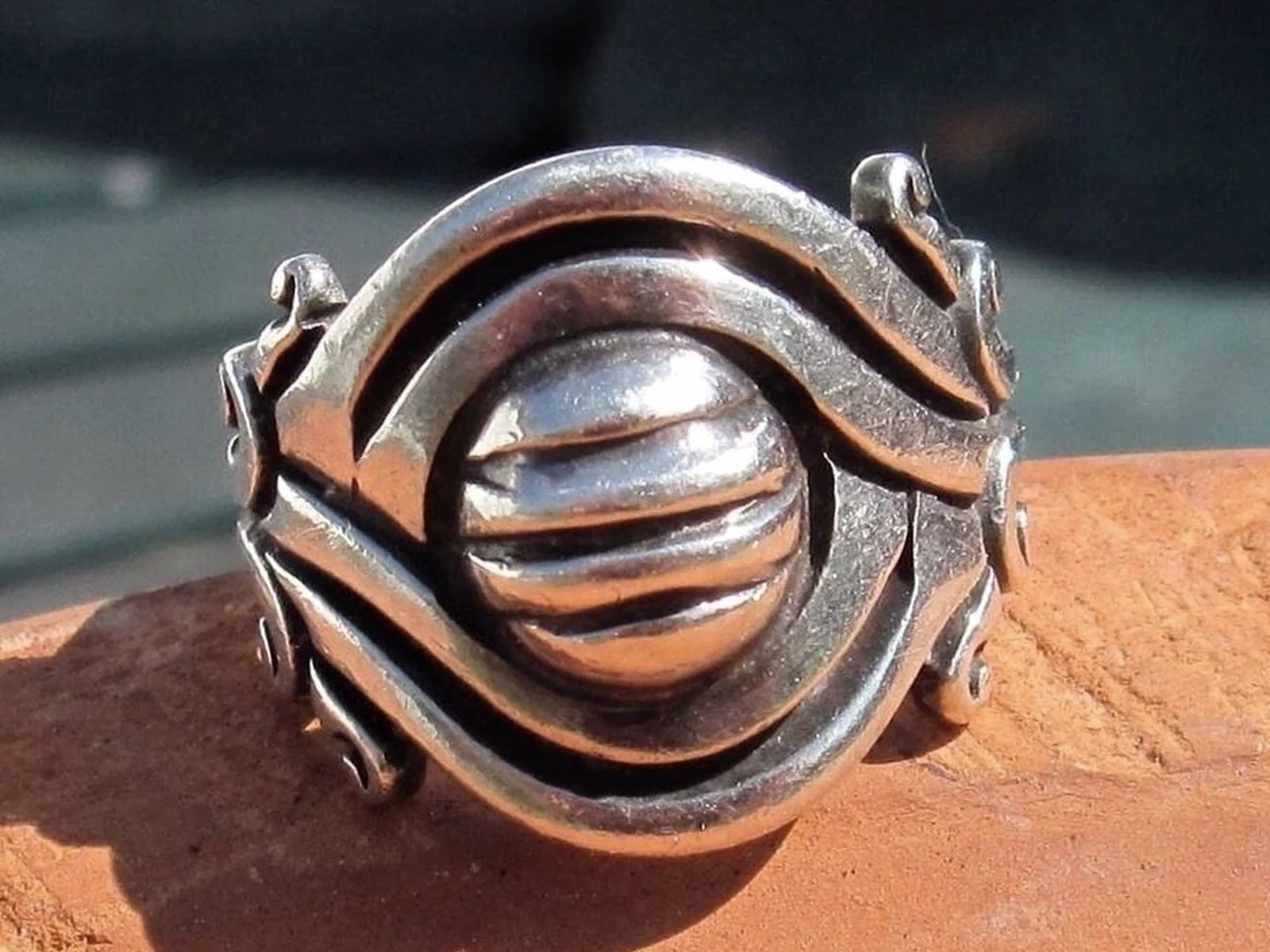
Built as a compact architectural spiral, this silver ring concentrates its force in a raised domed medallion, nearly three quarters of an inch tall, whose horizontal ribs catch light across the crown. Broad polished bands sweep around the center like an orbit, while the shoulders open into curled scrollwork that lifts the head of the ring away from the finger. At 8 grams and approximately size 7, it is modest in scale but emphatic in silhouette.
The design sits persuasively within the Aguilar language of volume, shadow, and controlled abstraction. Morrill and Berk write that Aguilar's silver jewelry drew primarily on Aztec and Mixtec art and architecture, with the pre-Conquest image serving as a starting point for stylization rather than literal copying; they also characterize his mature style as dramatic, without extraneous flourishes that would weaken the design's strength. This ring's ribbed dome and encircling bands do not declare a specific source motif, but they operate in that same manner: an ancientizing form reduced to relief, contour, and negative space. The open scroll shoulders are ornament and structure at once, giving the ring its movement without adding applied decoration. The broader workshop context is also relevant: Hougart records Aguilar's move from Spratling's Taller de Las Delicias to his own workshop in 1939, along with later marks including KTV, conjoined HA, and Taller Borda.
Museum Significance
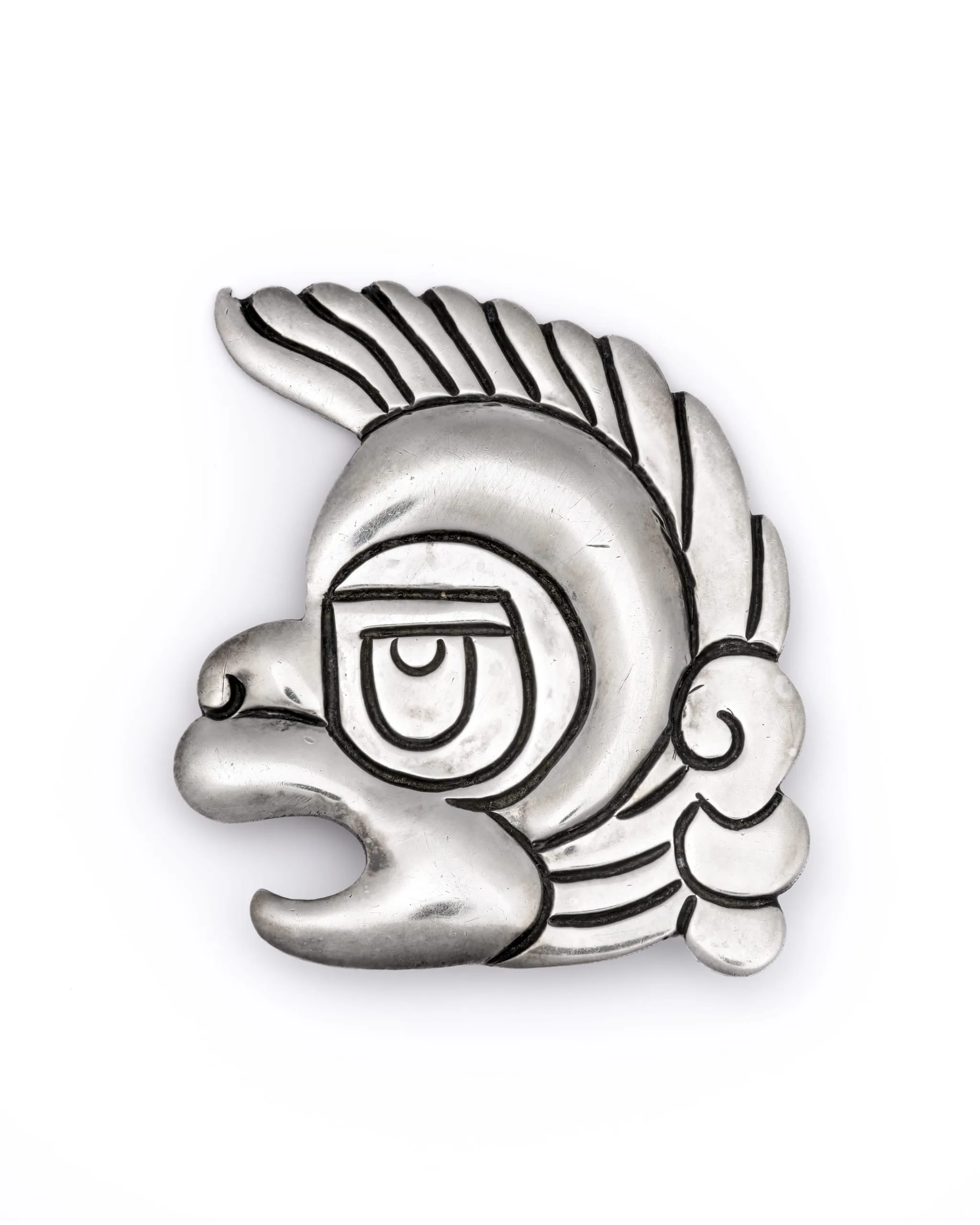
This ring matters as an example of the sculptural ambitions of the Taxco school. Aguilar's best jewelry often enlarges the visual force of a simple element: a rib, a curve, a shell, a glyphlike profile, a swelling dome. Here that approach is compressed into a wearable object whose central medallion reads almost as a miniature architectural form. LACMA's holding of Aguilar's circa 1950 Feathered Brooch confirms his recognized place in museum collections, but the importance of this ring rests in the object itself: high relief, open construction, and controlled modernist motion, qualities that connect it to Aguilar's documented transformation of ancient Mexican sources into bold twentieth century silver design.
Museum of Mexican Silver. “Maguey Ring.” Catalog no. MoMS-002174. https://museumofmexicansilver.com/pieces/aguilar-maguey-ring
See something wrong with this record? Suggest a correction and the piece details fill in automatically.
Héctor Aguilar
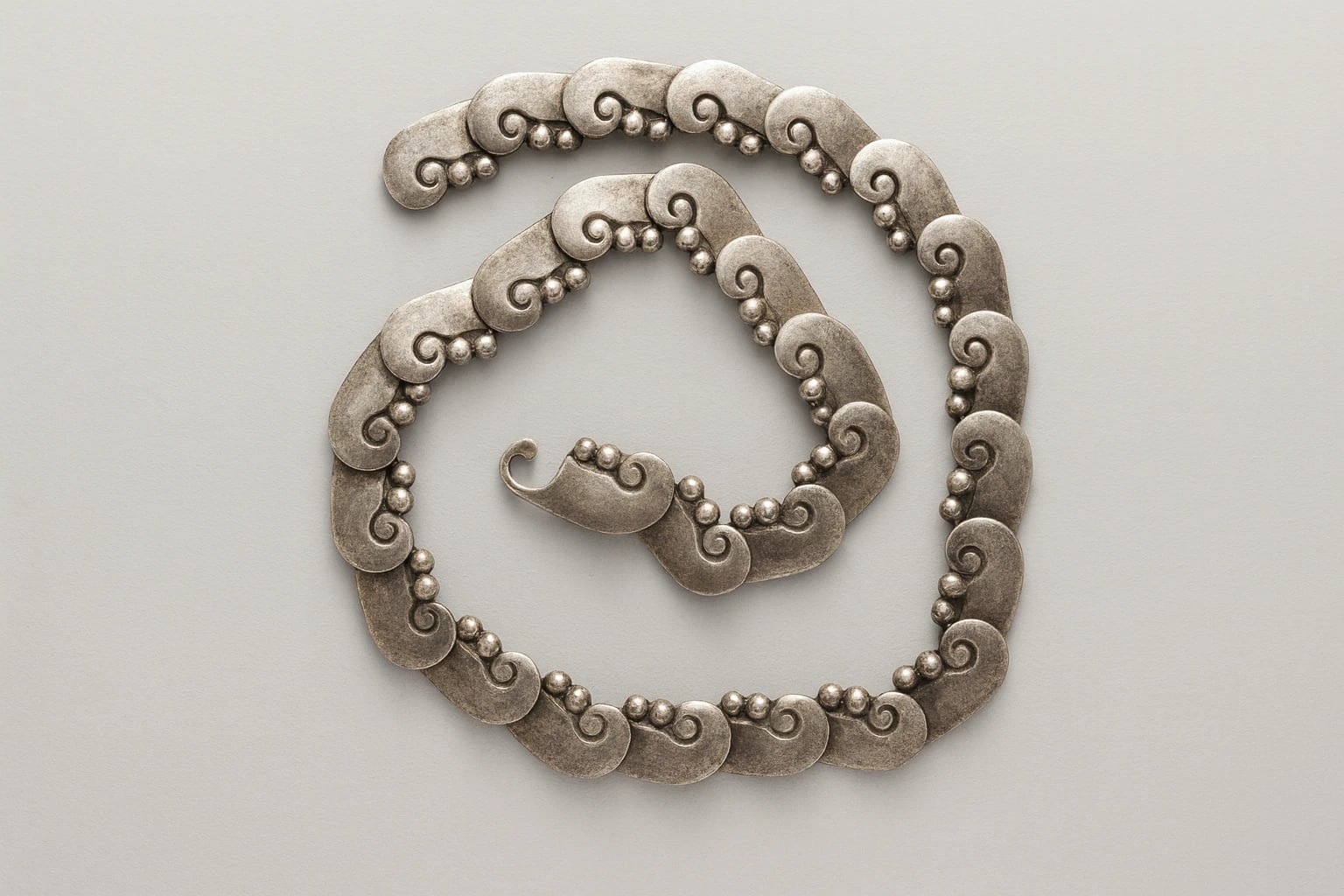
Narrow Scrolled Wave-and-Ball Necklace
Sterling silver