Saves instantly, no account needed. Already a member? Sign in.
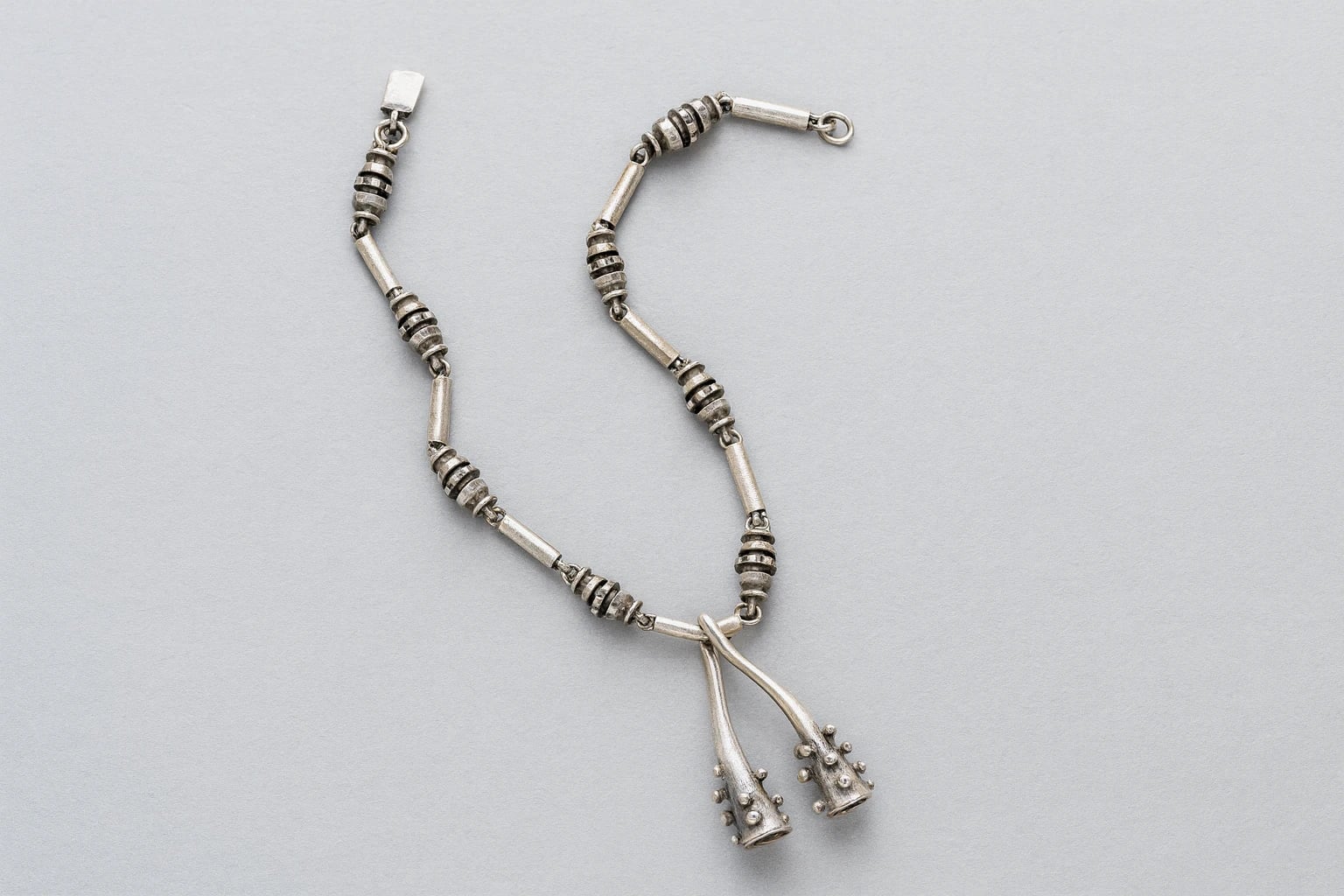
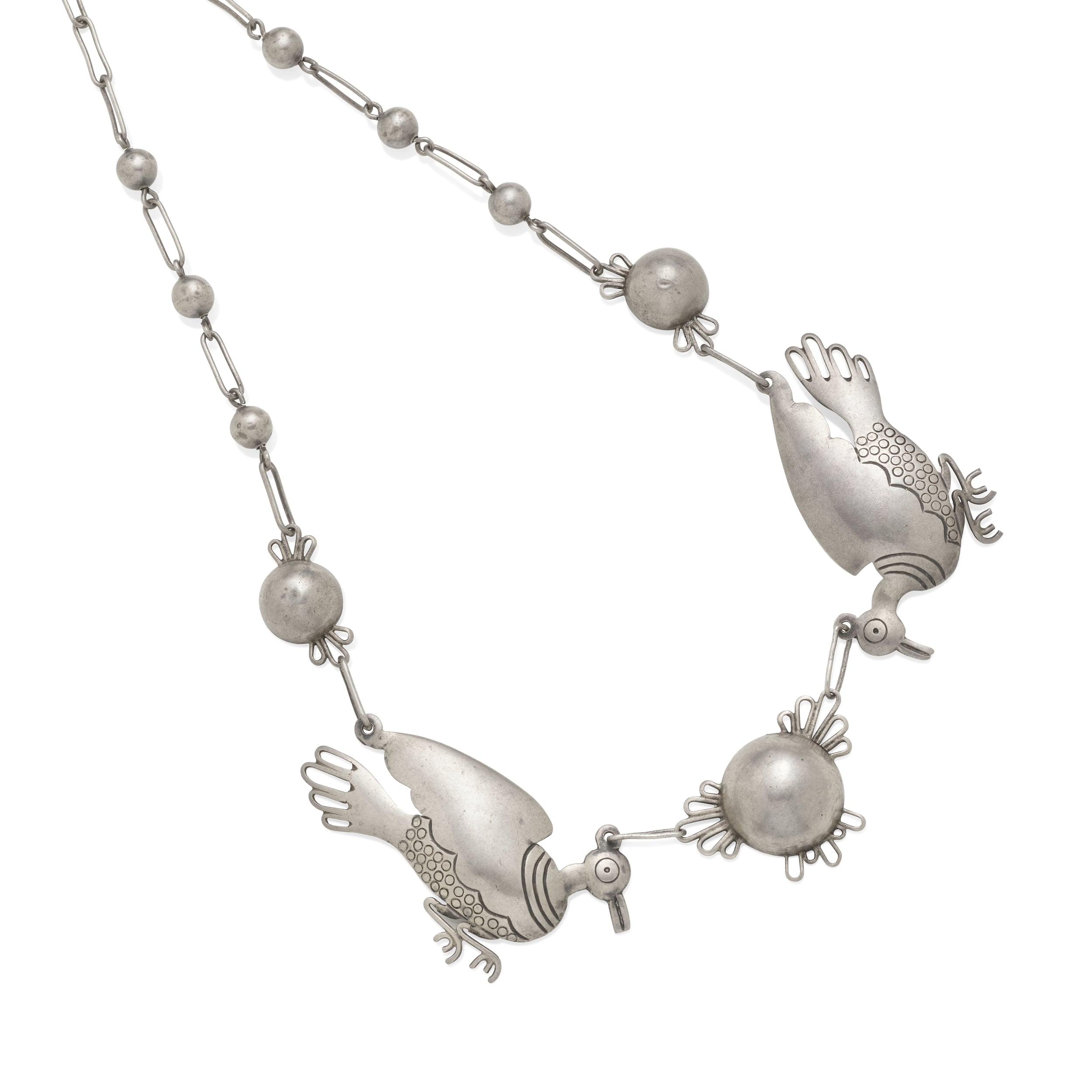
Two silver turkeys — their bodies chased with scaled plumage and tails fanned in broad display — serve as the focal elements of this early necklace, joined along a chain of alternating spherical beads and rectangular links, with three pendant bells completing the composition. The guajolote, native to Mexico and present in Pre-Columbian iconography from the Valley of Mexico to the Gulf Coast, was among the zoomorphic forms William Spratling brought into the wearable register of silver during the founding years of his Taxco workshop in the early 1930s.
Spratling's practice, as Gabrielle Stromberg has documented, was to take motifs from Pre-Columbian design and render them accessible to an American audience, drawing on indigenous design resources while introducing the craft vocabulary of the colonial silversmith (Stromberg, Antonio Pineda, 2008, p. 27). This necklace embodies that translation in resolved form: the birds retain the silhouetted massing and profile characteristic of ancient ceramic effigies, while surface chasing and wire-detailed feet show the hand of a trained taller. The pendant bells — a detail carrying both decorative and ceremonial resonance — anchor the piece further in native Mexican form.
That Silson produced a closely related example testifies to how quickly and widely the turkey motif registered beyond Spratling's own workshop — a measure of how successfully it had entered the visual vocabulary of Mexican modern silver by the mid-1930s.
Museum of Mexican Silver. “Tuliman Bird Necklace.” Catalog no. MoMS-000123. https://museumofmexicansilver.com/pieces/spratling-290
See something wrong with this record? Suggest a correction and the piece details fill in automatically.
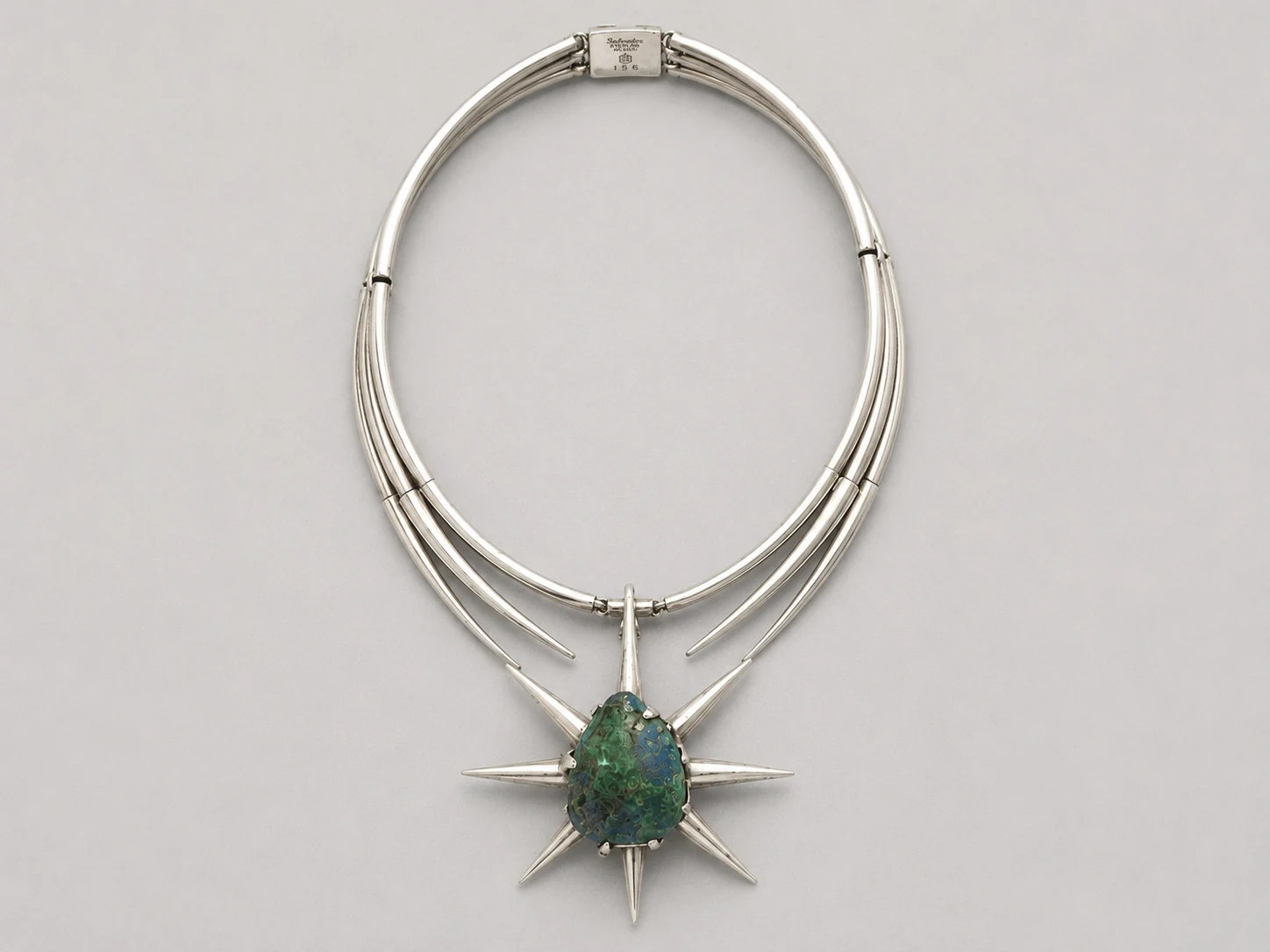
Alaska North Star Necklace
Silver