Saves instantly, no account needed. Already a member? Sign in.
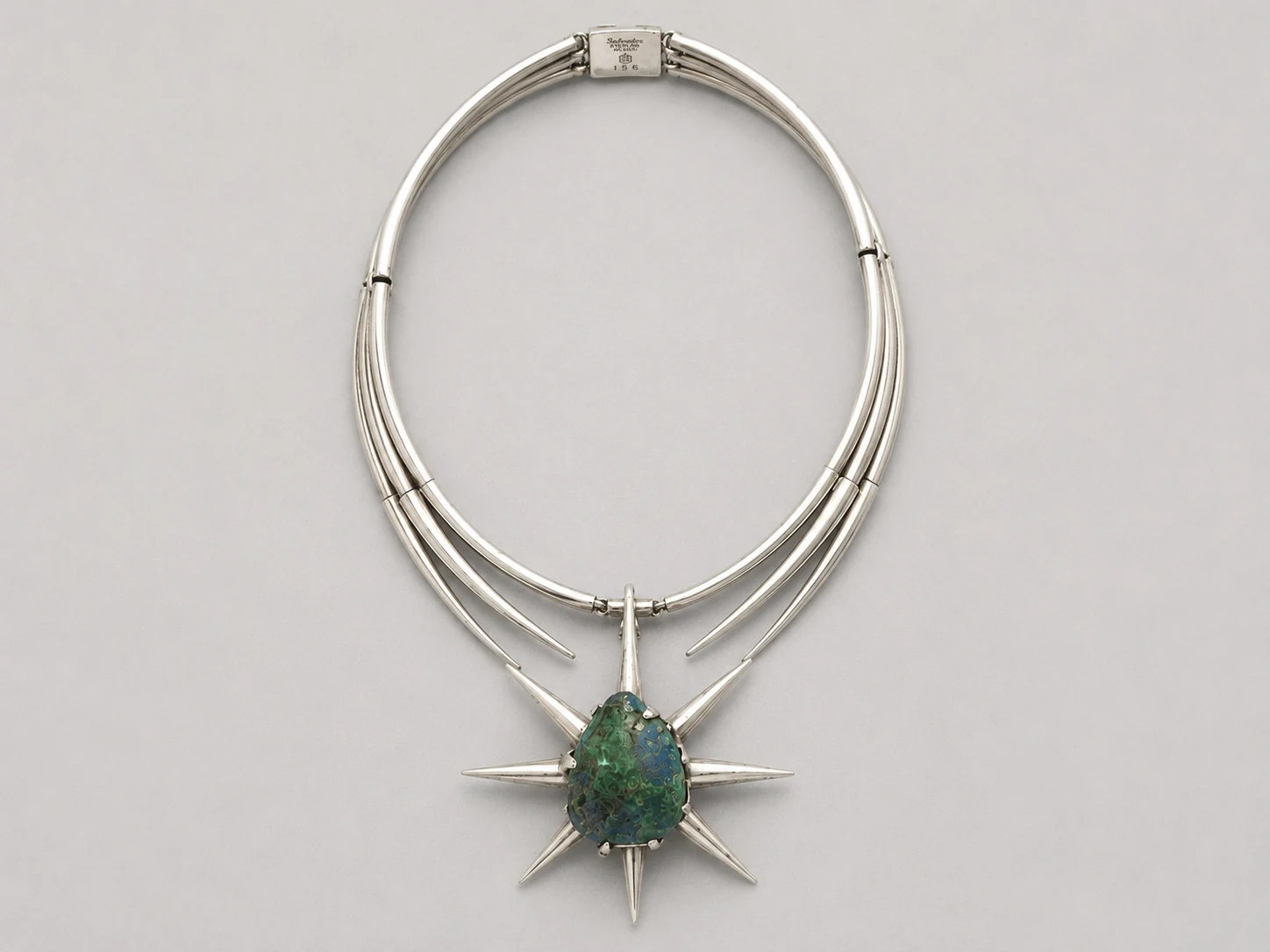
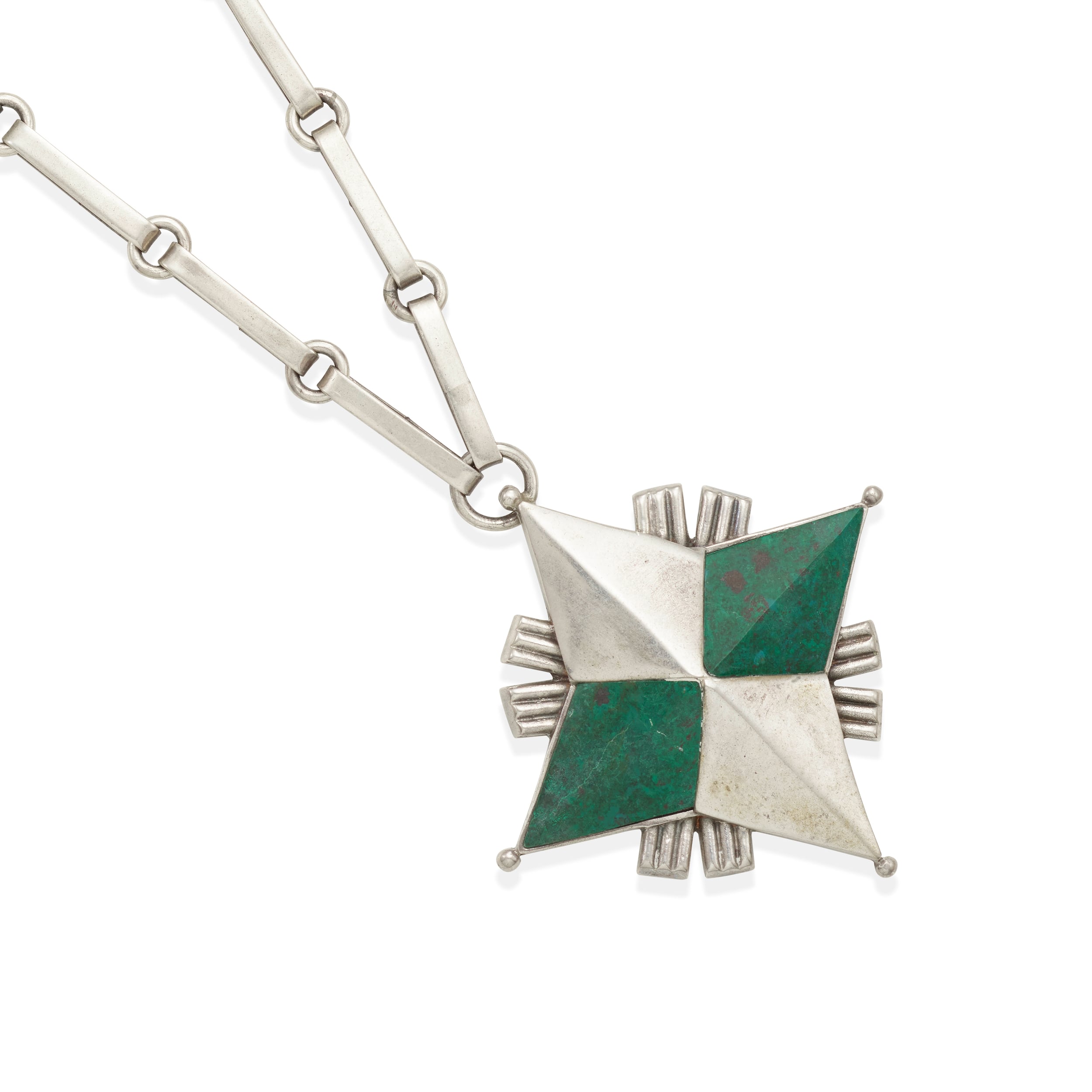
The four-pointed star at the center of this necklace is built like a small piece of relief sculpture. Four kite-shaped quadrants meet at a raised central point, each one creased along its long axis so that the pendant rises into a low pyramid. Two of the quadrants are silver, folded so that light breaks differently across each half of the facet, and two are inlaid with azur malachite cut to the same faceted profile, deep green with russet flecks of the copper matrix running through the stone. Because the green and silver quadrants alternate, the star reads as a pinwheel: the eye circles the pendant rather than resting on it. Between the four points, clusters of short ribbed bars project from beneath the star like compressed rays, and each point terminates in a small silver bead. The pendant hangs from a seventeen inch chain of elongated flat bars joined by rings, a chain sober enough to leave the star as the single event of the necklace, and open enough to echo its geometry in miniature.
The design belongs to one of the least familiar chapters of William Spratling's career. In 1949 Spratling undertook a project for the development of native craft production in Alaska, for which he created some two hundred model designs. This North Star pendant derives from that body of work: one of the Alaskan models is of very similar design, and the star with radiating bursts between its points reads naturally as a northern emblem, the polar star rendered in the hard faceted geometry Spratling favored in his later years. The necklace appears only in Spratling's pre-1958 catalog, which places its production within a narrow window in the final decade of his life. The pendant on this example carries the conjoined WS script hallmark. The design was also produced with tortoiseshell in place of azur malachite, that variant marked Spratling de Mexico with an Eagle 13, and the basic design has been reissued, so the material and the marks matter in distinguishing the versions from one another.
The choice of azur malachite is characteristic of Spratling's material intelligence in this period. Rather than setting a polished cabochon into a silver frame, the stone is cut and creased to match the silver quadrants exactly, so that stone and metal behave as equal structural units of the same faceted surface. The silver panels are active, throwing light off their angled planes, while the stone panels are quiet and absorbent, their mottled green supplying the color that the design's severe geometry withholds. It is inlay used architecturally, a habit that runs through Spratling's mature work and that distinguishes it from jewelry in which stones function simply as accents. Worn on the body, the pendant sits flat and frontal at the base of the neckline, and the bar-link chain keeps the composition graphic rather than ornamental.
Museum of Mexican Silver. “Alaska North Star Necklace.” Catalog no. MoMS-000503. https://museumofmexicansilver.com/pieces/spratling-293
See something wrong with this record? Suggest a correction and the piece details fill in automatically.
The necklace is documented in Morrill and Berk's Mexican Silver and in Goddard's Spratling field guide, and it is useful precisely because it records a moment when Spratling's design thinking traveled well beyond Taxco. The Alaskan project ultimately produced far fewer objects than models, so surviving jewelry connected to those designs preserves an episode otherwise known mostly on paper. Within a collection of Taxco silver, this necklace shows the late Spratling vocabulary, faceted geometry, matched stone inlay, restrained linkage, applied to a subject drawn from the far north, evidence that the Taxco workshop system he built could absorb and answer design problems from a very different landscape.
William Spratling
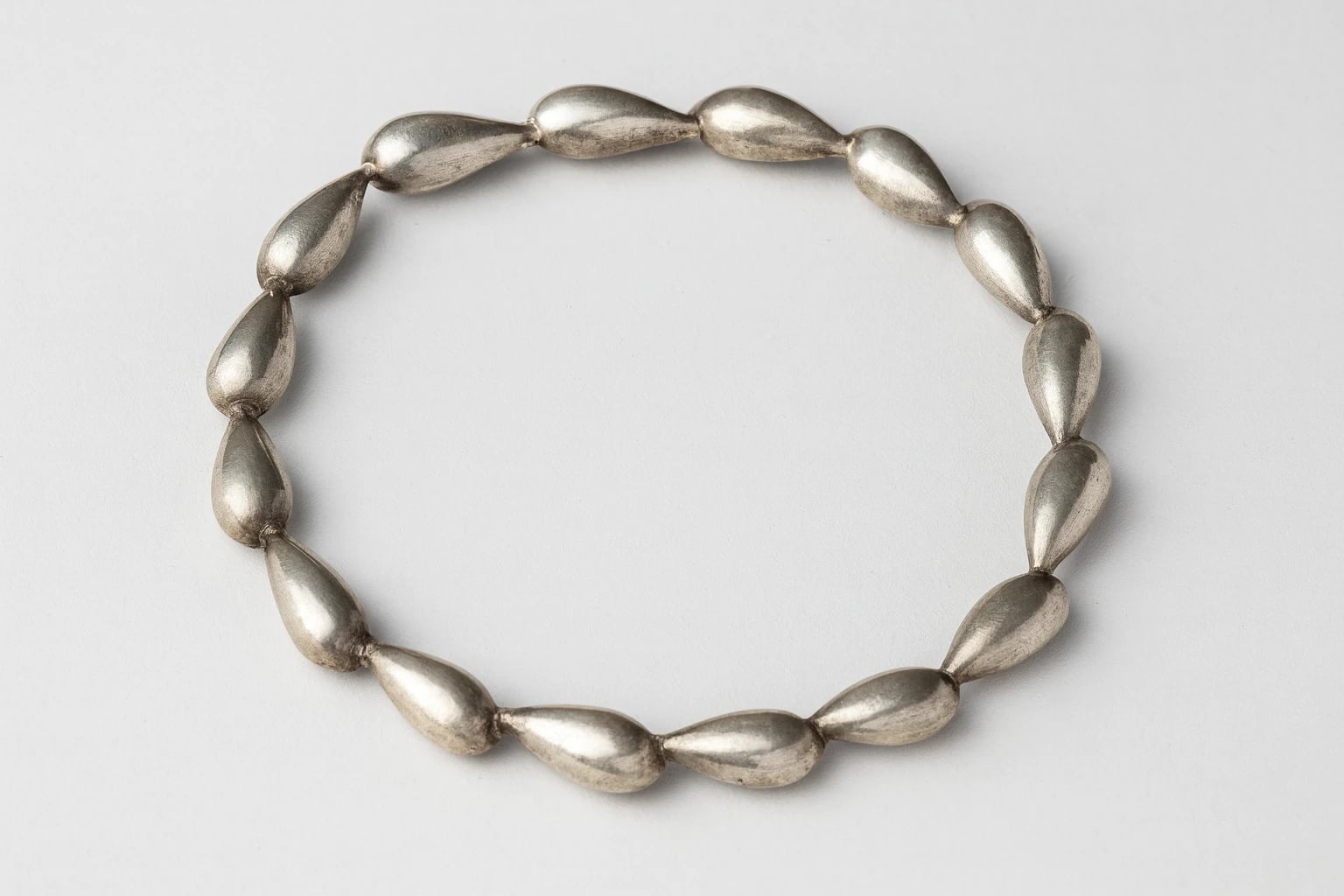
Necklace of Teardrop Links
First Design Period: 1931 - 1946
Silver