Saves instantly, no account needed. Already a member? Sign in.
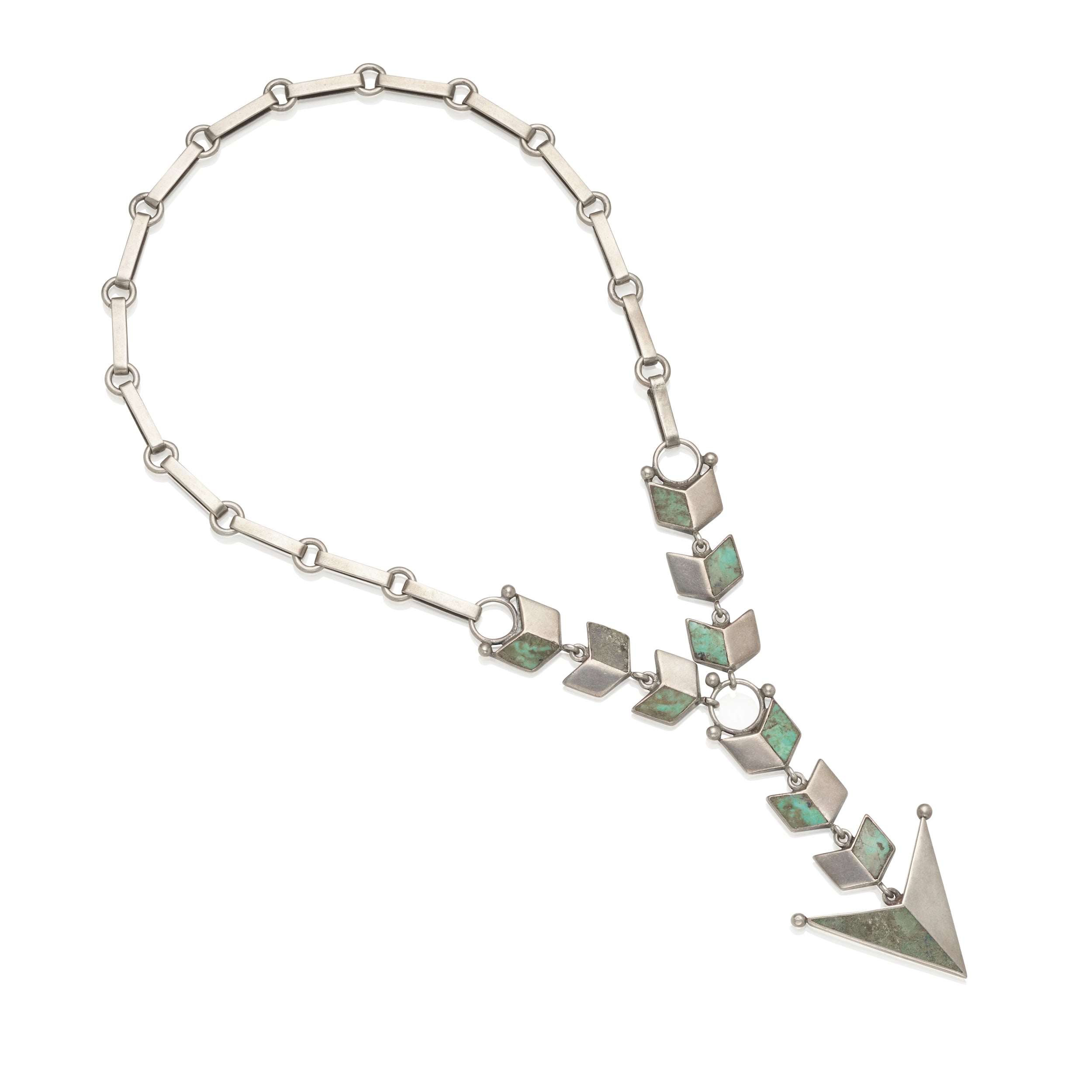
Spratling called this design the "V pendant," and the name describes its logic exactly: the entire necklace is built from one letterform repeated at every scale. Chevron links, folded like tiny open books, alternate faces of plain silver with faces of green azur malachite as they step down the chest in two converging lines. Where the lines meet, they continue as a single column that ends in a broad arrowhead, the largest V of all, inlaid with the same stone and finished with small silver spheres at its upper points. The pendant is not decorated with a motif. It is the motif, assembled link by link, and the wearer's body becomes the ground on which the geometry resolves.
The construction rewards close attention. The suspension chain is itself reduced to essentials, flat rectangular bars joined by round rings, so that the necklace announces its vocabulary of straight line and circle before the pendant begins. Three open rings, each capped with bead finials, mark the transitions: two where the chain hands off to the chevron branches, one at the junction where the branches merge. These rings do real work. They articulate the pendant so it drapes and moves rather than hanging as a rigid plate, and they give the eye a place to rest between passages of angled stone. The alternation of inlaid and bare silver faces along each chevron keeps the color moving in a syncopated rhythm down to the terminal arrow, where the azur malachite finally occupies a single uninterrupted field. Spratling also produced the design with obsidian inlay, and the two stones change its character considerably: obsidian gives the arrow a dark, dense gravity, while the mottled greens and blue-flecked passages of azur malachite lighten the geometry and let the mineral's own irregularity play against the strict silver framework.
That choice of stone is not incidental. As Kuipers has argued, the materiality of Spratling's work was bound up with Mexico's mineral identity: from the mid 1930s onward he set locally sourced stones into his silver, and the pairing of precious metal with native mineral carried associations of the country's subsoil wealth, ancient and modern at once. In the V pendant that idea is expressed with unusual economy. There is no figurative reference here, no jaguar or serpent adapted from a codex or pottery stamp of the kind that shaped his early designs. Instead the stone is presented within pure geometry, faceted planes of silver framing faceted planes of mineral, a late and disciplined statement of a principle he had worked out over decades.
Museum of Mexican Silver. “V Pendant Necklace.” Catalog no. MoMS-000763. https://museumofmexicansilver.com/pieces/spratling-3115
See something wrong with this record? Suggest a correction and the piece details fill in automatically.
The design is documented in Goddard's field guide to Spratling's work and in Morrill's Maestros de Plata, and this example carries the Spratling workshop mark. Within his production the V pendant occupies a useful position: it shows the designer at his most reductive, trusting repetition, articulation, and the contrast of two materials to carry a necklace of considerable presence, sixteen inches of chain delivering a three inch fall of chevrons to a single emphatic point.
William Spratling
Silson Pill Box Pendant
Silver Plate