Saves instantly, no account needed. Already a member? Sign in.
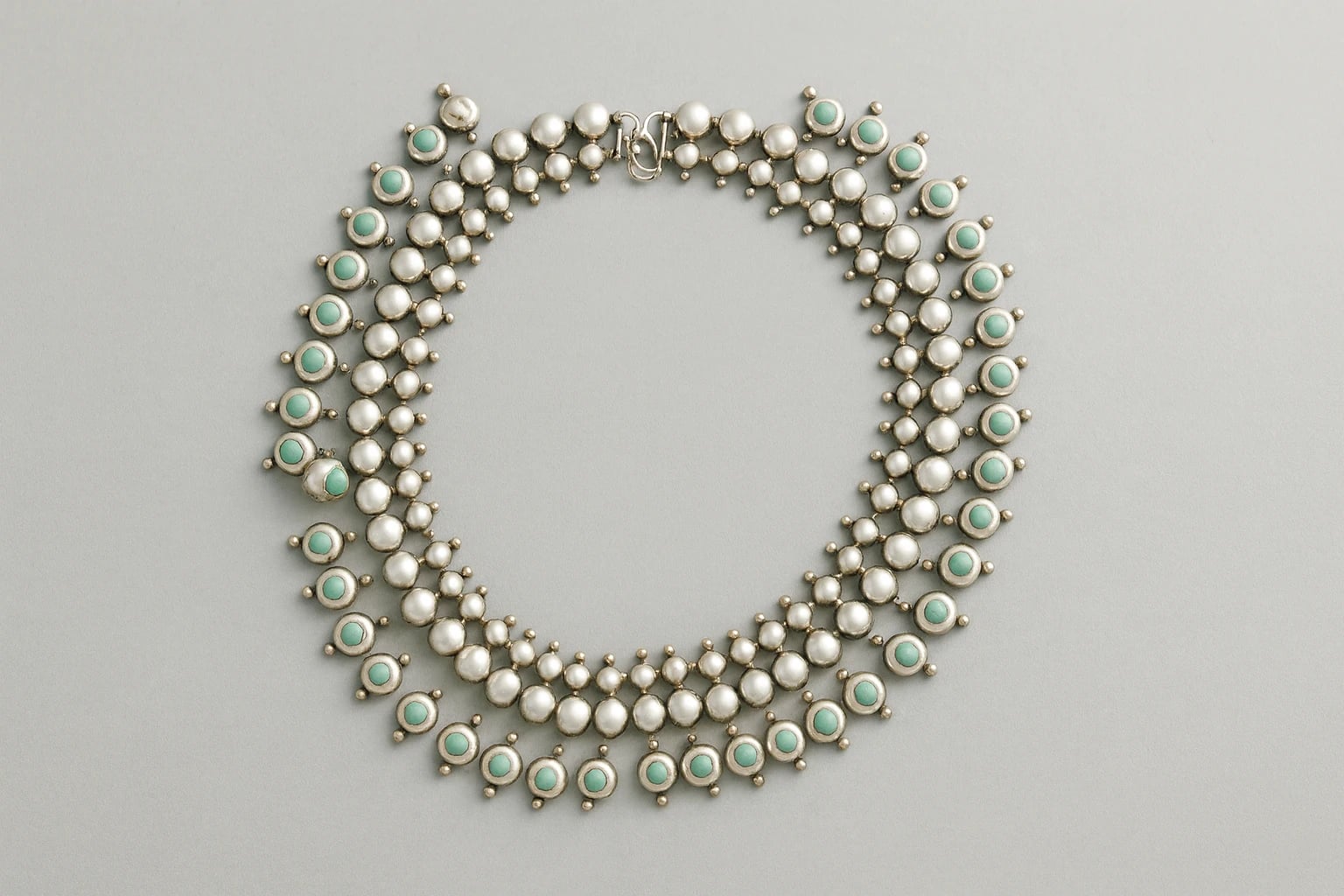
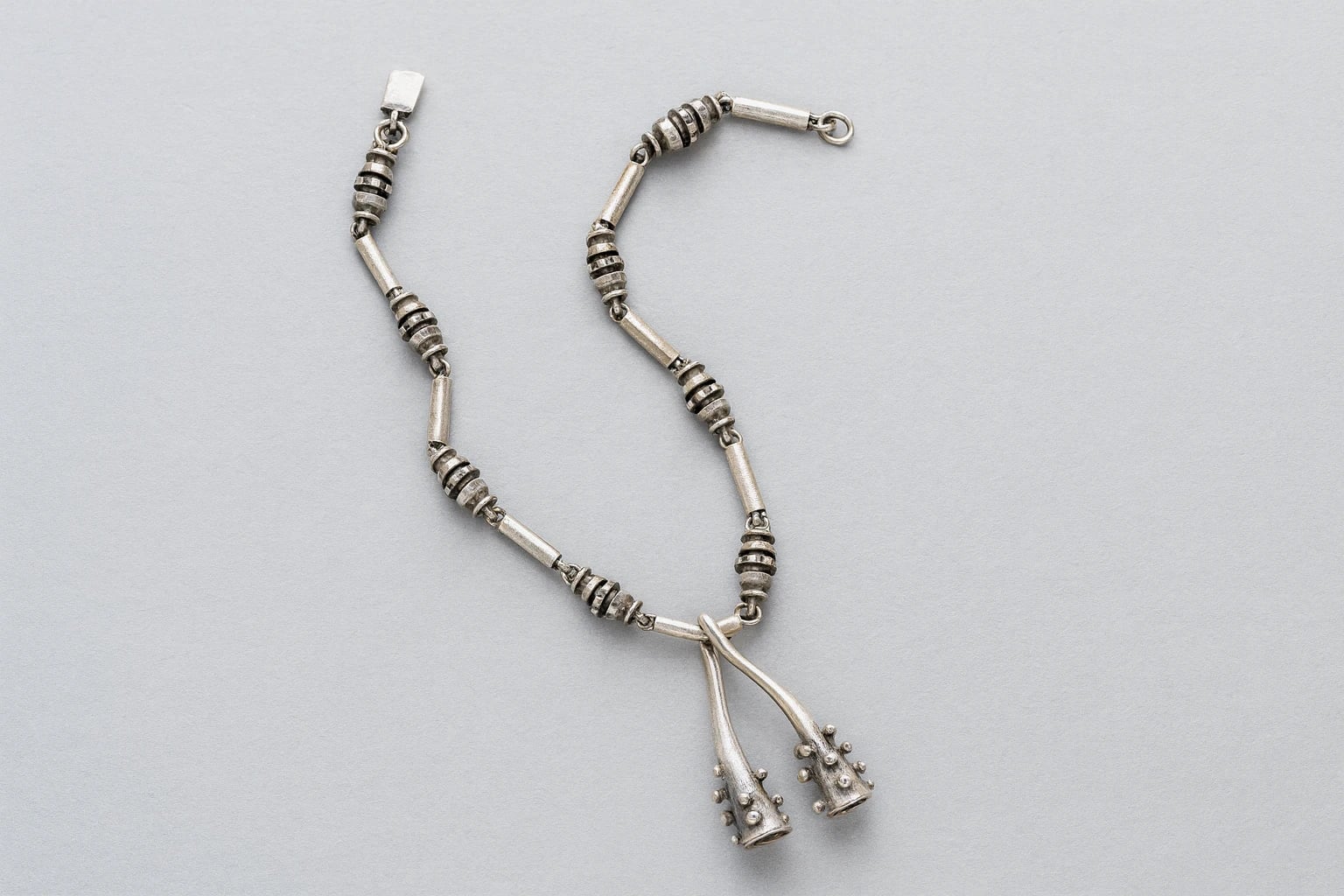
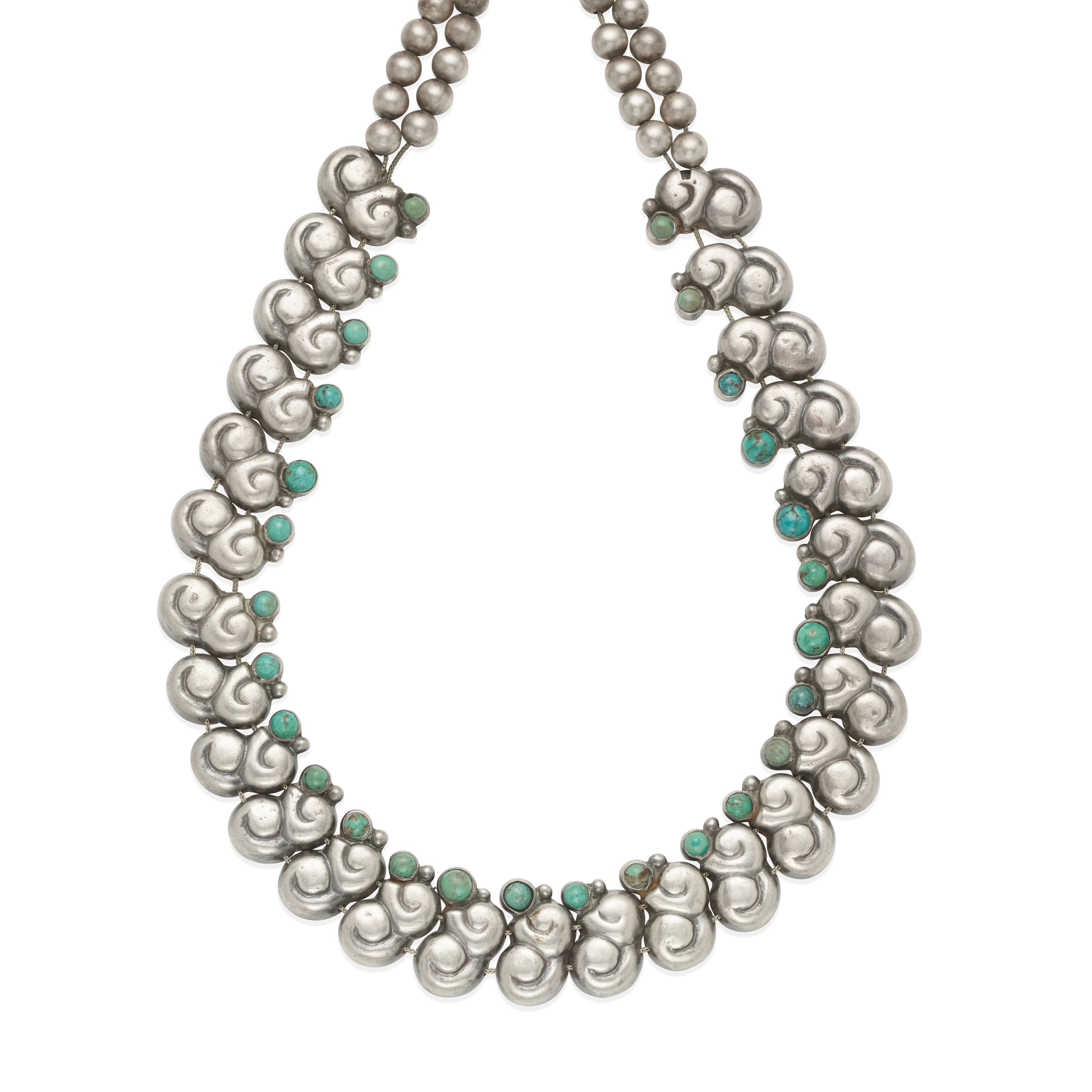
Bold scrolled forms in high-relief silver, each link coiling inward to a tight volute and holding a round turquoise stone at its apex, give this necklace a sculptural rhythm of considerable force. The forms call up the stepped-and-scrolled design grammar that runs through Mesoamerican material culture, translated here into three-dimensional linked elements arranged as a dense bib collar, suspended from a double strand of plain silver beads.
The Pre-Columbian vocabulary was central to the program William Spratling established when he founded the Taxco revival in the early 1930s. As Stromberg documents, he worked deliberately to take "motifs from Pre-Columbian design" and translate them "into a style that was accessible to an American audience and clientele." The volute was among the most versatile of those forms, resonant with ancient precedent yet abstract enough to function as pure design. The Spratling workshop rendered each scroll as a swelling, rounded element with an oxidized finish that deepens the antiqued quality of the silver and throws the high-relief curves into sharp contrast.
Turquoise carries particular weight in this context: its associations with pre-Columbian craft traditions and with the indigenous peoples of Mesoamerica made it a natural complement to designs rooted in that heritage. Set into the terminal of each scroll, the stones establish a vivid blue-green counterpoint to the darkened silver without diminishing the sculptural primacy of the link work. The dating to circa 1940–46 places the necklace within Spratling's First Design Period, when his workshop's synthesis of indigenous motif and modernist form was at its most concentrated.
Museum of Mexican Silver. “Silver Clouds Necklace.” Catalog no. MoMS-000319. https://museumofmexicansilver.com/pieces/spratling-721
See something wrong with this record? Suggest a correction and the piece details fill in automatically.
William Spratling
Turquoise Half Sphere Necklace
First Design Period: 1931 - 1946
Silver