Saves instantly, no account needed. Already a member? Sign in.
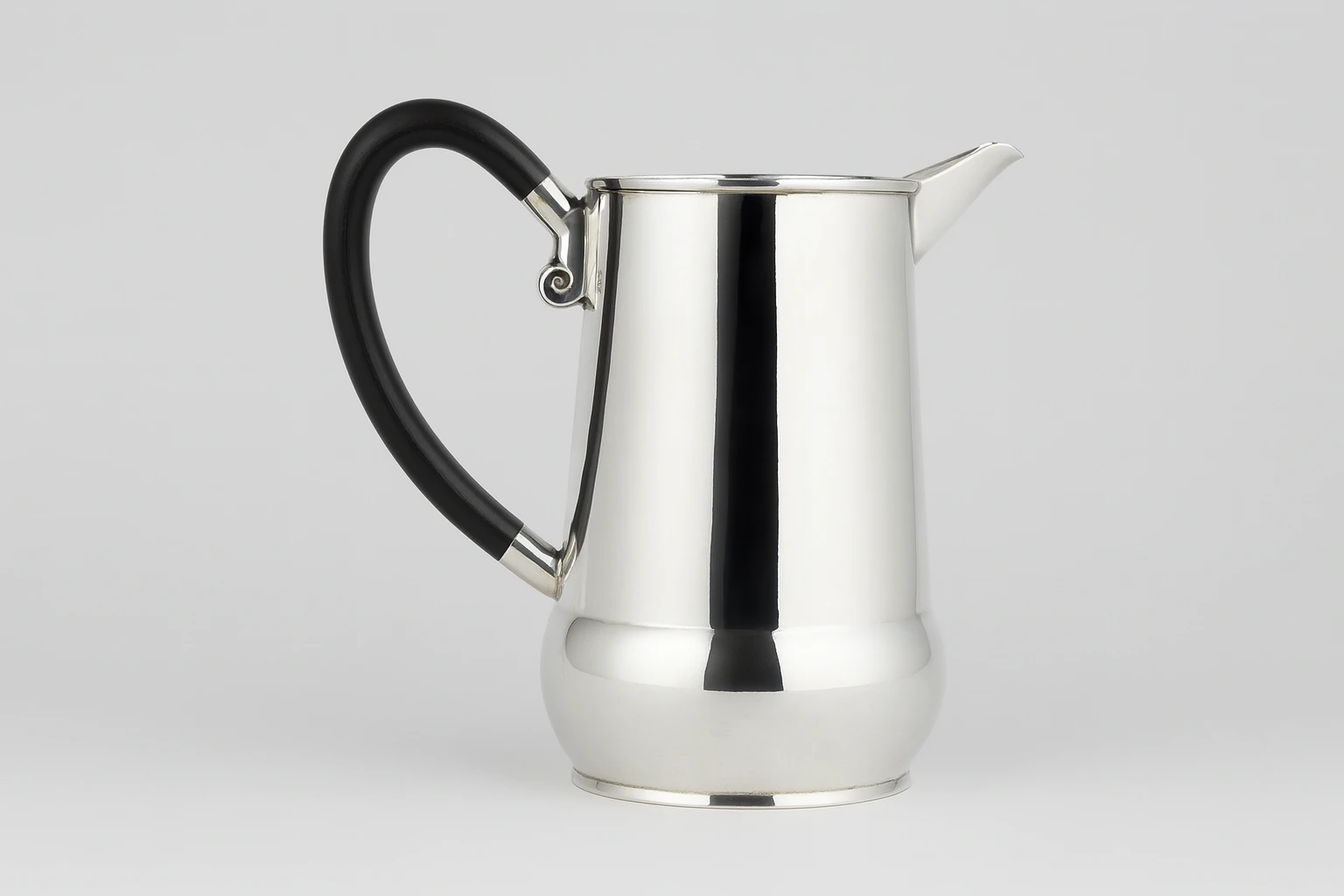
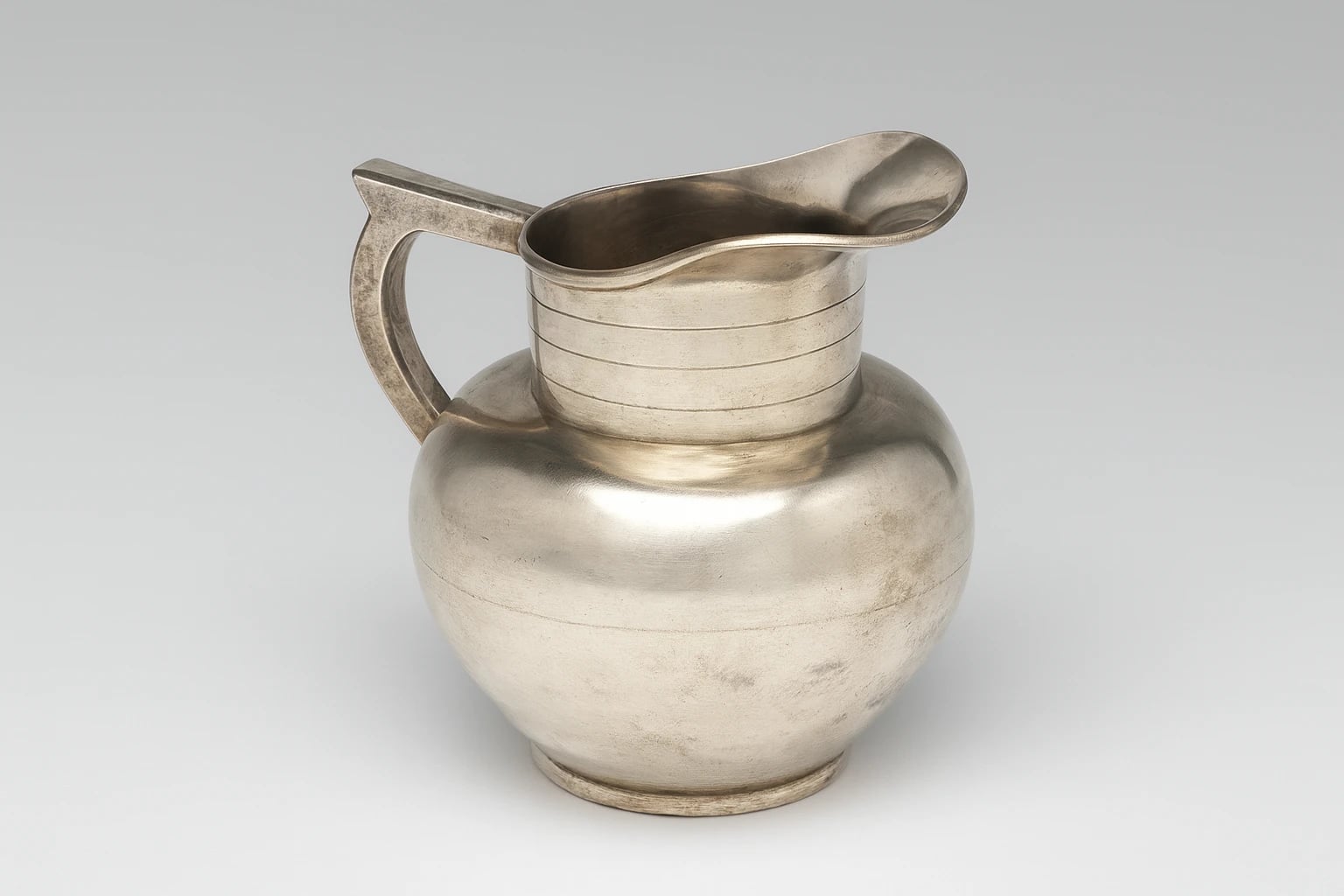
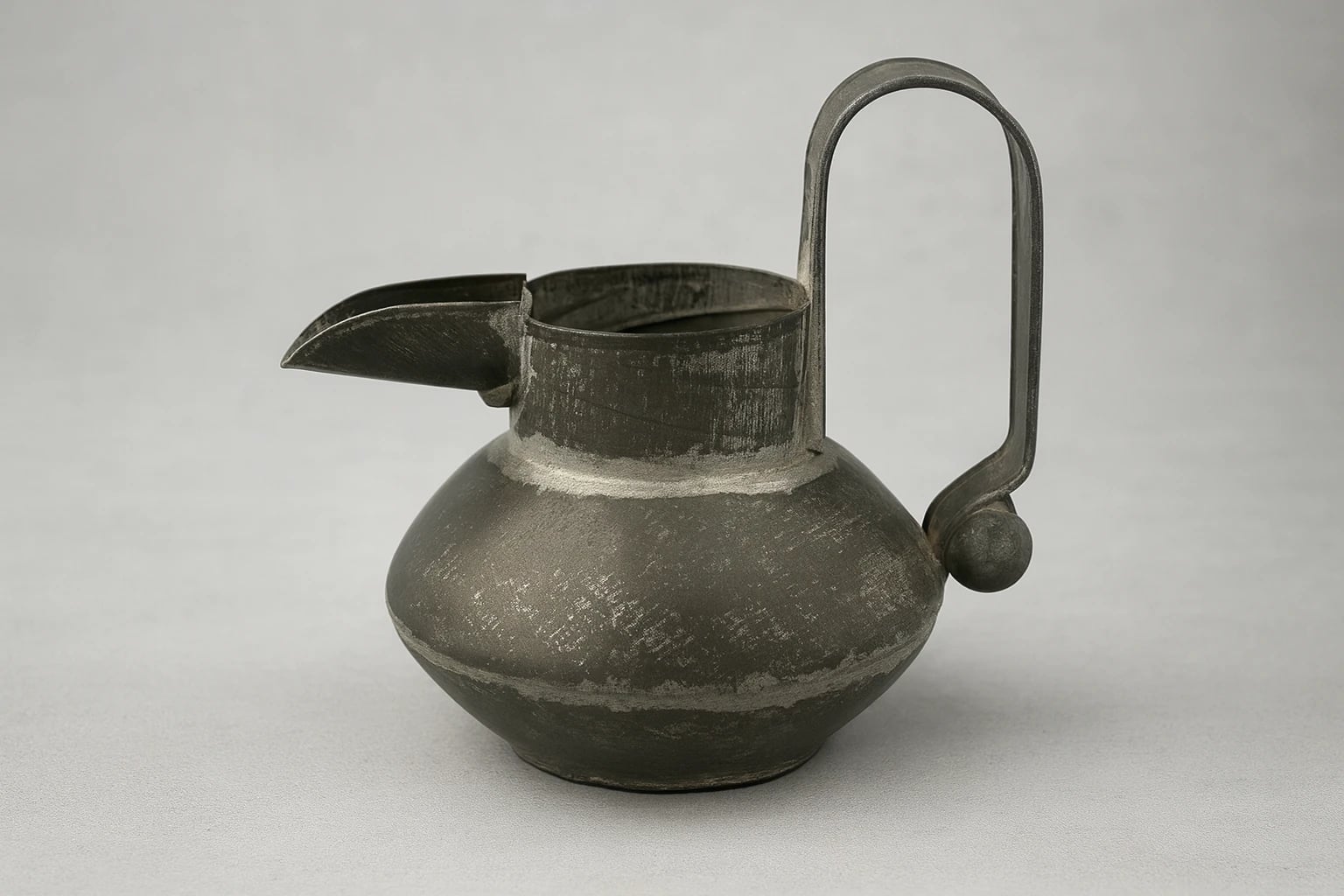
A tin pitcher stands apart from the silver that made William Spratling famous, and this vessel shows how seriously he treated the humbler metal. The body rises to an elongated pouring lip, and a tall strap handle arcs from the rim down to the lower wall, giving the whole form a vertical stretch that the pouring spout answers at the opposite side. The design depends on a small number of decisions: the height of the handle, the reach of the lip, the proportion between them. Tin holds none of the prestige of sterling, yet Spratling brought the same attention to line and silhouette that governs his silver hollowware.
The strap handle is the governing element. Broad and flat where a rounded handle might have been expected, it reads as a continuous ribbon of metal that repeats the vertical thrust of the body while framing an open interval of negative space along the pitcher's flank. That opening keeps the form from feeling heavy and sets up a rhythm between solid wall and void. The elongated lip works as the handle's counterweight, pulling the eye forward and down along the axis of a pour. Tin takes a softer, more matte surface than silver, and its cooler gray absorbs light rather than throwing it back, so the pitcher depends on contour and proportion rather than reflection to carry the design.
Spratling's tin and copper work belongs to the wider ambition of the Taller de Las Delicias, which he founded in Taxco in 1931 and organized around a range of materials rather than silver alone. The museum's hallmark reference, rebuilt from Hougart, records his marks on copper and on tin as well as on silver and gold, including a tin mark reading "Taxco · WS · Mexico" dated to the 1931 to 1946 period. Those base-metal objects were part of a Mexican postrevolutionary interest in everyday domestic goods made well, and they let the workshop apply its design language to forms that ordinary households used. The pitcher extends the vocabulary of Spratling hollowware into a metal chosen for its own qualities, not as a cheaper substitute.
Because tin objects survive less often than silver, which was kept, cleaned, and handed down as something precious, a Spratling pitcher in this material documents a part of his production that is easily overlooked. It records the breadth of the Las Delicias program and the discipline Spratling carried across materials, from precious to utilitarian. As a study in proportion worked out in a modest metal, the pitcher clarifies how much of his design intelligence lay in silhouette and interval rather than in the value of the material itself.
Museum of Mexican Silver. “Strap Handle Tin Pitcher.” Catalog no. MoMS-000950. https://museumofmexicansilver.com/pieces/spratling-515
See something wrong with this record? Suggest a correction and the piece details fill in automatically.
William Spratling
Jaguar Cream Pitcher
Silver