Saves instantly, no account needed. Already a member? Sign in.
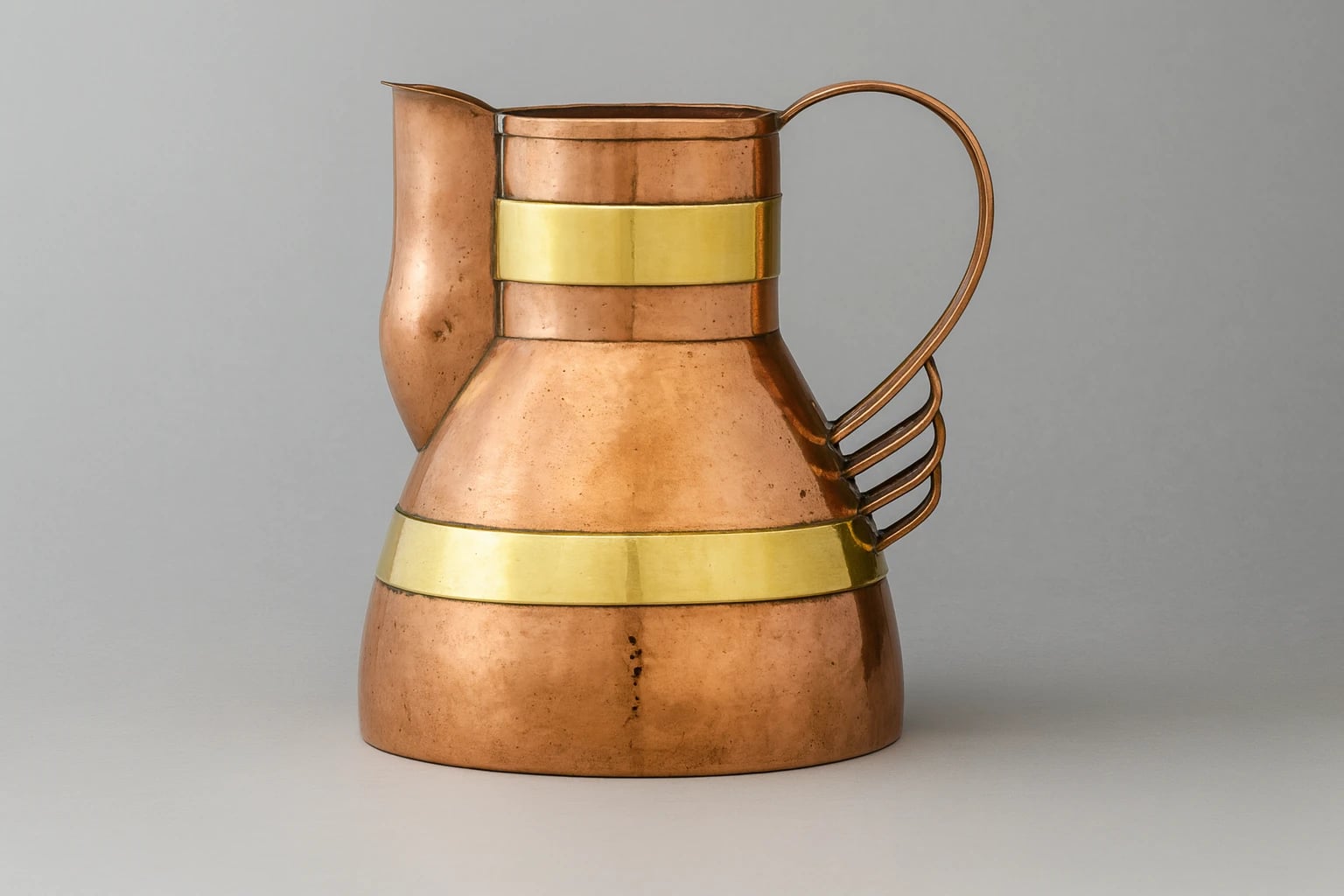
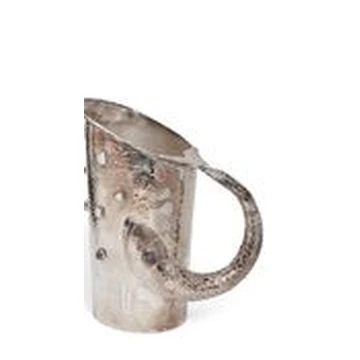
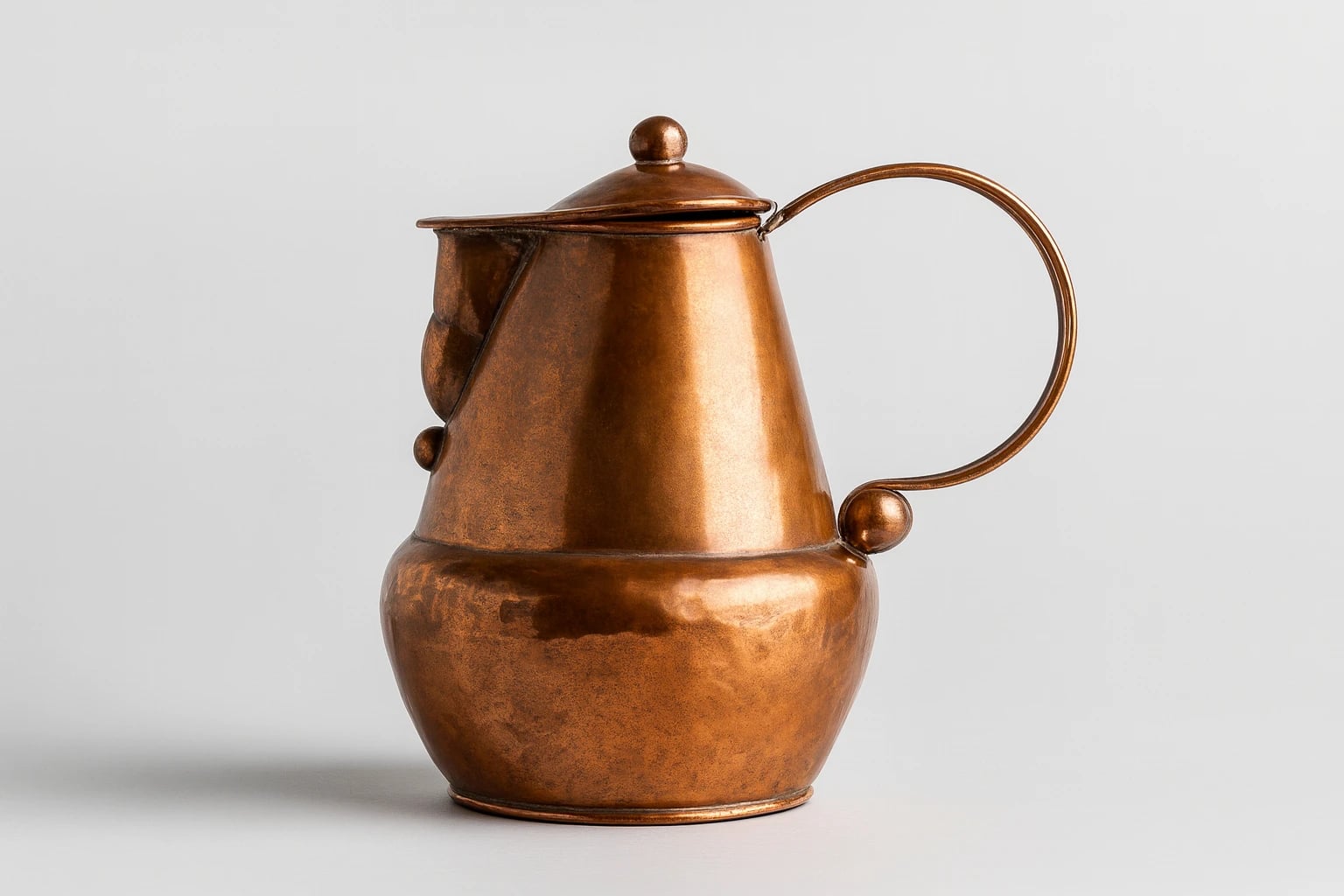
Copper rather than silver defines this pitcher, and that choice places it within a strand of Héctor Aguilar's production that is often overlooked in favor of his silver jewelry and hollowware. Working the metal in a warm reddish material, Aguilar treats the vessel as an exercise in continuous form: a swelling body, a lifted spout, and a handle that resolves the profile rather than interrupting it. The pitcher is documented in Penny Morrill's *Silver Masters of Mexico: Héctor Aguilar and the Taller Borda* (1996), plate I-38, and dates to approximately 1945, a period when Aguilar's workshop had matured into one of the most capable design operations in Taxco.
The form is organized around a single sweeping silhouette. The body rises from a narrow foot and widens toward the shoulder, then draws inward before the rim opens into a pouring spout. The handle answers that curve, connecting the upper body to the lower wall in a loop that keeps the eye moving around the vessel. Copper allows this kind of full, rounded volume to read as one gesture, its surface catching light along the curves and deepening in the recesses. The material carries a distinct visual temperature, and Aguilar uses that warmth to give the pitcher a domestic, tactile presence different from the cooler reflectivity of silver.
Aguilar founded the Taller Borda after leaving his managerial role at Spratling's workshop, and by the mid-1940s he directed a large operation producing jewelry, hollowware, and functional objects across silver, copper, and mixed metals. The copper work belongs to the same design intelligence that shaped his silver: Morrill records copper mirrors and copper-and-silver bracelets from the same period, marked with the same workshop hallmark. Aguilar and the smiths of the Taller Borda understood copper not as a lesser substitute but as a material with its own color, weight, and working properties, suited to larger functional forms where silver would have been prohibitively costly. The pitcher shows the workshop applying its command of proportion and line to a household object.
Within a collection, this pitcher documents the breadth of the Taller Borda beyond the jewelry for which Aguilar is best known. It records a moment when a leading Taxco workshop extended modern design into the useful objects of daily life, giving a copper pitcher the same clarity of form that governed its silver. The piece, from the collection of Ronald A. Belkin and published by Morrill, helps establish copper as an integral part of Aguilar's output rather than a marginal one.
Museum of Mexican Silver. “Copper Pitcher.” Catalog no. MoMS-001643. https://museumofmexicansilver.com/pieces/aguilar-copper-pitcher-1945
See something wrong with this record? Suggest a correction and the piece details fill in automatically.
Héctor Aguilar
Sterling Water Pitcher
1939-1962
Silver