Saves instantly, no account needed. Already a member? Sign in.
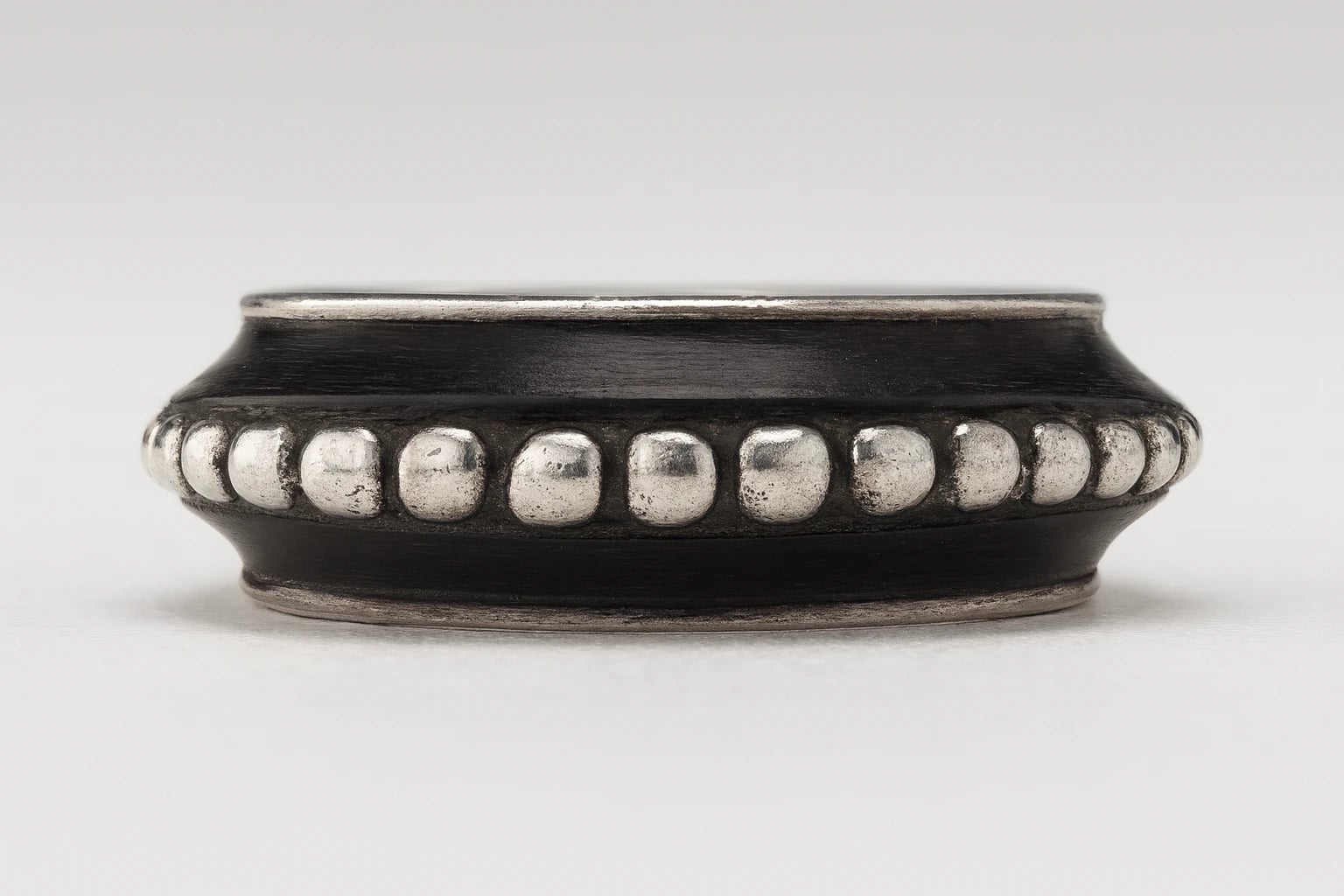
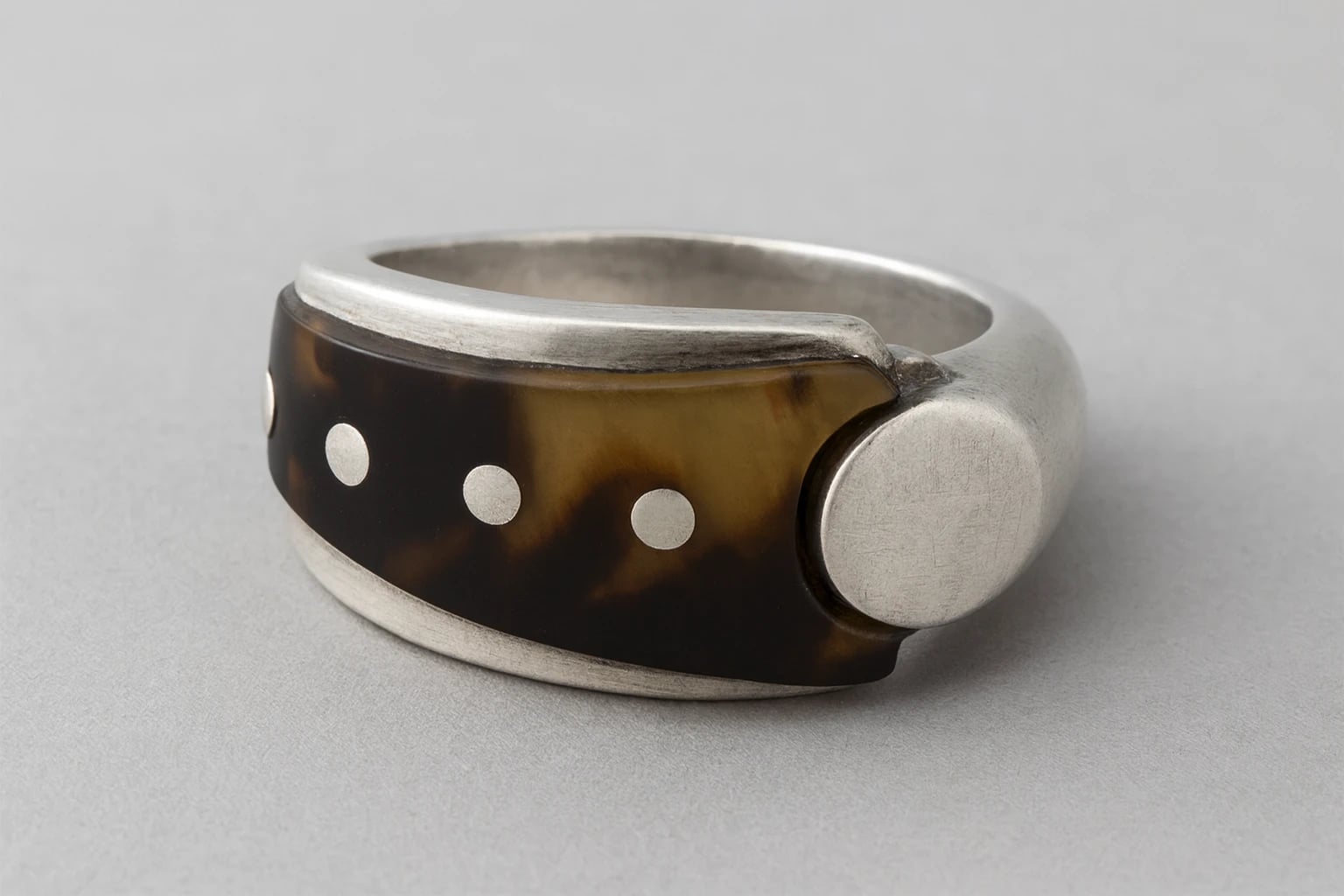
A wedge of tortoise shell curves around the finger, its warm translucence broken by a regular course of silver rivets, while the shank narrows to a plain band of heavy silver. The design sets two materials against each other by contrast of temperature and weight: the shell reads brown, amber, and mottled where light passes through it, and the silver stays cool and reflective. Spratling used the rivets structurally and decoratively at once, securing the shell to its metal support while marking it with a rhythm of small bright points. The result is a ring built around a single material relationship rather than an applied motif.
The wedge form gives the ring its character. Rather than a uniform band, the tortoise shell swells to its greatest depth at the crown and tapers toward the underside of the finger, so the mass of color concentrates where it is seen and thins where it would interfere with wear. The rivets follow that widening surface, spacing themselves along the shell's length. Tortoise shell, an organic material worked warm and shaped to a curve, behaves differently from a set stone. It carries light into its body instead of returning it from a facet, and Spratling exploited that translucence by keeping the surrounding silver plain, letting the shell hold the eye. The heavy silver he favored in these years provides the necessary weight and a stable seat for the riveted panel.
This design first appeared in Spratling's wholesale catalogues in 1958 and was produced until his death in 1967, placing it within the late period that many consider his most inventive. Spratling had been working with the pairing for several years by then, writing to a friend that he had been doing things with heavy silver and tortoise shell that had never been done in this way before. That claim of priority matters for reading the ring: he treated tortoise shell not as a decorative inlay in the colonial manner but as a primary material carried by a modern silver structure. The approach belongs to the same instinct that runs through his career, from the early clay-seal brooches to the later work, of finding a native or unexpected material and giving it a clean contemporary setting. Davis and Pack's Mexican Jewelry and Phyllis Goddard's field guide both record the tortoise shell designs among his production.
Examples of this ring are found only occasionally today, and it stands as a well-resolved instance of Spratling's material experiments in his final decade. It shows how a Taxco workshop under a strong design hand could take an organic substance rarely used this way in modern silver and build a small, wearable object around the contrast of shell and metal. For a collection of the Mexican silver renaissance, it documents the range of Spratling's late thinking beyond his better-known silver-and-stone work.
Museum of Mexican Silver. “Tortoise Shell Wedge Ring.” Catalog no. MoMS-000632. https://museumofmexicansilver.com/pieces/spratling-96
See something wrong with this record? Suggest a correction and the piece details fill in automatically.
Simple Shaped Silver Ring
First Design Period: 1931 - 1946
Silver