Saves instantly, no account needed. Already a member? Sign in.
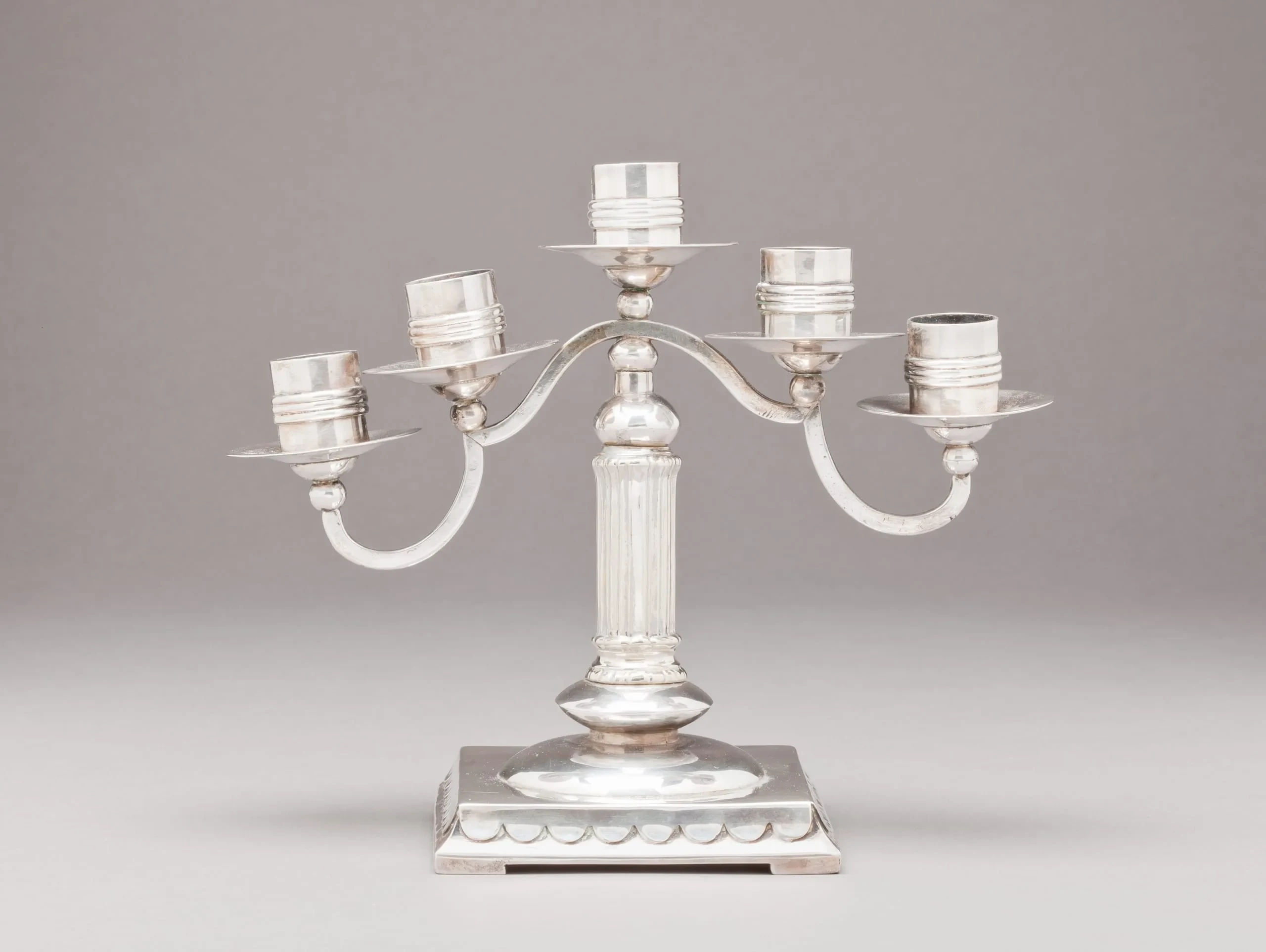
This small five-light candelabrum brings colonial silver vocabulary into the first years of the Taxco renaissance with unusual restraint. Recorded by LACMA as a work by William Spratling from circa 1935, it measures only seven inches high, yet its structure has the ceremonious order of a larger table object: a square base, a raised foot, a fluted column, paired scrolling arms, and five cylindrical candle sockets set above shallow drip pans. The scale is domestic, even intimate, but the design preserves the vertical poise and frontal symmetry associated with colonial candlesticks and church silver.
Its ornament is concentrated where the hand and eye expect punctuation. A scalloped band runs along the lower edge of the base, the central column is vertically fluted, and each candle socket is encircled by a tight group of horizontal ribs. These repeated bands give the object its rhythm without covering its surfaces. The arms are broad, polished S-curves rather than thin wires, so the candelabrum reads as a sequence of silver planes catching light from different angles. The drip pans are nearly flat, with slightly lifted edges that sharpen the silhouette and separate each cup from the underlying knop. Candlelight would have activated exactly the features the design emphasizes: convex beads, concave dishes, ribbed collars, and the bright interruptions of the scrolls.
The title “Colonial-style Candelabrum” is precise, but the object is not simply antiquarian. Spratling’s early work drew from colonial as well as ancient Mexican sources, and Morrill and Berk note that he later described Aztec and Colonial motifs as points of departure for the workshop’s first designs. In this object, the colonial source is filtered through reduction. The column, scroll arm, scallop, and knop remain legible, but they have been simplified into a clean sequence of volumes. That discipline aligns the candelabrum with the larger modernizing tendency of Las Delicias in the mid 1930s, when Spratling’s workshop was developing hollowware and table objects alongside jewelry. Morrill and Berk describe the workshop’s water pitchers, candlesticks, and teapots of the period as composed of simple shapes without superfluous ornament, a characterization that fits the controlled economy of this piece.
The candelabrum also helps correct a narrow view of the Mexican silver renaissance as a history only of jewelry or of ancient Mexican motifs translated into adornment. Here the modern work occurs through a table object and through colonial form. Its importance lies in that position: it shows the early Spratling workshop testing how inherited Mexican silver types could be made newly usable for a modern interior. The result is not a rejection of colonial design, but a measured recasting of it in the language of Taxco silver: bright, compact, structurally clear, and alert to the way reflected light can become ornament.
Museum of Mexican Silver. “Colonial-Style Candelabrum.” Catalog no. MoMS-002270. https://museumofmexicansilver.com/pieces/spratling-colonial-style-candelabrum-lacma-m2013-4-15
See something wrong with this record? Suggest a correction and the piece details fill in automatically.
William Spratling
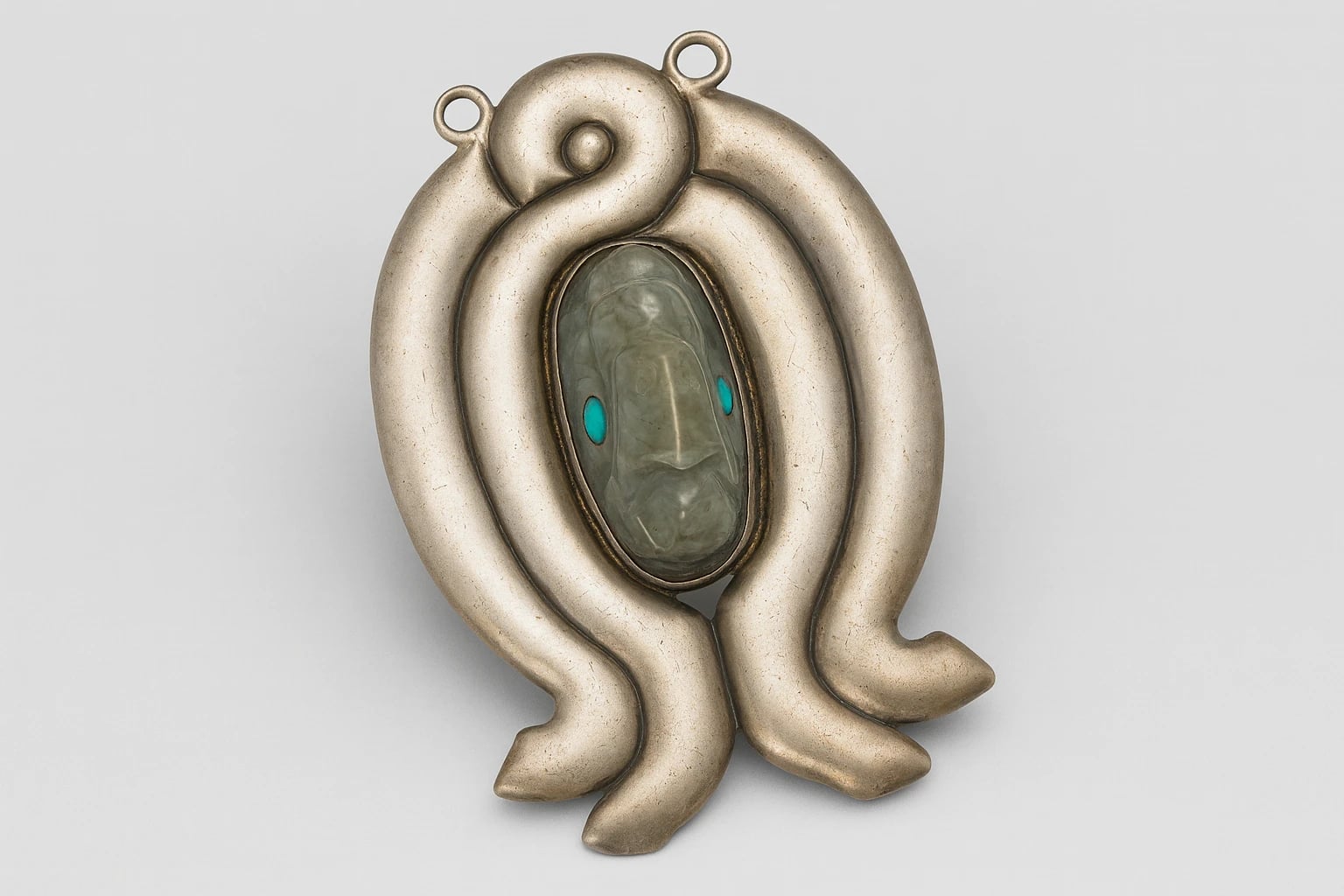
Pre-Columbian Greenstone Bird Brooch/Pendant
c. 1940-1946
Sterling silver