Saves instantly, no account needed. Already a member? Sign in.
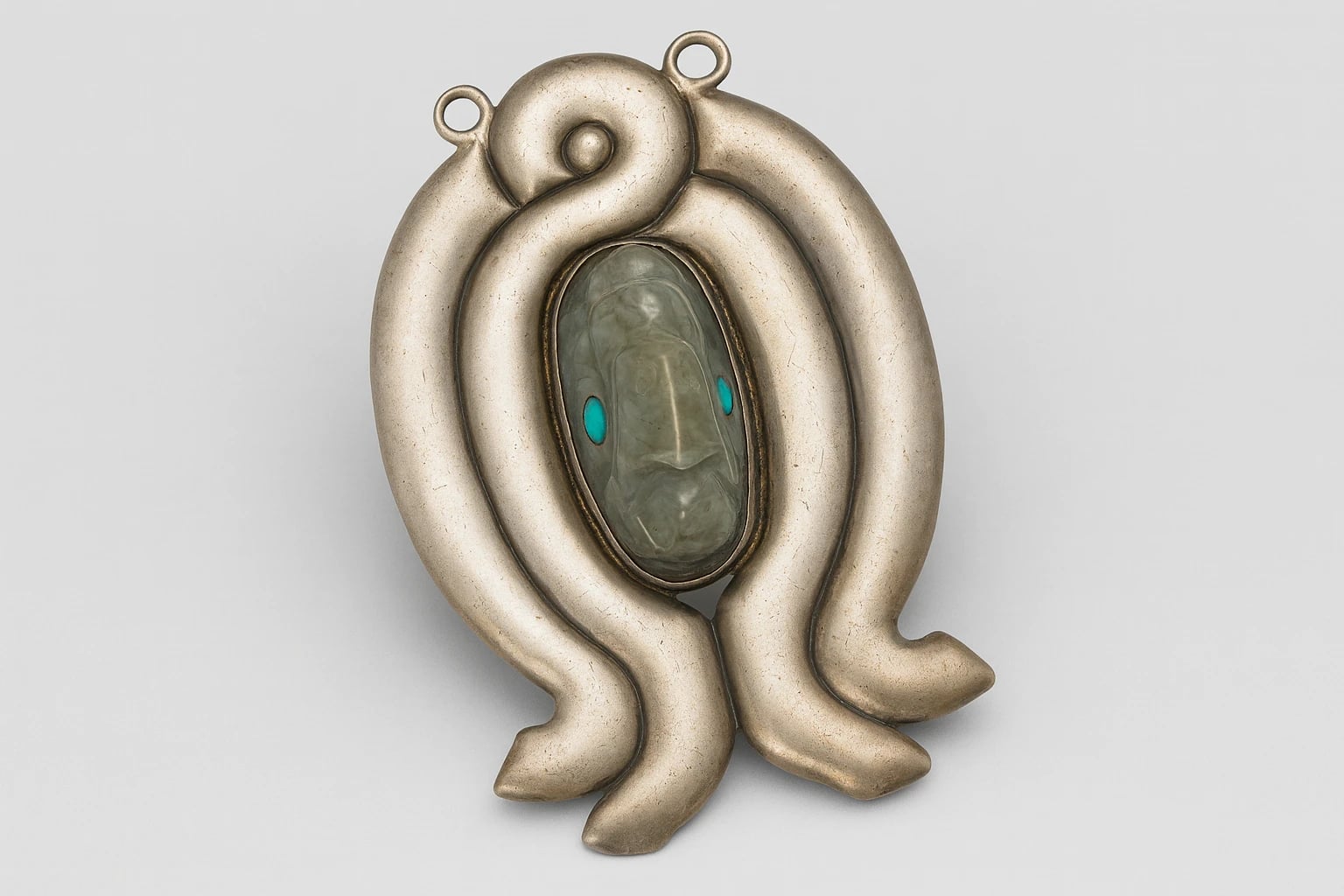
This brooch is among the clearest expressions of William Spratling's belief that Mexico's ancient past could be made present again through modern design. At its center is not a modern imitation of a Pre-Columbian object, but an actual ancient carving: a small greenstone bird head, fashioned centuries before Spratling arrived in Taxco. He set it into a bold silver framework whose swelling, curving forms transform the fragment into something newly alive. The ancient stone remains unmistakably itself, but the silver around it gives it a second existence as jewelry, sculpture, and modern Mexican art.
That distinction matters. Spratling is often described as a designer who borrowed motifs from codices, ceramics, clay stamps, and archaeological sculpture. He certainly did that. But his relationship with Pre-Columbian art was far deeper than decorative quotation. He spent decades assembling important collections of ancient Mexican sculpture, particularly small stone figures, masks, and architectural forms from Guerrero. Morrill describes him as a passionate student of these objects, drawn especially to the dramatically simplified jade, jadeite, serpentine, and rock-crystal sculpture associated with Mezcala and related traditions. His personal collection later became central to the Museo Guillermo Spratling in Taxco.
Here that collector's eye and the designer's hand converge. Rather than copying the bird in silver, Spratling preserves the ancient carving at the center of the composition and builds outward from it. The surrounding silver seems to unfurl from the stone itself. Its broad, rounded contours suggest wings, feathers, or flowing plumage without describing them literally. Small turquoise inlays intensify the face and create flashes of color against the cool gray-green stone. The result is deliberately ambiguous: part bird, part abstract modernist form, part archaeological relic. It is exactly the kind of collision between ancient Mexico and twentieth-century design that made Taxco silver so radical in the 1930s and 1940s.
The use of an actual Pre-Columbian carving gives the work unusual historical force. In most Neo-Pre-Columbian jewelry, the past is represented through imagery. Here, the past is physically present. The object therefore operates across two radically different moments in Mexican history. One maker shaped the greenstone in the Pre-Columbian world; centuries later, Spratling and the silversmiths of Taxco transformed it again without erasing its original identity. The brooch is not simply inspired by antiquity. Antiquity has been materially incorporated into the work.
Museum of Mexican Silver. “Pre-Columbian Greenstone Bird Brooch/Pendant.” Catalog no. MoMS-002296. https://museumofmexicansilver.com/pieces/spratling-pre-columbian-greenstone-bird-brooch-pendant
See something wrong with this record? Suggest a correction and the piece details fill in automatically.
That practice also reflects the intellectual world in which Spratling worked. Postrevolutionary Mexico was actively redefining national identity through renewed attention to indigenous and Pre-Columbian culture. Artists such as Diego Rivera, David Alfaro Siqueiros, and others treated the ancient past as a foundation for modern Mexican identity rather than as a vanished archaeological curiosity. Taxco's silversmiths participated in the same project. Gobi Stromberg describes the Taxco School as combining Pre-Columbian references with modernist experimentation, producing objects that were recognizably contemporary yet unmistakably Mexican. Spratling was particularly influential in translating ancient forms into designs accessible to a new international audience.
This brooch goes one step further. It collapses the distinction between source and interpretation. The Pre-Columbian carving is simultaneously artifact and design element; the silver surround is simultaneously frame and transformation. Neither dominates the other. The ancient stone gives the modern object historical depth, while the modern silver gives the ancient carving a new visual and social life.
That is why the piece is more important than its scale suggests. It captures, in a single wearable object, one of the central ideas of the Mexican silver renaissance: that modernism in Mexico did not require rejecting the past. It could instead be built directly upon it. Spratling's achievement was not simply to reproduce ancient imagery in silver, but to make Mexico's ancient visual language function again in the modern world. In this brooch, he did so literally.
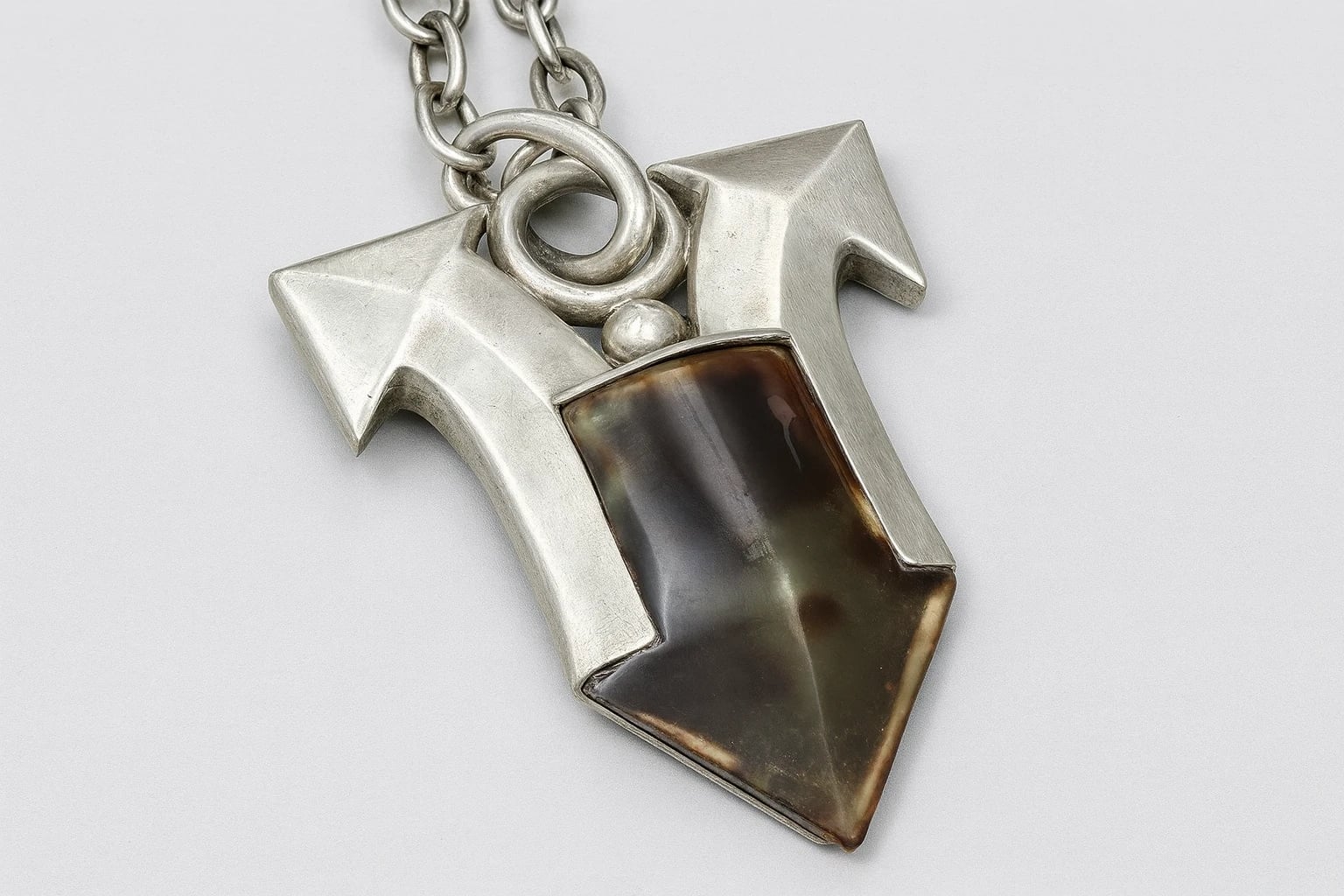
William Spratling
Tortoise Shell Arrow Necklace
Sterling silver