Saves instantly, no account needed. Already a member? Sign in.
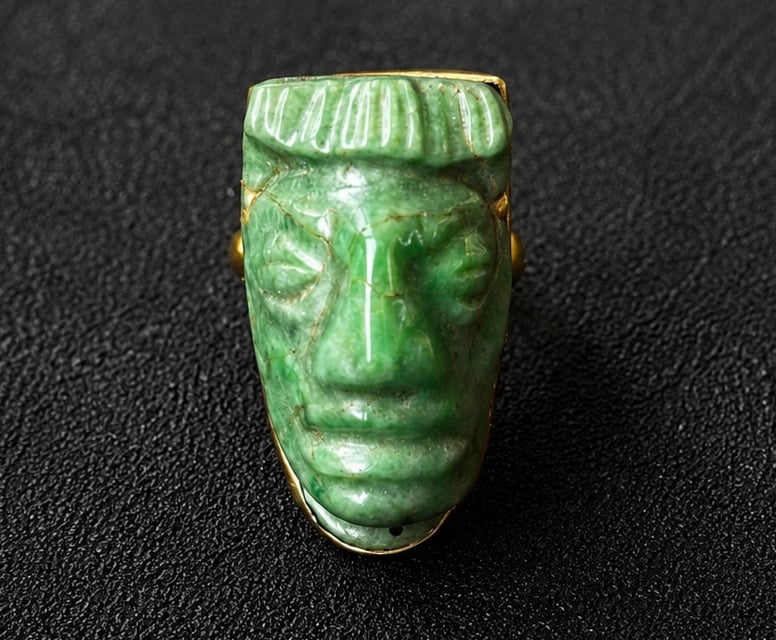
This gold and jade ring is an exceptional and likely unique work within William Spratling’s jewelry production. Unlike Spratling’s better-known silver designs, which often translated ancient Mexican motifs into modern handwrought silver, this ring incorporates an actual Pre-Columbian jade or jadeite carving as its central element. The result is not merely a modernist design inspired by antiquity, but a direct physical convergence of ancient Mesoamerican lapidary art and mid-20th-century Taxco jewelry design.
The carved green stone face, with its compact frontal format, strong nose, compressed mouth, and incised headdress or hairline, has the presence of a miniature mask. Its expressive features and tactile polish recall the small stone figures, masks, and carved objects that fascinated Spratling throughout his life. Morrill and Berk describe Spratling as a passionate collector and student of ancient sculpture from Guerrero, especially small stone figures and masks associated with the Mezcala region south of the Río Balsas; these works were carved from hard stones including jade, jadeite, rock crystal, and serpentine, and were admired for their dramatically simplified, stylized forms.
The ring’s gold mount is deliberately restrained. Rather than competing with the ancient carving, the gold setting frames and protects it. The thin gold bezel, full backing, and rounded shank transform the jade face into a wearable object while preserving its sculptural authority. This balance between modern setting and ancient stone is central to the ring’s importance: Spratling does not overwhelm the archaeological fragment with ornament, but presents it as the visual and cultural core of the work.
Gold jewelry by Spratling is itself rare in comparison with his silver production. Morrill and Berk note that Spratling used the hallmark “18K” above “WS” on his goldwork. Spratling is remembered above all as the founder of Taxco’s modern silver renaissance, but his occasional gold pieces occupy a much smaller and more specialized category within his body of work.
The ring’s greatest rarity lies in the union of three factors: Spratling authorship, 18-karat gold construction, and a carved Pre-Columbian jade element from Spratling’s own collection. Spratling’s collecting was not incidental to his design practice. His personal holdings of Pre-Columbian art were exhibited, studied, and ultimately formed part of his cultural legacy; by 1967, he described his collecting of Guerrero stone sculpture as a pursuit carried out for more than thirty-five years, “one piece at a time” and with great selectiveness.
The carved jade face came from William Spratling’s extensive personal collection of Pre-Columbian objects.
Museum of Mexican Silver. “Mayan Jade God Mask Ring.” Catalog no. MoMS-002167. https://museumofmexicansilver.com/pieces/spratling-gold-jade-face-ring
See something wrong with this record? Suggest a correction and the piece details fill in automatically.
For that reason, this ring should be understood as a singular studio object rather than a production model. Even if Spratling made other gold rings or other jewels incorporating ancient stones, this example is unique by construction: the ancient jade carving cannot be duplicated, and its reported origin in Spratling’s personal collection gives the object a biographical and historical dimension beyond ordinary jewelry. It is at once adornment, sculptural setting, collecting history, and a statement of Taxco modernism’s deep engagement with Mexico’s ancient past.
In museum terms, the ring stands at the intersection of two Spratling identities: the modern designer who helped define the Taxco School, and the collector-scholar who found enduring inspiration in Pre-Columbian form. Morrill and Berk describe Spratling’s larger achievement as the adoption and reinterpretation of Pre-Columbian artifacts and indigenous craft traditions in silver, a process through which he revived an ancient iconographic vocabulary for the modern era. This ring carries that project further: it does not simply reinterpret the ancient object; it preserves and re-presents it within a modern gold framework
William Spratling
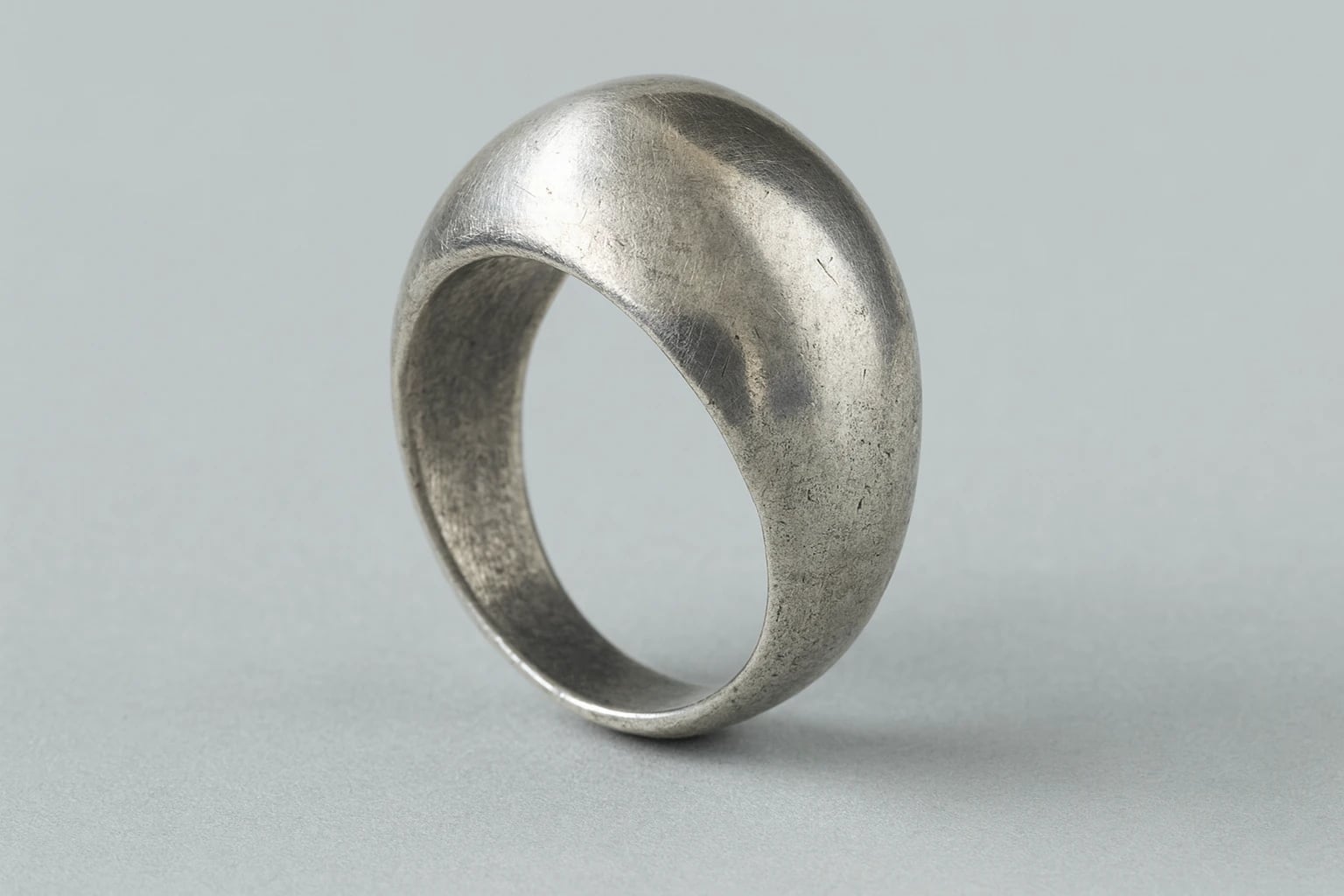
Simple Heavy Silver Domed Ring
First Design Period: 1931 - 1946
Silver