Saves instantly, no account needed. Already a member? Sign in.
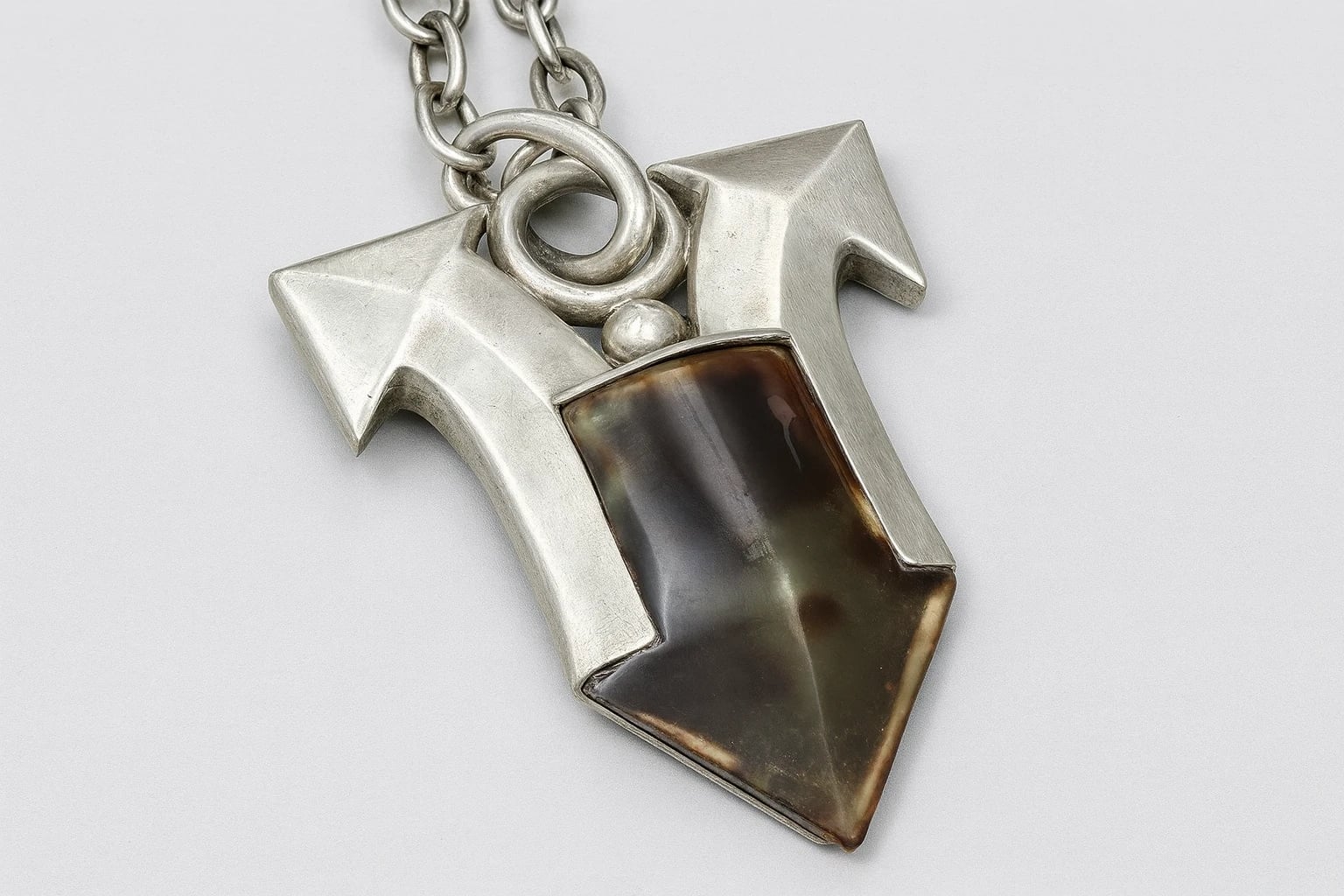
This pendant condenses the force of a blade, arrowhead, or ceremonial axe into a wearable modernist emblem. Its broad silver shoulders are cut with inward notches and beveled planes, dropping to a pointed lower form set with a polished brown translucent tortoiseshell inset; the whole is carried on a large silver suspension ring and oval-link chain. The reverse bears the circular William Spratling mark with the conjoined WS and MADE IN MEXICO, together with the oval SPRATLING SILVER stamp. Morrill records that the oval Spratling Silver mark denoted the workshop’s 980 silver standard, while Stromberg dates closely related circular Made in Mexico Spratling marks with sans-serif conjoined WS to the 1940–1946 period, placing this necklace in the mature Las Delicias/Spratling y Artesanos years rather than the later 925 script-mark production (Morrill 1994, p. 45; Stromberg 2008, pp. 87, 97).
The design is characteristic of Spratling’s strongest silver vocabulary: archaeological suggestion without literal quotation. The pendant reads as a reduced sign, weapon, glyph, shield, and ornament at once, where the silver frame supplies architecture and the dark inset supplies depth, warmth, and visual weight. Morrill describes Spratling’s decisive turn from European and colonial silver models toward Pre-Conquest art and architecture as a revolution in Mexican silver design, noting his sustained study of clay stamps and ancient Mexican motifs (Morrill 1994, pp. 39–41). Here that historical language is not copied as a figure; it is abstracted into cut silhouette, symmetry, and mass.
The tortoiseshell-and-silver contrast also belongs to a documented Spratling material idiom. Morrill writes that Spratling’s later new gadgets included beautiful combinations of silver and tortoiseshell or wood, with an increasing emphasis on simplified form, surface, and line (Morrill 1994, p. 73). This necklace shows the same discipline at pendant scale: no chasing, repoussé, or pictorial ornament distracts from the outline. The inset is held like a dark organic relic inside a polished silver armature, allowing the object to move between modernist jewelry and an imagined ancient pectoral.
Museum Significance
This necklace matters because it shows Spratling at the point where Taxco silver became an international modern design language rather than simply a regional craft. Stromberg describes the Taxco School as a world-renowned network of designers and talleres whose structure allowed designers to work with master smiths while dramatically expanding their markets (Stromberg 2008, p. 15). The marks and construction of this pendant connect it to that larger workshop system: a signed Spratling object, made for circulation, but still dependent on hand-cut form, careful finishing, and the authority of the maker’s mark. The Museum of Arts and Design holds a related Spratling tortoiseshell and sterling silver pendant dated circa 1955, underscoring how these compact silver-and-organic-material pendants sit within the recognized design legacy of the Taxco School.
Previously displayed in Museo Belber and part of the private collection of Federico Jimenez
Museum of Mexican Silver. “Tortoise Shell Arrow Necklace.” Catalog no. MoMS-002051. https://museumofmexicansilver.com/pieces/spratling-tortoise-shell-arrow-necklace
See something wrong with this record? Suggest a correction and the piece details fill in automatically.
William Spratling
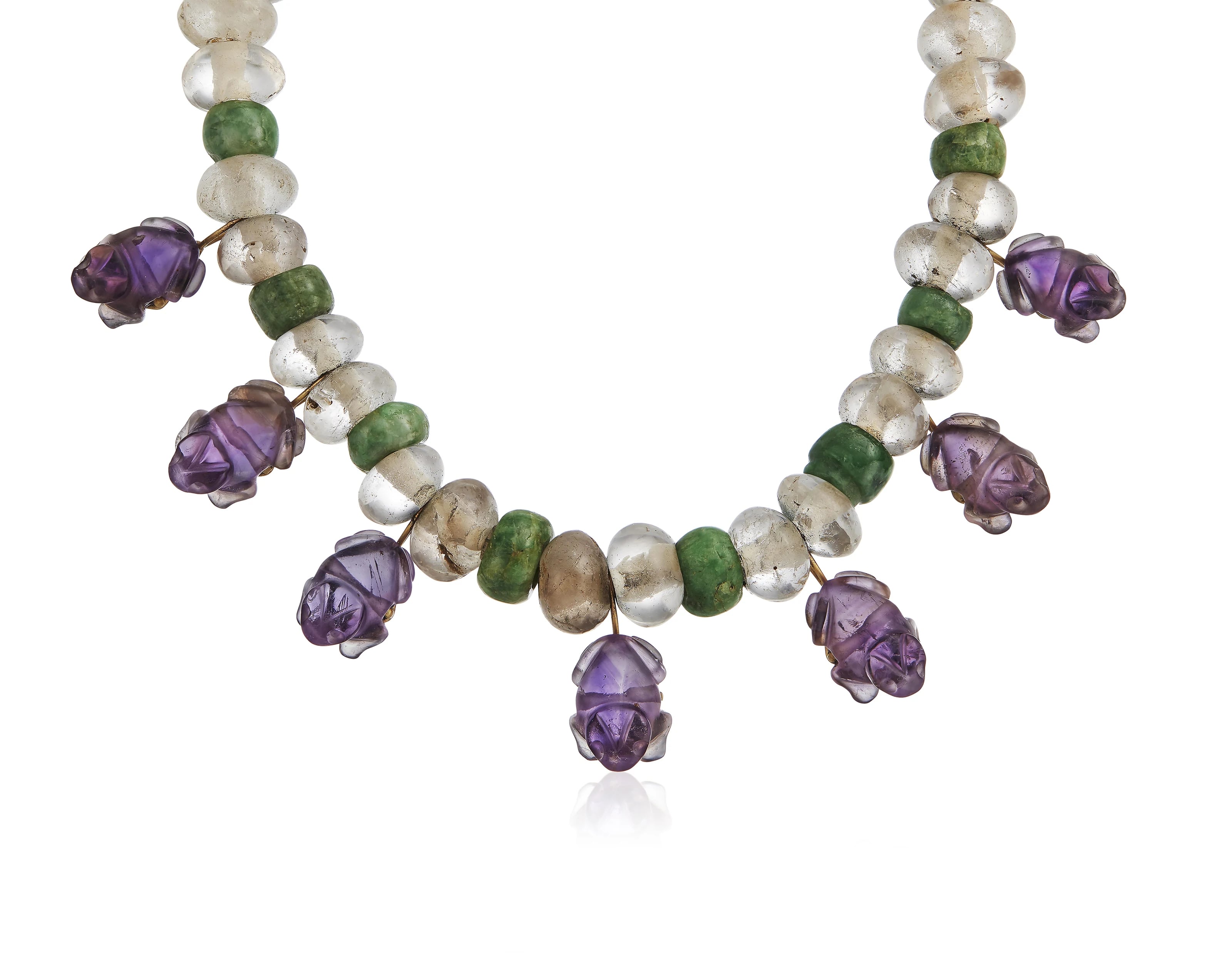
Carved Amethyst Frog and Jade Necklace in Gold
18k yellow gold