Saves instantly, no account needed. Already a member? Sign in.
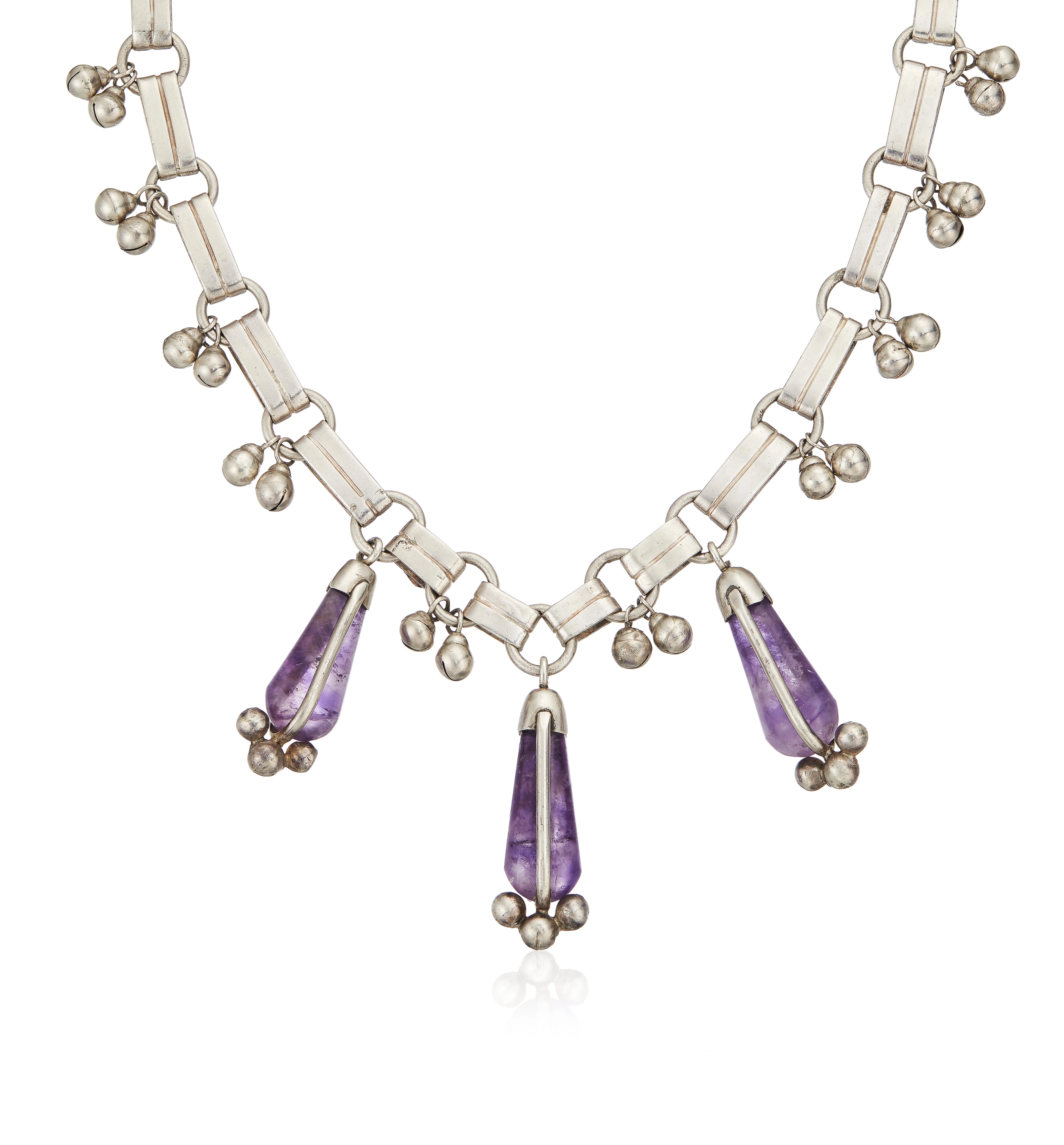
A necklace built for sound as much as for sight, this piece belongs to the first decade of William Spratling's silver workshop, when the vocabulary that would define Taxco modernism was still being invented link by link. Its quiet ambition lies in the marriage of a disciplined silver chain to the loose, ringing energy of cascabel clusters and three suspended amethyst drops, a combination that turns an ornament into something closer to an instrument. Pieces from this early window, when Spratling y Artesanos was the engine driving an entire regional industry back to life, are where the workshop's design language is at its most legible, and a necklace that carries both the figural fringe and substantial faceted stones sits among the more fully realized survivals of the period.
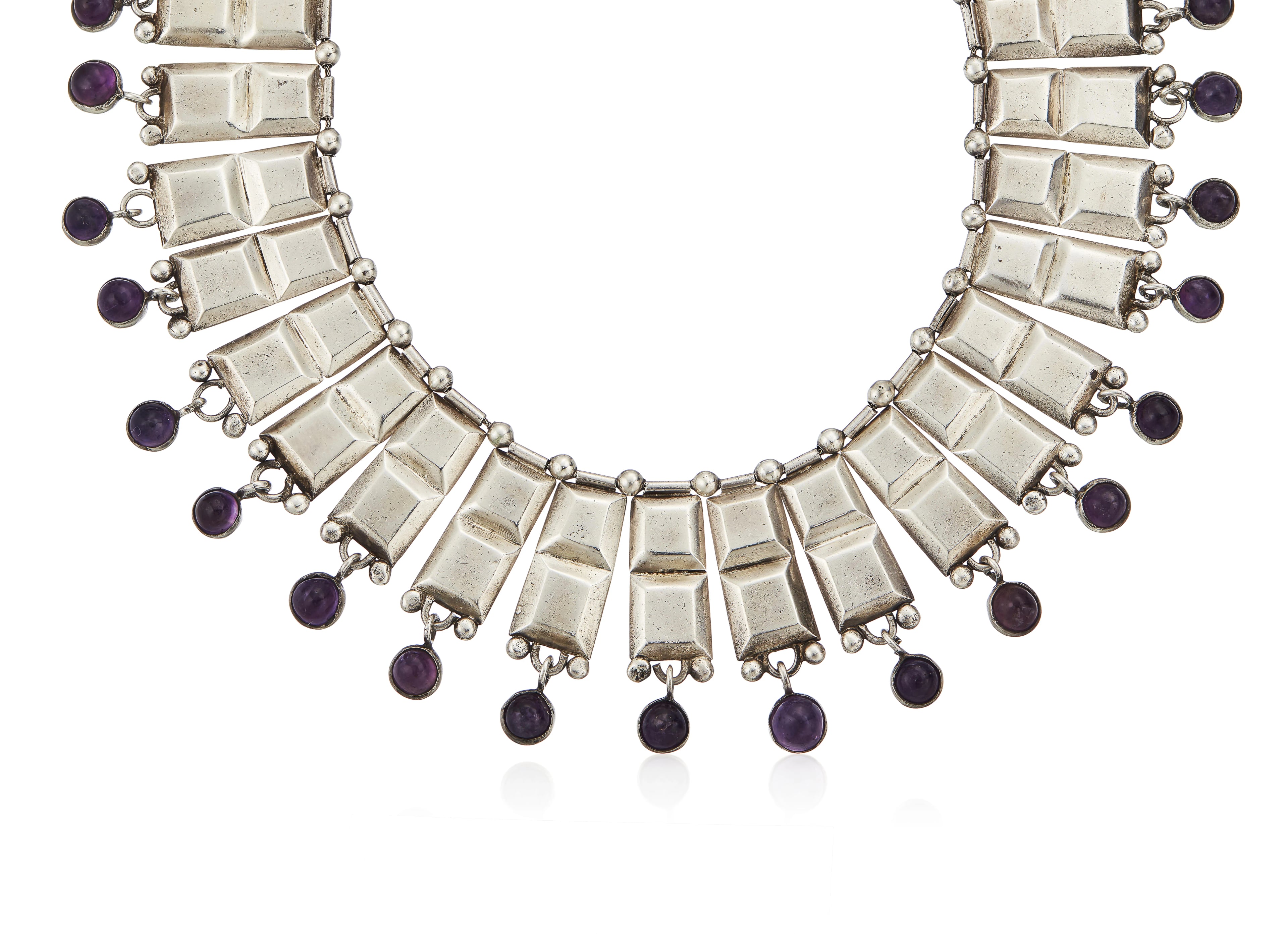
The construction reads clearly. Rectangular silver links, joined by stirrup connectors, carry a fringe of small spherical bells, the cascabeles, which gather in tight clusters along the chain and crown each of the three tapering amethyst drops at the front. The stones are held in open mounts that let light pass through the purple, while the bells around them are purely tactile and aural, an early instance of Spratling treating jewelry as a thing to be heard when worn. The cascabel is among the classic Spratling motifs that Casa Spratling still draws from his modernist archive, and its presence here, paired with hand-finished links rather than cast uniformity, marks the object as workshop production from a moment when each piece still bore the hand.
The marks confirm the dating and the maker. The conjoined WS within the circular "Spratling Made in Mexico" stamp is the primary mark Spratling introduced around 1940, when he resolved to put his full name on his silver rather than initials alone, and it remained in use until Spratling y Artesanos ceased operations in 1946. Alongside it the oval "Spratling Silver" tertiary mark was used only from roughly 1940 to 1944, replaced thereafter by "Sterling." The two marks together therefore narrow the necklace to about 1940 to 1944, squarely within Spratling's celebrated first design period. Amethyst, a stone Spratling returned to repeatedly in these years, gives the piece its color against the broad, bright weight of the silver, and the result is characteristic of the workshop at the height of its early confidence: indigenous and colonial sources absorbed and restated in a clean modern idiom, made by hand and meant to be worn, and heard.
Museum of Mexican Silver. “Amethyst Drop Necklace.” Catalog no. MoMS-002061. https://museumofmexicansilver.com/pieces/william-spratling-amethyst-and-silver-necklace
See something wrong with this record? Suggest a correction and the piece details fill in automatically.
William Spratling
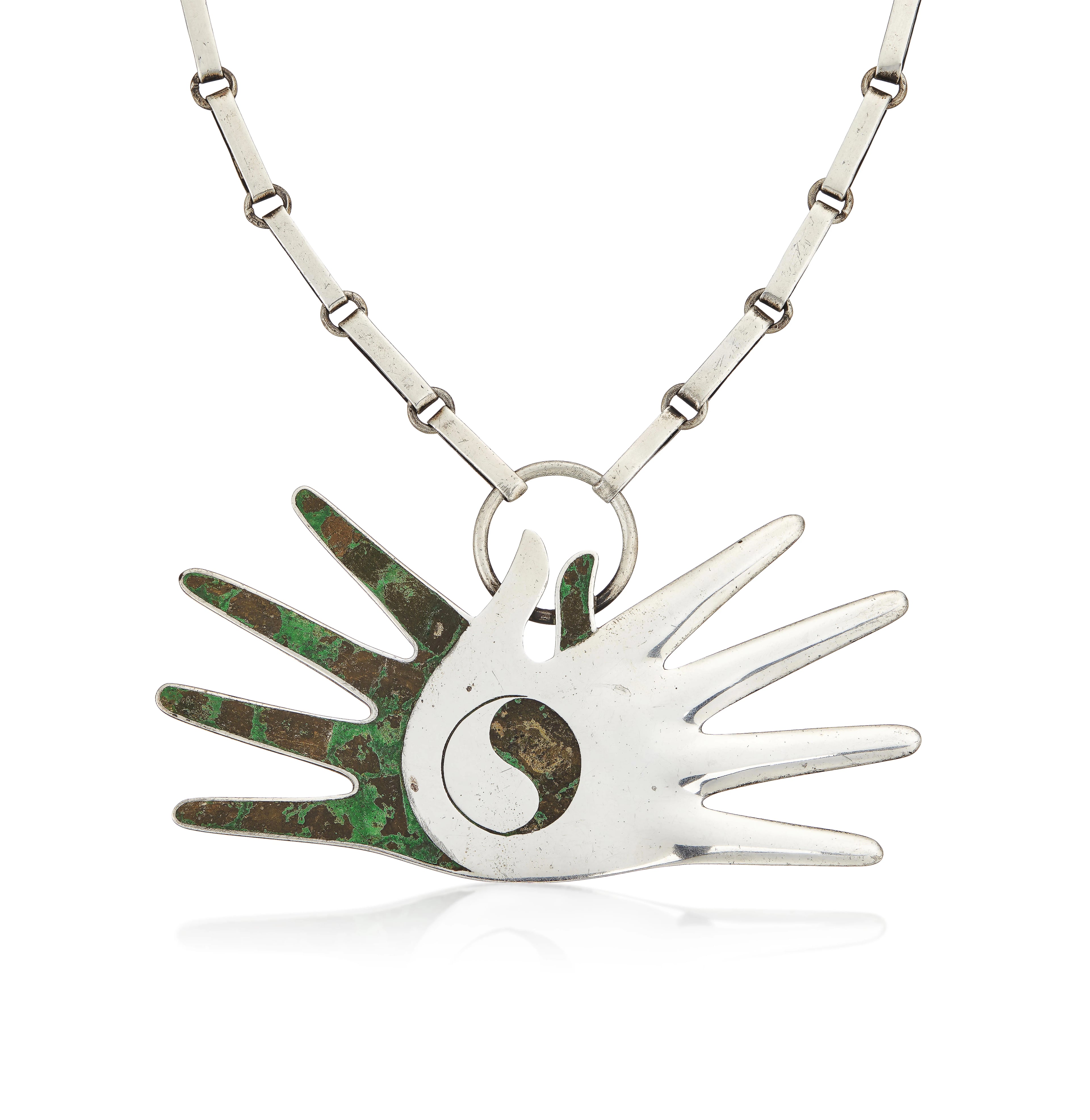
'Hands' Hardstone Necklace
Sterling silver