Saves instantly, no account needed. Already a member? Sign in.
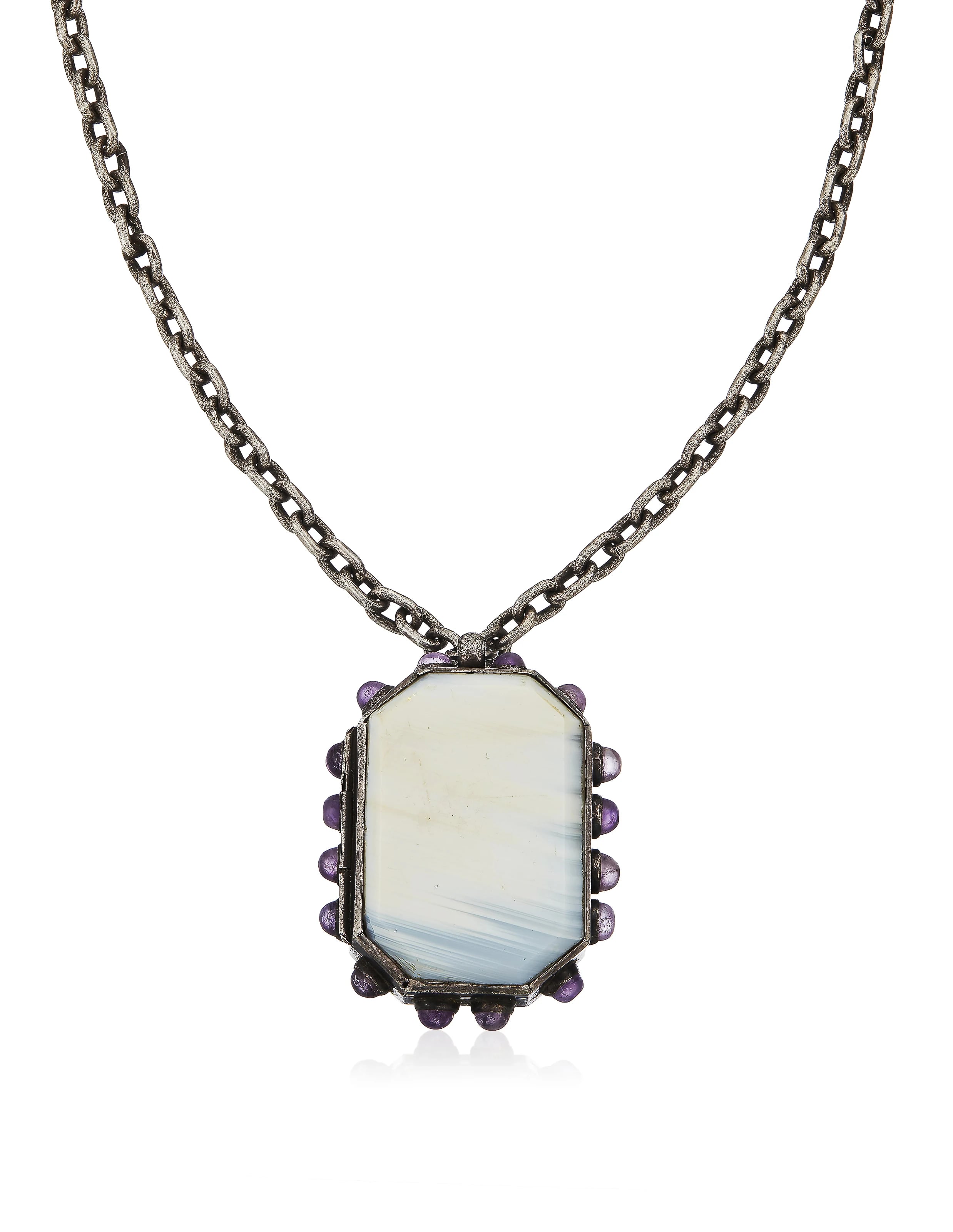
A locket is the most intimate object a silversmith makes, and the relicario, Mexico's devotional reliquary worn against the body, carries centuries of that meaning before any modern designer touches it. Here that colonial form is reimagined in the visual language of Taxco's silver age: a broad octagonal panel of pale agate, its faint blue striations left to read as the stone's own drawing, ringed by a tight border of amethyst cabochons and hung from a heavy elongated-link chain. It is precisely the kind of object that converted a generation of collectors to this material. In Mexican Silver (1994), Penny Morrill recalls that her own education in Mexican silver began with a chunky amethyst-cabochon necklace she encountered in a London shop, a 1940s Spratling design she calls timeless because it reads as contemporary today as when it was made. This locket belongs to that same confident, stone-forward idiom.
The "SPRATLING SILVER" mark, used circa 1940 to 1944, places the piece in the years of the original Taxco workshop, the period before Spratling y Artesanos ceased operations around 1946; silver-and-amethyst pieces of this kind are conventionally dated to circa 1940 to 1946. By this point Spratling had moved past the literal Pre-Columbian zoomorphs of his earliest output toward a more architectonic jewelry built on the contrast of a single large hardstone against massed colored cabochons. The composition here is governed by that contrast: the cool, near-translucent agate as a quiet field, the purple amethysts ringing it like a beaded frame, the whole given weight and presence by the substantial linked chain rather than a delicate one. The setting is hand-raised silver, the bezels and the irregular hand-worked detail consistent with a piece made in the shop rather than from a later die.
What makes the object scholarly interesting is the marriage of devotional form and modern design. Spratling repeatedly drew on Mexico's colonial and folk vocabulary and rebuilt it for a mid-century audience, and the relicario locket is one of the clearest expressions of that method: a religious object emptied of its specific iconography and recharged as a piece of wearable modern sculpture. A complete locket-and-chain from these original-workshop years, carrying the "SPRATLING SILVER" mark of his most admired period, is a notable survival.
Museum of Mexican Silver. “Agate and Amethyst Locket Necklace.” Catalog no. MoMS-002086. https://museumofmexicansilver.com/pieces/william-spratling-agate-and-amethyst-locket-necklace
See something wrong with this record? Suggest a correction and the piece details fill in automatically.
William Spratling
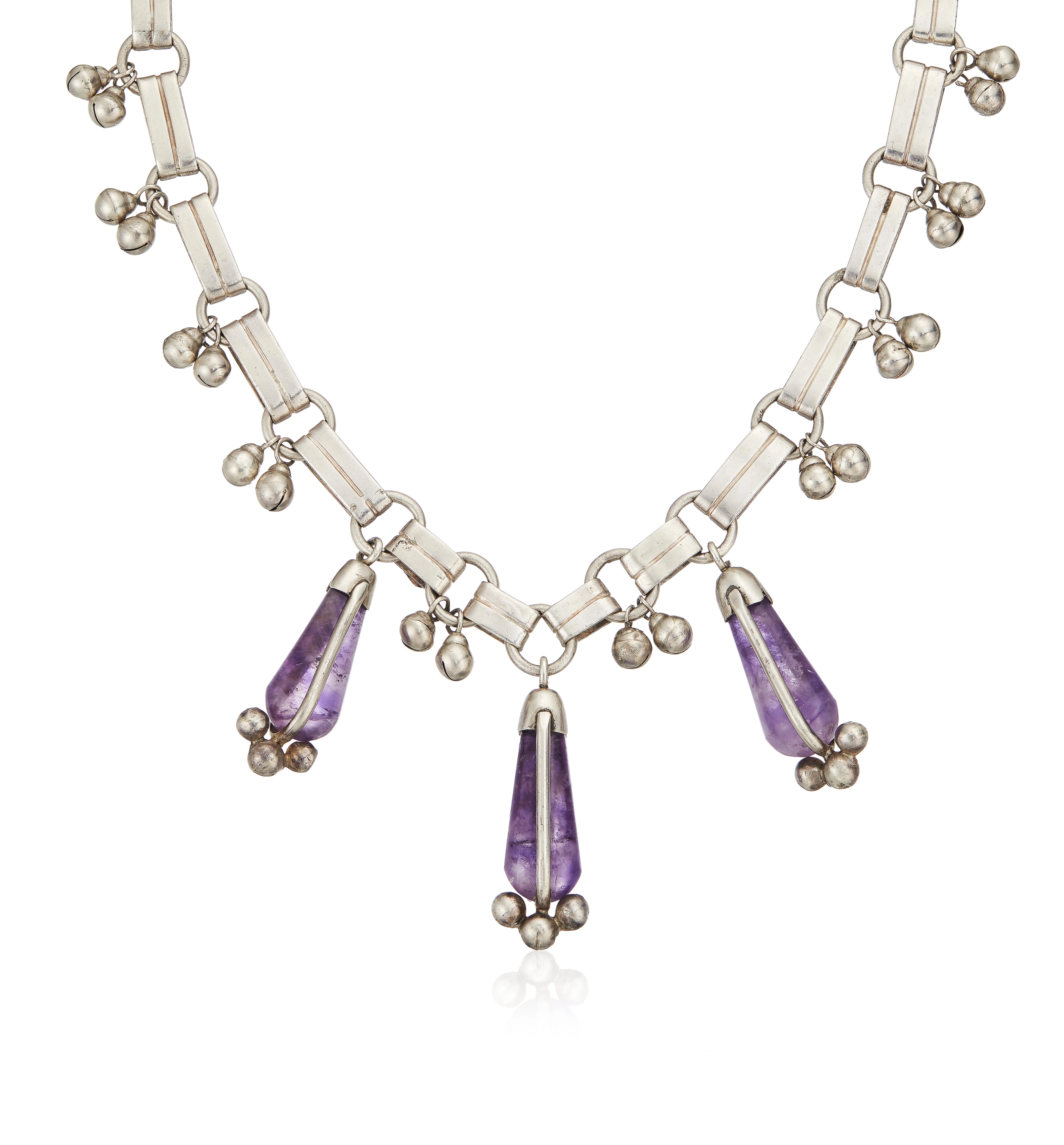
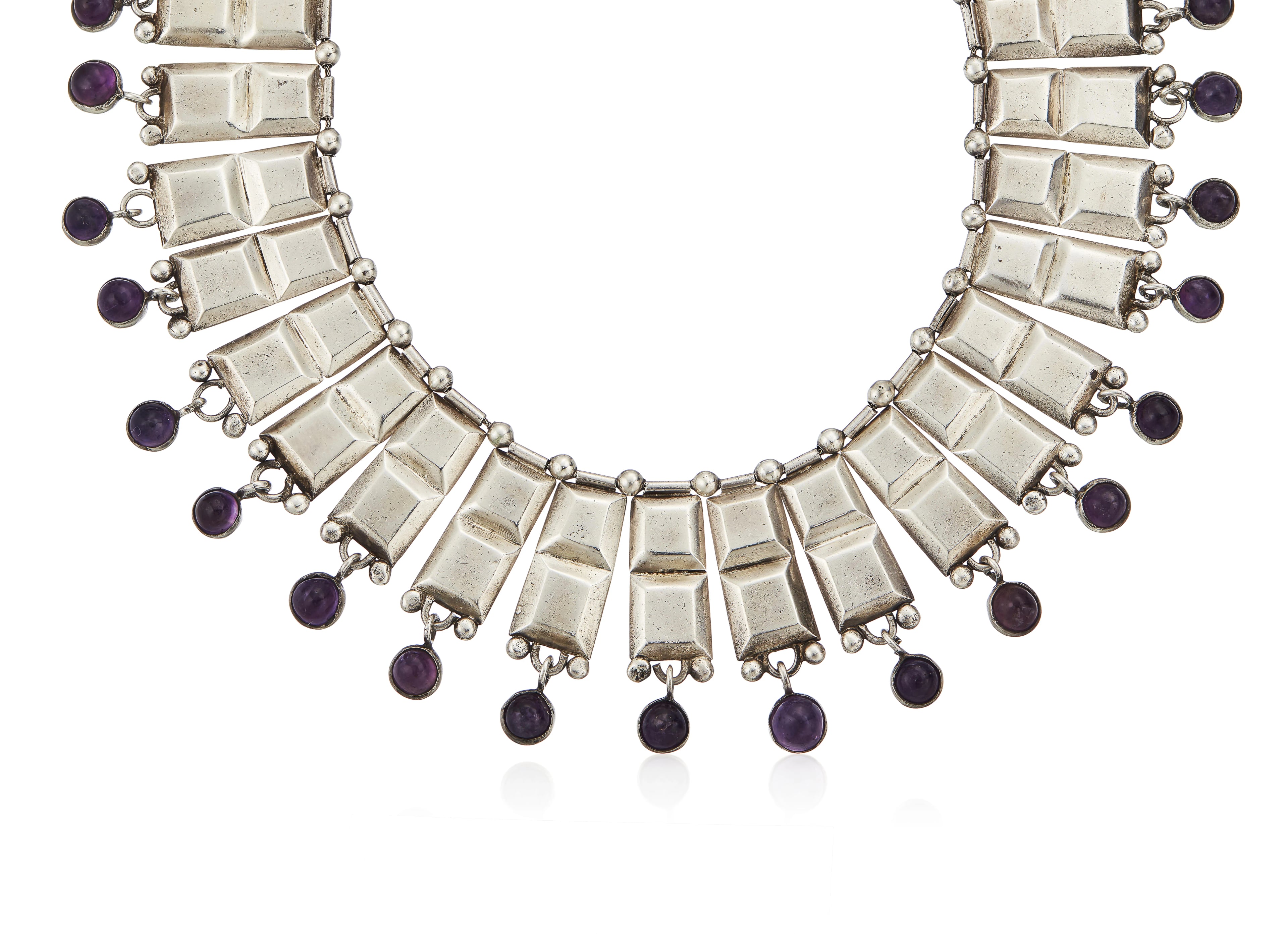
Kit Kat Amethyst Necklace
Silver