Saves instantly, no account needed. Already a member? Sign in.
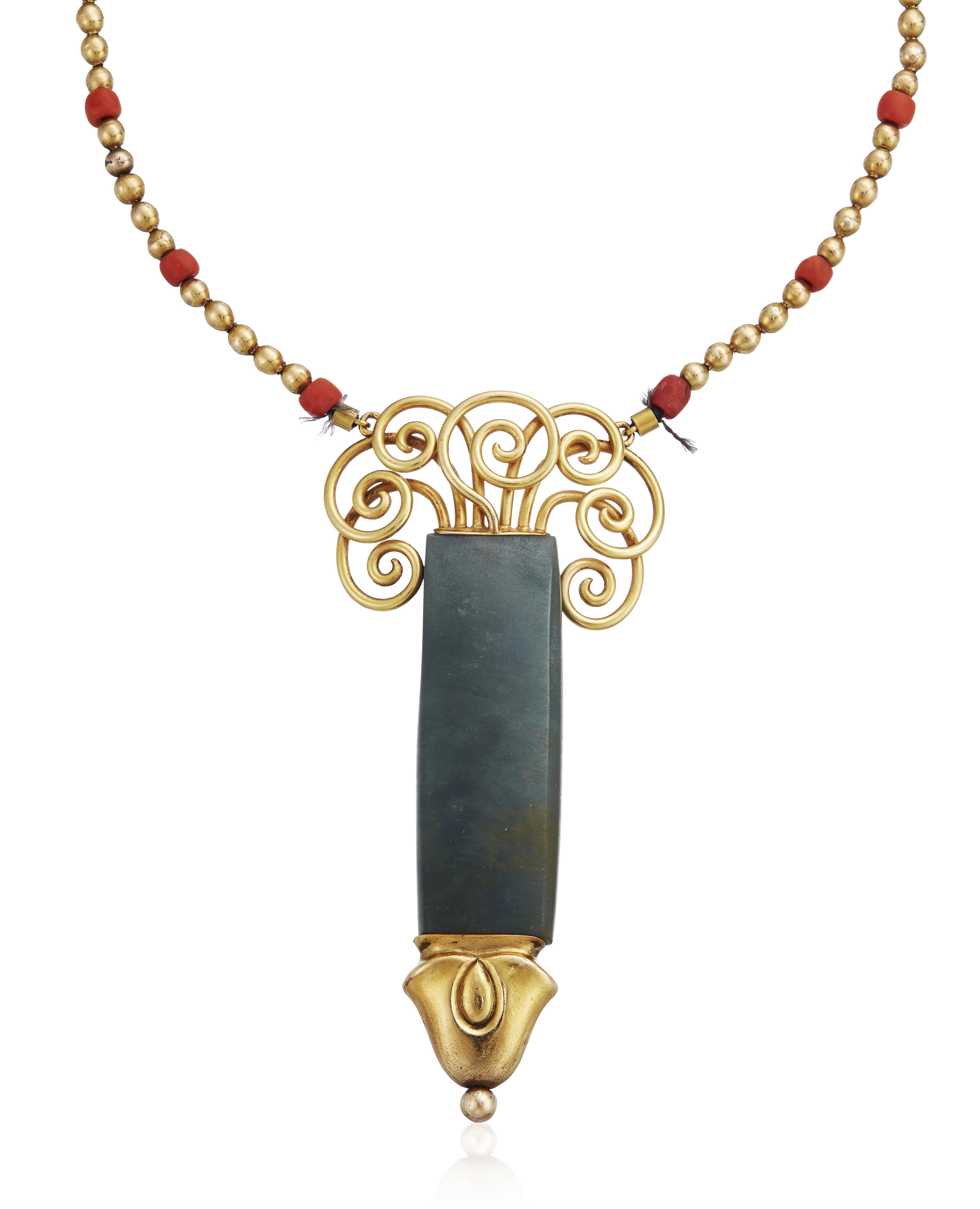
A columnar jade set in 18-karat gold, this necklace belongs to the last and rarest chapter of William Spratling's work: the gold jewelry he produced in the 1960s, almost all of it one of a kind, each piece marked only with a small WS beneath 18K. He had spent three decades reviving silver in Taxco, and only at the very end of his life turned to gold as the setting for the Pre-Columbian stones he had collected for decades. He was killed in an automobile accident outside Taxco in August 1967, which makes the gold output a narrow window of a few years and this necklace a survivor from it.
The design reads the way Spratling's late work tends to read, as a frank conversation with the ancient material at its center. The smooth columnar jade is given almost no ornament of its own; the goldsmith's invention is concentrated above it, in a crown of scrolled gold volutes that gathers the stone to the chain, and below it, in a tapered gold cap that resolves in a teardrop and a single gold bead drop. The effect is to frame the jade rather than to compete with it, the gold acting as mount and pedestal so that the stone keeps its presence. The necklace itself alternates gold beads with coral, the warm coral playing against the cooler green of the column and the yellow of the gold.
This vocabulary did not come from nowhere. Spratling's lifelong absorption in Pre-Columbian art is well documented. Penny Morrill records his fascination with the Remojadas sculptors of southern Veracruz, whose work he admired for its purity of inspiration and expression, and which he himself gathered into the book More Human than Divine; she also notes that his Pre-Columbian collection was large enough that the ranch was placed under police guard to protect it after his death (Morrill and Berk, Mexican Silver, 1994, pp. 76-77). Gobi Stromberg places this within the broader current of "Mexican design," the neo-Pre-Columbian sensibility that fused indigenous form with a modern idiom and that, in her account, inspired Spratling and the Taxco school directly (Stromberg, Silver Seduction: The Art of Mexican Modernist Antonio Pineda, 2008, p. 69). A jade column carried in gold is that idea made wearable: the material and the columnar geometry nod to the ancient, while the scrolled gold and the coral-and-gold strand are unmistakably mid-century Taxco.
Because Spratling's gold pieces were made individually and only over the final years of his life, they are far fewer than his silver, and examples pairing carved jade with gold and coral are scarce. For a maker whose name is synonymous with Mexican silver, a fully realized gold necklace of this kind sits at the uncommon end of his catalogue, a small late body of work in which he set the stones he had loved longest in the most precious metal he ever used.
Museum of Mexican Silver. “Jade and Coral Pendant Necklace.” Catalog no. MoMS-002090. https://museumofmexicansilver.com/pieces/william-spratling-jade-and-coral-pendant-necklace
See something wrong with this record? Suggest a correction and the piece details fill in automatically.
William Spratling
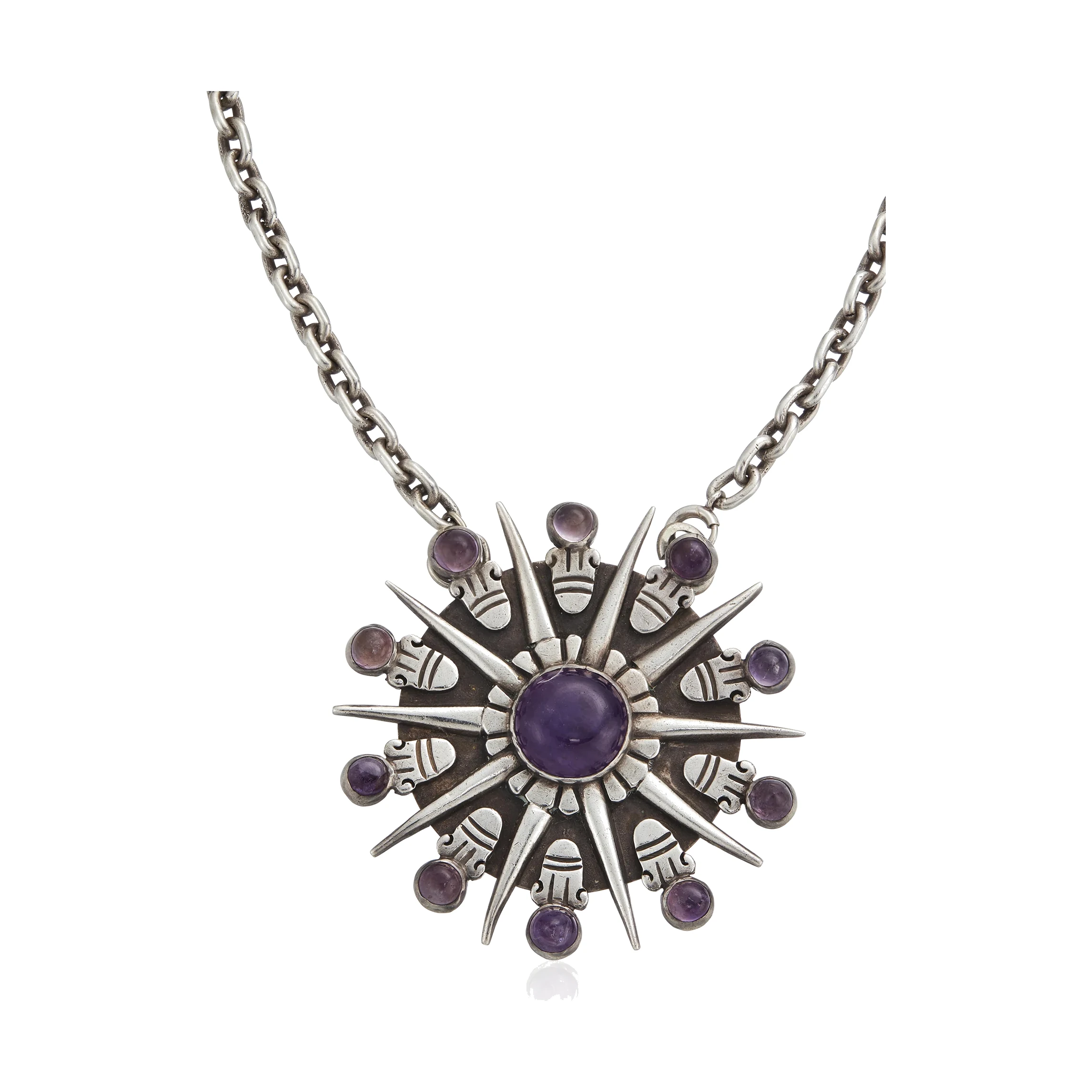
Sunburst Amethyst Pendant Necklace
Silver