Saves instantly, no account needed. Already a member? Sign in.
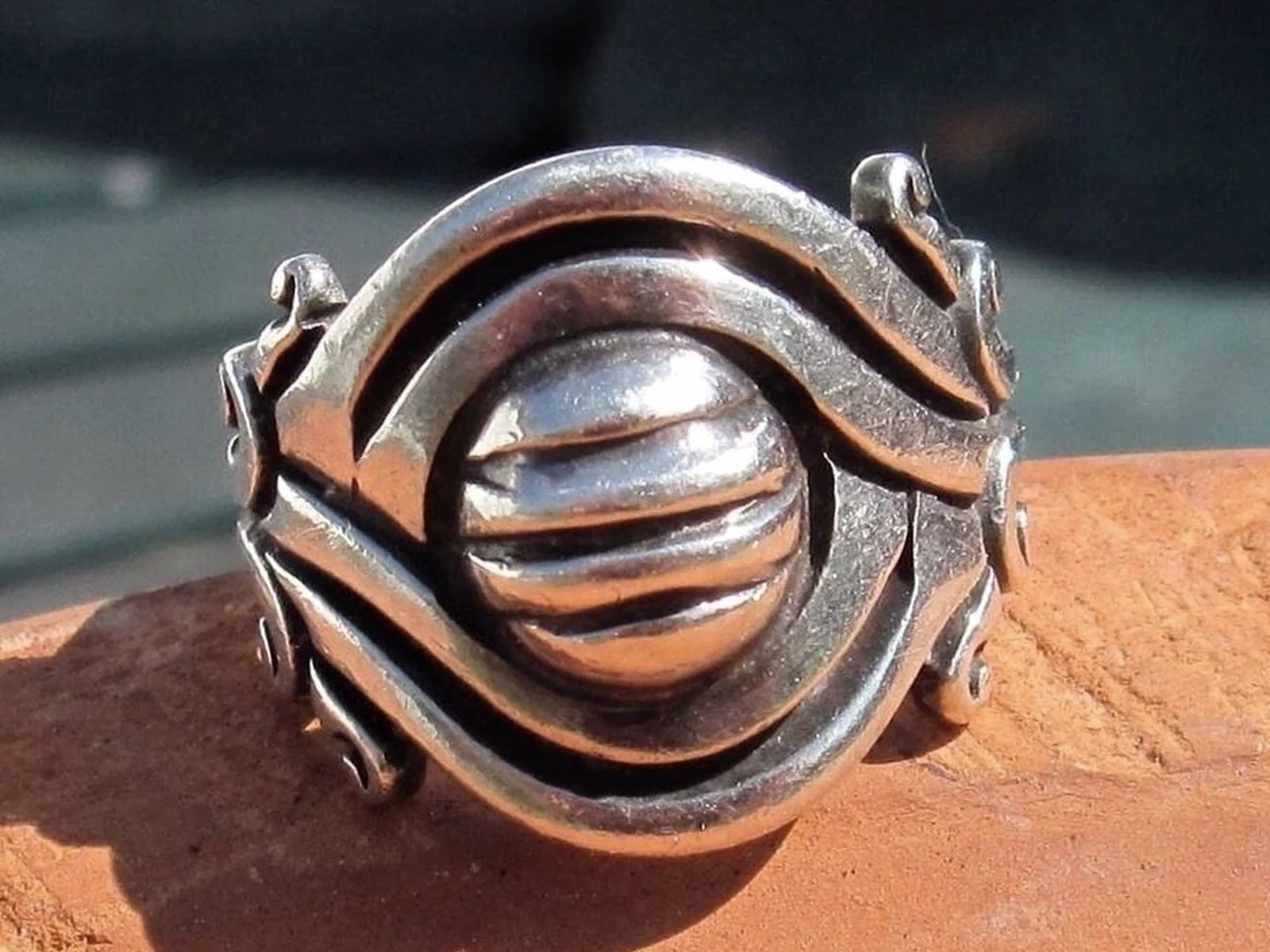
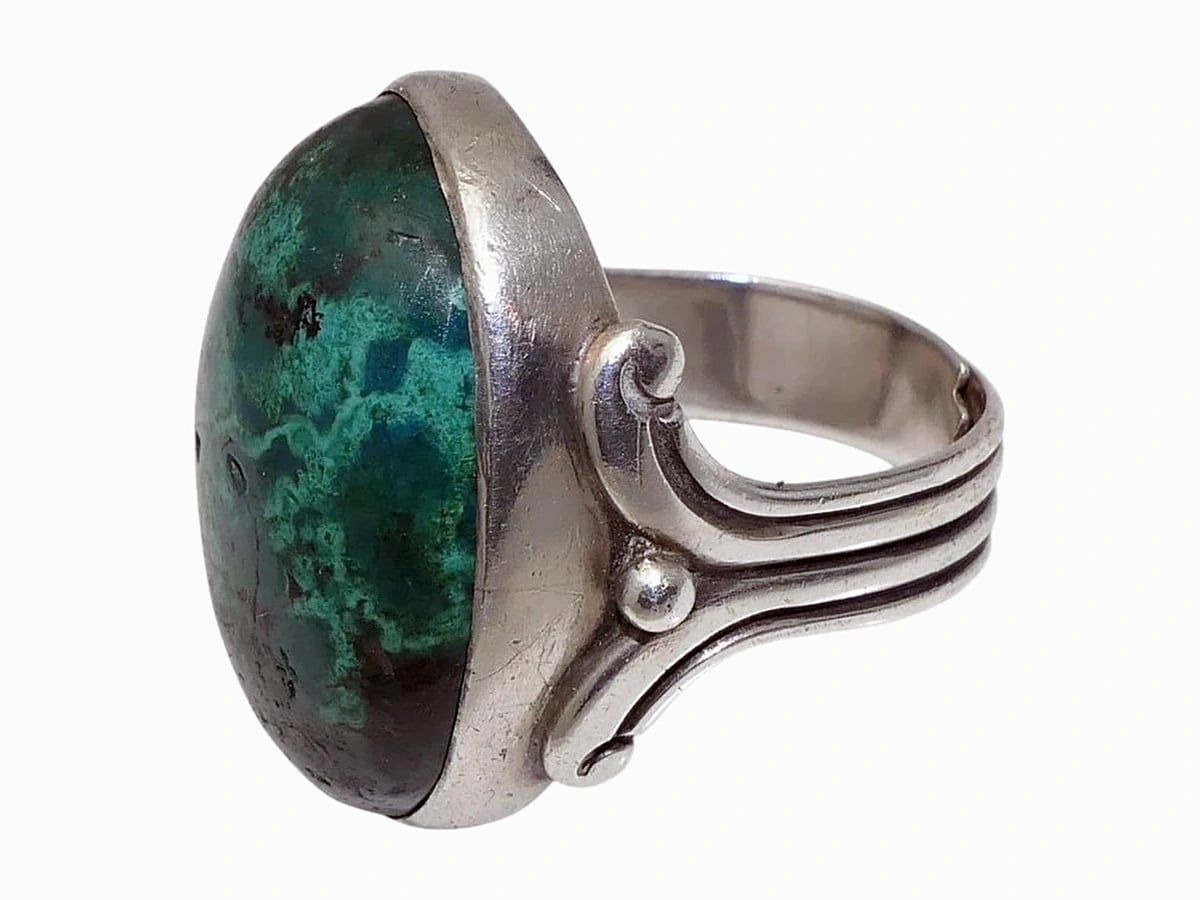
A high-domed oval chrysocolla gives this late Taller Borda ring its force: a saturated blue-green stone set in a broad, plain silver bezel, lifted above an open adjustable shank of three parallel ridges. The shoulders curl into volutes that meet the bezel with small raised bead terminals, a compact ornamental vocabulary that lets the stone carry the drama while the silver supplies weight, rhythm, and architectural support. The visible .940 HA Taxco mark with eagle assay 9 places the ring within Aguilar's documented postwar mark group, consistent with the 1955 to 1962 date supplied for the piece.
The design is characteristically Aguilar in its restraint. Morrill and Berk describe Héctor Aguilar's jewelry as drawing primarily on Aztec and Mixtec art and architecture, with the Pre-Columbian source serving as a point of departure rather than a literal copy, and they emphasize the strength and simplicity of his mature style. Here that language is compressed into a ring: the split shank reads almost as bundled silver architecture, the scroll shoulders soften the geometry without becoming decorative excess, and the bead terminals provide precise punctuation at the transition from band to bezel.
The ring's scale matters. At 19.1 grams, with a chrysocolla stone measuring about 1 1/4 by 7/8 inches and rising about 7/16 inch, it has more physical authority than most rings can carry. The adjustable size 10 shank is not incidental hardware, but part of the design, built as structure, rhythm, and side profile. The natural pitting in the chrysocolla and the patina of the silver reinforce the object as a vintage, worn, and preserved piece rather than a studio abstraction.
Museum Significance
This ring is important because it shows Aguilar's monumental design language at the intimate scale of the hand. Taller Borda is often remembered through large bracelets, necklaces, flatware, holloware, and sculptural silver, but this piece demonstrates the same intelligence in miniature: natural stone treated as architecture, silver worked as muscular structure, and ornament disciplined into volute, bead, and ridge. For the Museum of Mexican Silver, it is a concise late example of Aguilar's mature Taxco vocabulary, anchored by the HA Taxco and eagle 9 marks and animated by one of the workshop's most recognizable formal devices.
Fine vintage condition; natural chrysocolla has minor pitting; silver has patina.
Museum of Mexican Silver. “Chrysocolla Cabochon Ring.” Catalog no. MoMS-002053. https://museumofmexicansilver.com/pieces/hector-aguilar-malachite-ring
See something wrong with this record? Suggest a correction and the piece details fill in automatically.
Héctor Aguilar
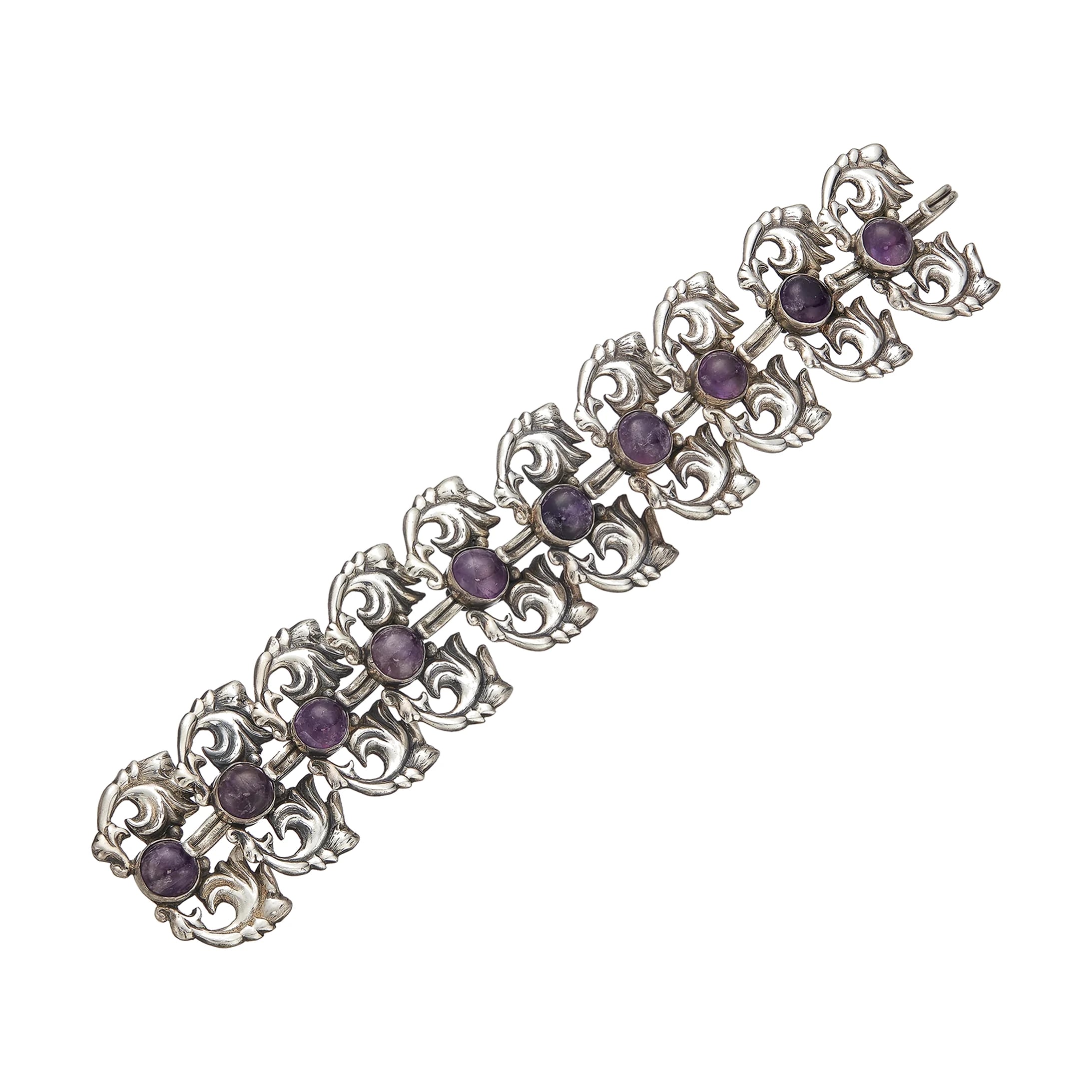
Openwork Amethyst and Silver Bracelet
Silver