Saves instantly, no account needed. Already a member? Sign in.
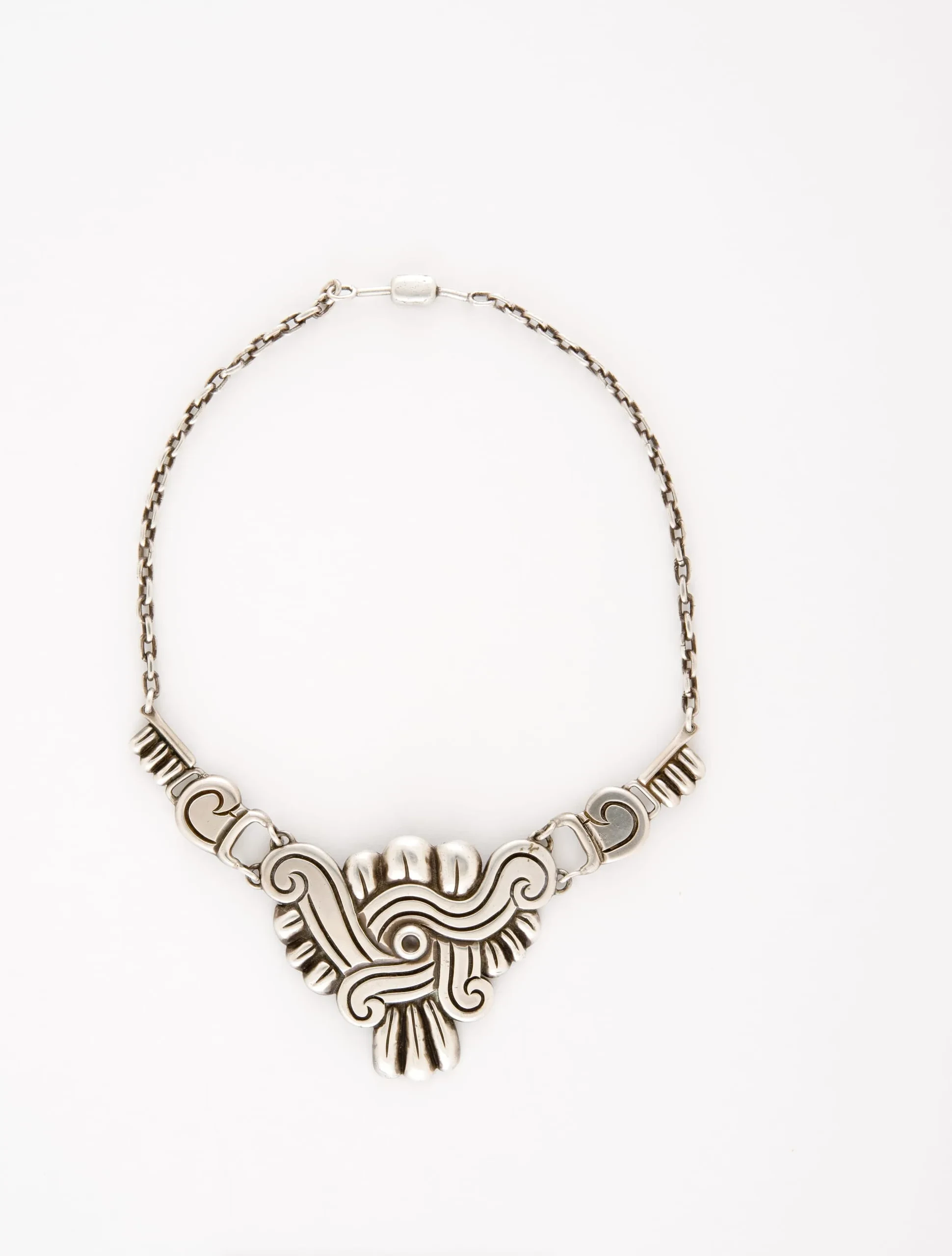
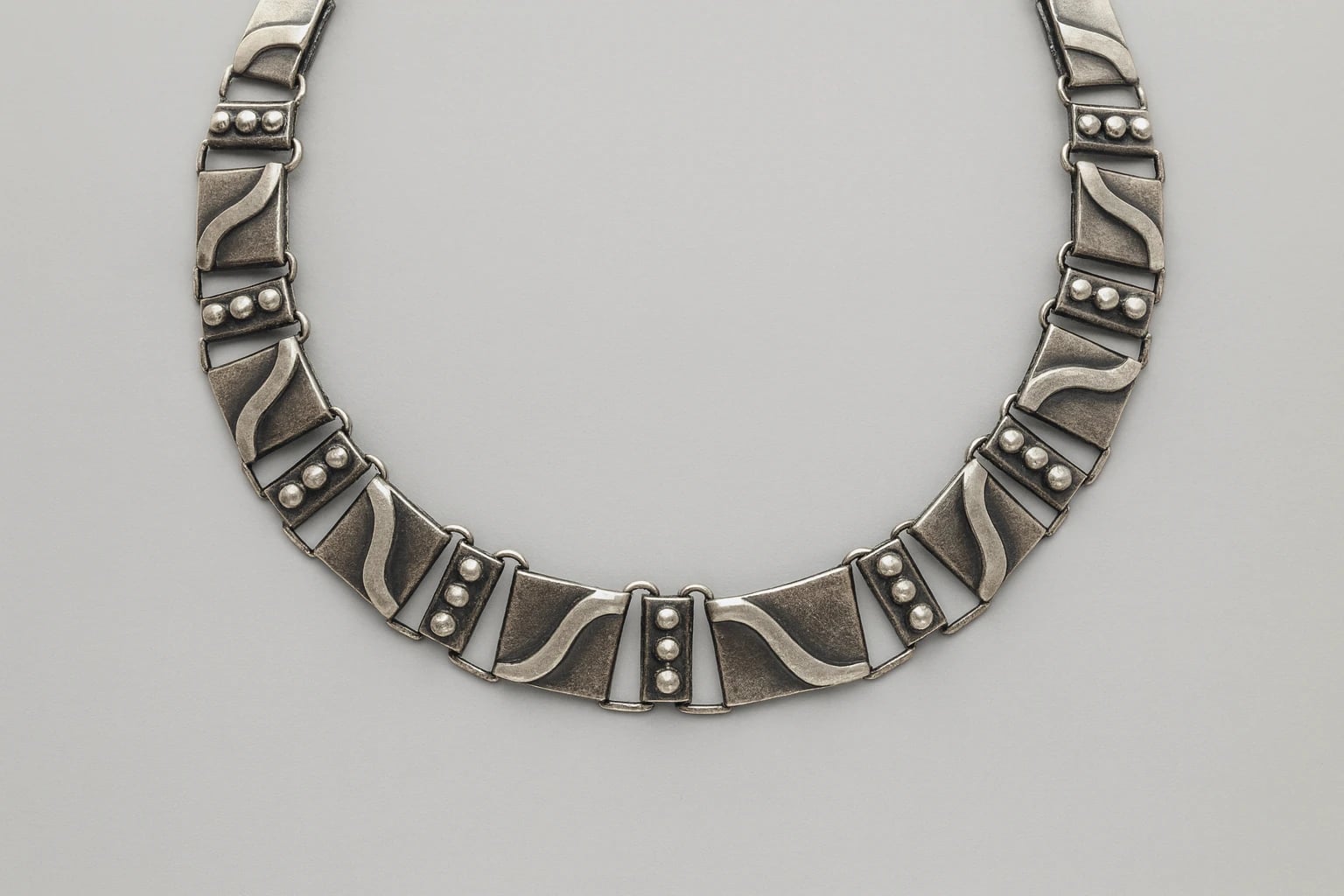
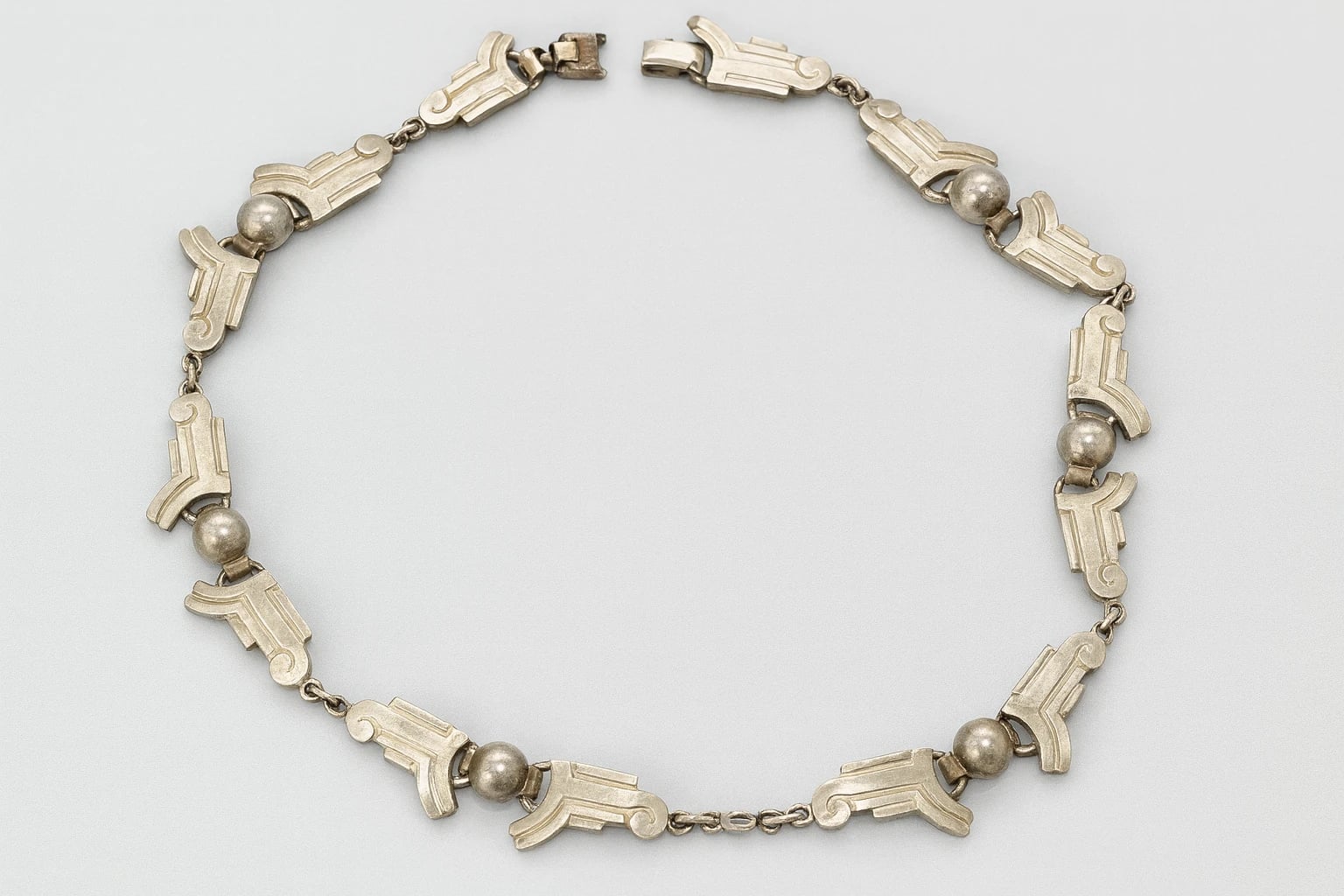
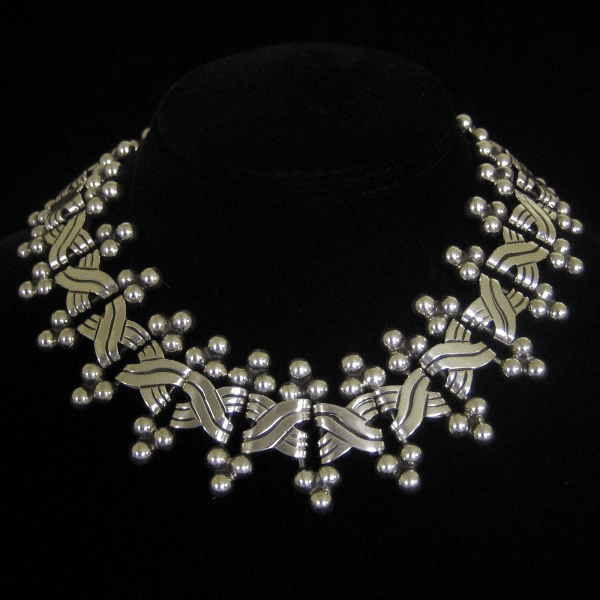
Among the necklaces Héctor Aguilar produced at the Taller Borda, the Six Spheres is one of the most fully resolved statements of his architectural instinct. Aguilar came to silver not as a trained metalsmith but as a designer and manager, and the strength of his best work lies in structure rather than ornament. Here that structure is total. The collar is built from a repeating unit in which a flat plaque, engraved with a low relief of interlaced waves and a small cross at its center, is flanked by tight clusters of polished silver balls. Set edge to edge around the throat, the units read at once as a continuous band and as a sequence of discrete sculptural events, a rhythm of solid and void that holds the eye at every point along its length. The available evidence, drawn from Gallery 925's cataloguing, places the design in 1940 and cites its illustration in Penny Morrill's Silver Masters of Mexico, making it one of the better documented forms in the Aguilar corpus.
The engineering rewards close attention. Each plaque is engraved rather than pierced, so the wave motif is carried in shallow relief that catches light without weakening the metal, while the spheres are hollow and applied, giving the necklace visual mass without punishing weight. The photographs show the piece worn, and it sits as a collar that follows the curve of the neck rather than standing off from it. That wearability is not incidental. Aguilar's ambition was to make handwrought silver that functioned as modern jewelry rather than as costume or curiosity, and the balance struck here between sculptural presence and comfort on the body is precisely the quality that distinguishes his work from the more literal figuration common in Taxco. The clasp is stamped with the conjoined HA of the Taller Borda over MADE IN MEXICO and STERLING, the mark Morrill and Hougart both associate with the workshop's independent production.
What sets the Six Spheres apart from the rest of Aguilar's necklaces is its refusal of color and narrative. Many of the workshop's designs lean on gemstone cabochons or on recognizable motifs; this one relies entirely on the interplay of engraved plane and rounded volume in a single material. The result is severe and almost abstract, closer in spirit to the geometric discipline of International Modernism than to the folkloric register that the outside world often expected of Mexican silver. The interlaced wave engraving and the massed spheres give the piece a subtle pre-Columbian resonance, an echo of stepped and beaded stonework, without ever quoting an artifact directly. It is modern first, and Mexican in accent rather than in subject.
Museum of Mexican Silver. “Six Spheres Necklace.” Catalog no. MoMS-001947. https://museumofmexicansilver.com/pieces/aguilar-six-spheres-necklace-2
See something wrong with this record? Suggest a correction and the piece details fill in automatically.
The Taller Borda operated from 1939 until its closing in 1962, and across those years Aguilar's handwrought silver and copper, produced alongside a large volume of pressed work for firms such as Coro, established him as one of the central figures of the Taxco renaissance. Within that output the fully handwrought designs are the ones that carry his authorship most clearly, and the Six Spheres is among the strongest of them. Its documented date, its appearance in the standard Morrill monograph, and the coherence of the design itself all argue for its place in a serious collection. A necklace like this belongs in a museum because it demonstrates, in a single wearable object, how a Taxco workshop translated modernist principles of rhythm, repetition, and material honesty into jewelry that a person could actually wear, and it does so with a conviction that few of Aguilar's contemporaries matched.
Record data: the date of circa 1940 was stated only in the prose and is now entered in the Date field, with its basis named. The standard is entered as sterling silver, which is what the clasp mark records — conjoined HA over MADE IN MEXICO and STERLING — rather than the 940 alloy used on other Taller Borda work; that mark is described in the note and should be added to the structured Marks field once it has been photographed and matched to a guide entry. Place of manufacture is Taxco. Construction is recorded under Techniques.
Still outstanding: dimensions. Neither interior length nor plaque width has been measured, and neither can be taken from the images. The Morrill volume cited in the prose is now listed under References; the exact plate number should be added when it is checked against the book.
Héctor Aguilar
Necklace with Pre-Columbian Motifs
circa 1940
Silver