Saves instantly, no account needed. Already a member? Sign in.
To find Antonio Pineda working in gold is to catch him at his most uncommon. His reputation rests almost entirely on silver, and on a particular silver at that: the 970 fineness he stamped on his work as a mark of ambition, harder and brighter than ordinary sterling. A cuff executed in 14k yellow gold sits outside that body of work, a rare excursion into a costlier metal for a maker whose name is synonymous with the high-grade silver of Taxco. That alone places this piece among the scarcer things to carry his hallmark.
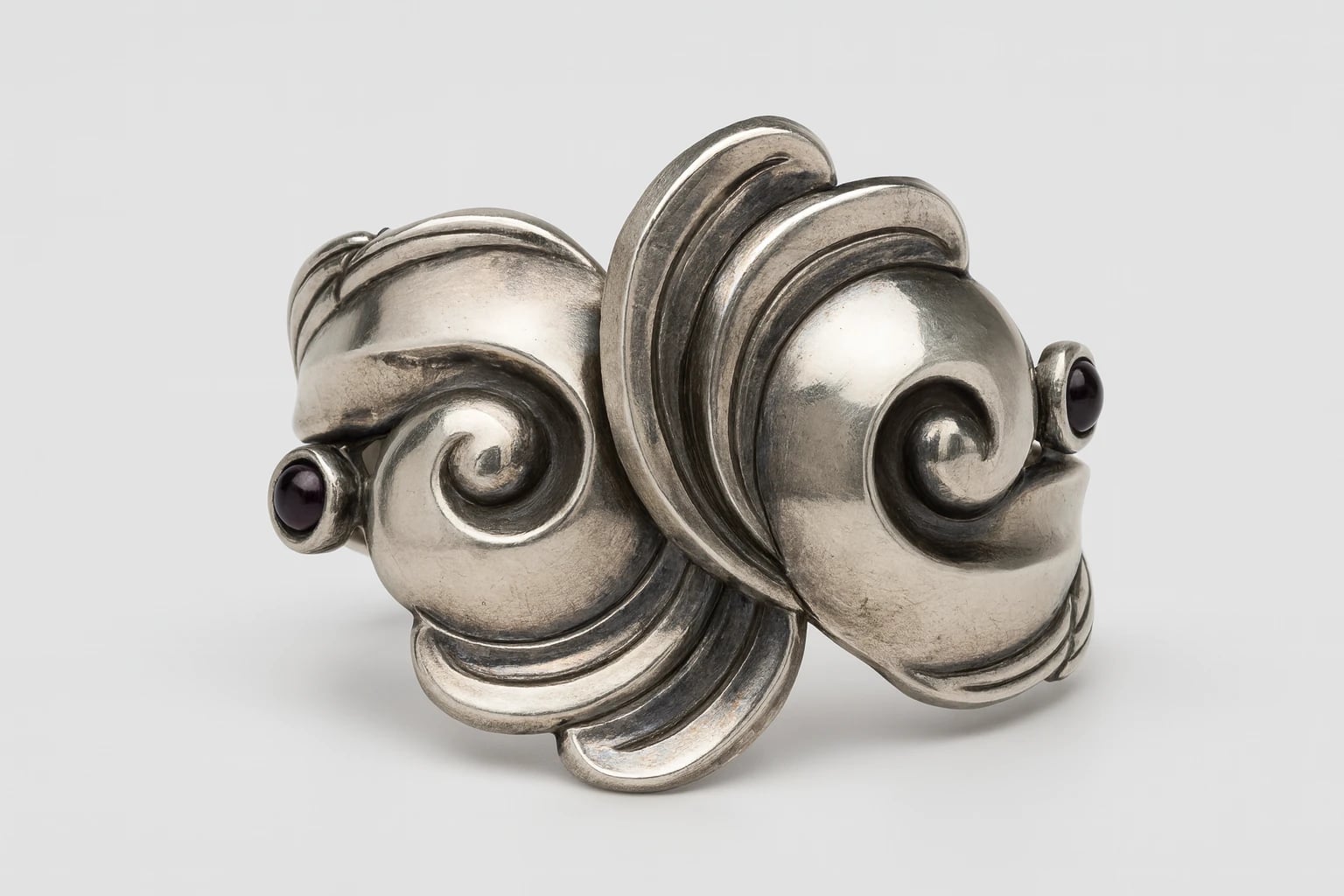
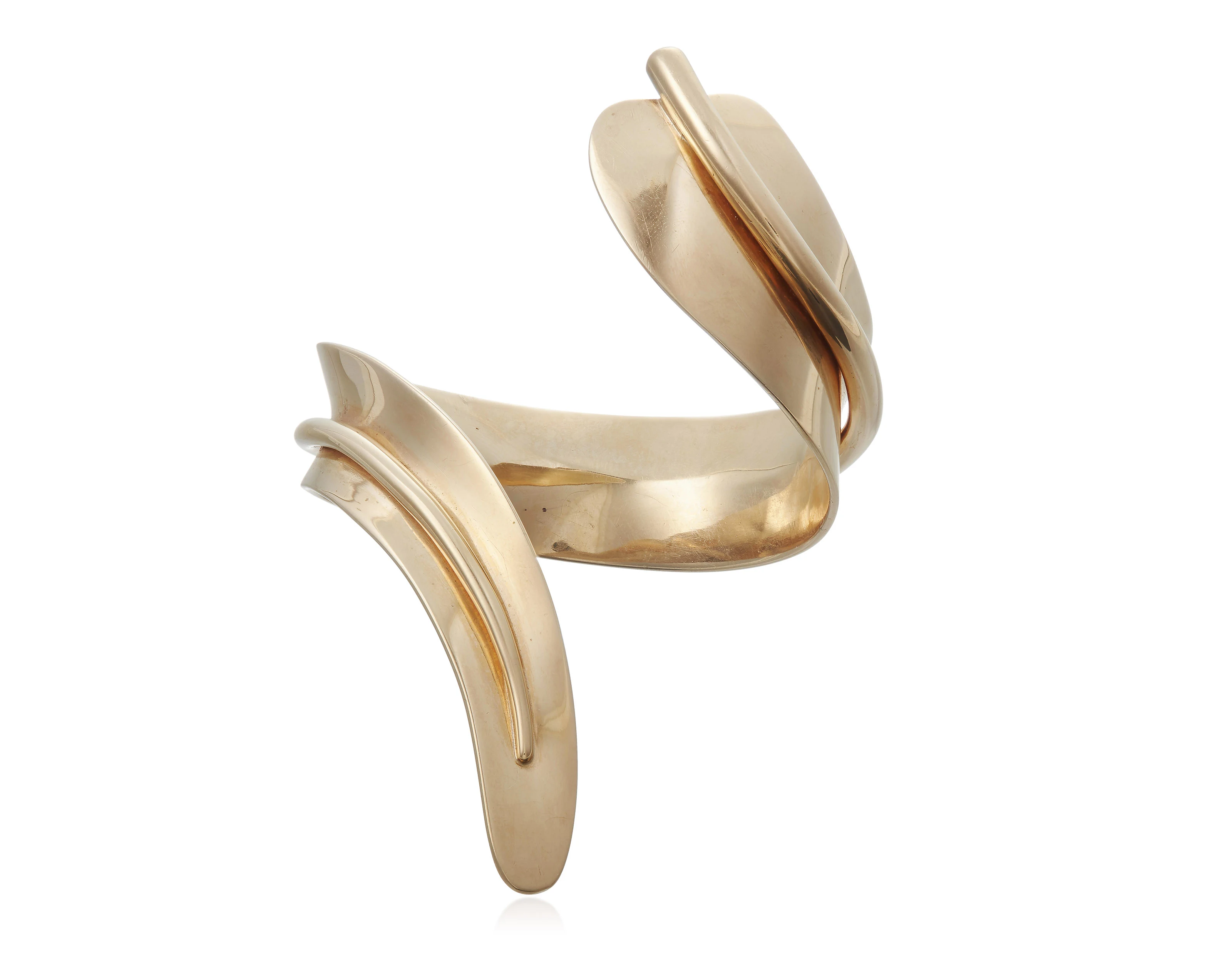
The design is pure sculpture worn on the wrist. Two tapering, twisted gold forms wrap past one another in a bypass construction, each ribbon swelling from a broad burnished plane to a slender pointed terminal, the polished gold catching light along every curve. There is no stone, no applied ornament, nothing to distract from the movement of the metal itself. The effect is exactly the vocabulary the literature attaches to Pineda: clean lines, generous scale, smooth contours, and the confident handling of solid form that made him, in Gobi Stromberg's account, a key figure in the pioneering vein of modern silver design forged in Taxco between the 1930s and 1970s (Stromberg, "Antonio Pineda," 2008, p. 15). What reads in his silver as architectural restraint becomes, in gold, something warmer and more sensuous.
The marks confirm the hand. The piece is signed "ANTONIO TAXCO" with the crown, the hallmark Stromberg documents as Pineda's own, the "Antonio-Taxco Crown" that anchored his maker's stamp throughout his career (Stromberg, "Antonio Pineda," 2008, p. 81). Here it appears alongside a 14K fineness mark rather than the 970 and eagle stamps that accompany the crown on his silver, the signature shifted to suit the gold. Pineda had begun his career as a silver designer in the Taller de las Delicias, the workshop that grew out of William Spratling's enterprise, before opening his own shop in 1941 (Morrill, "Silver Masters of Mexico: Héctor Aguilar and the Taller Borda," 1996, p. 178). By the time a cuff like this could be made, his taller was a substantial operation capable of the precise hollow construction and flawless finish his best work demands.
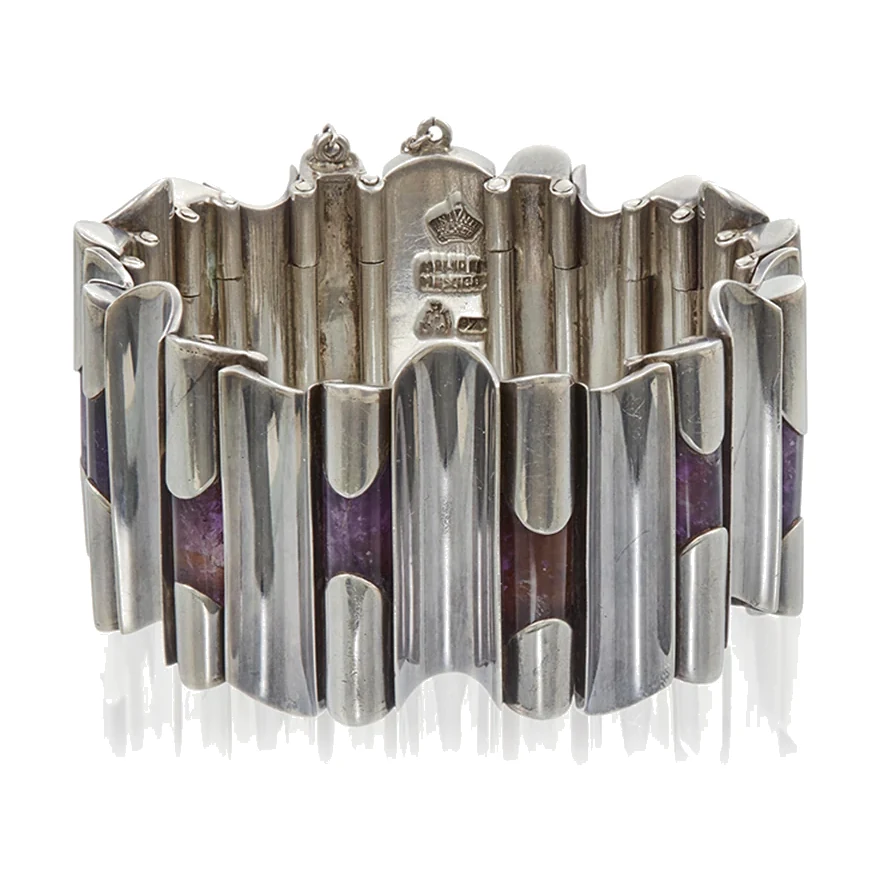
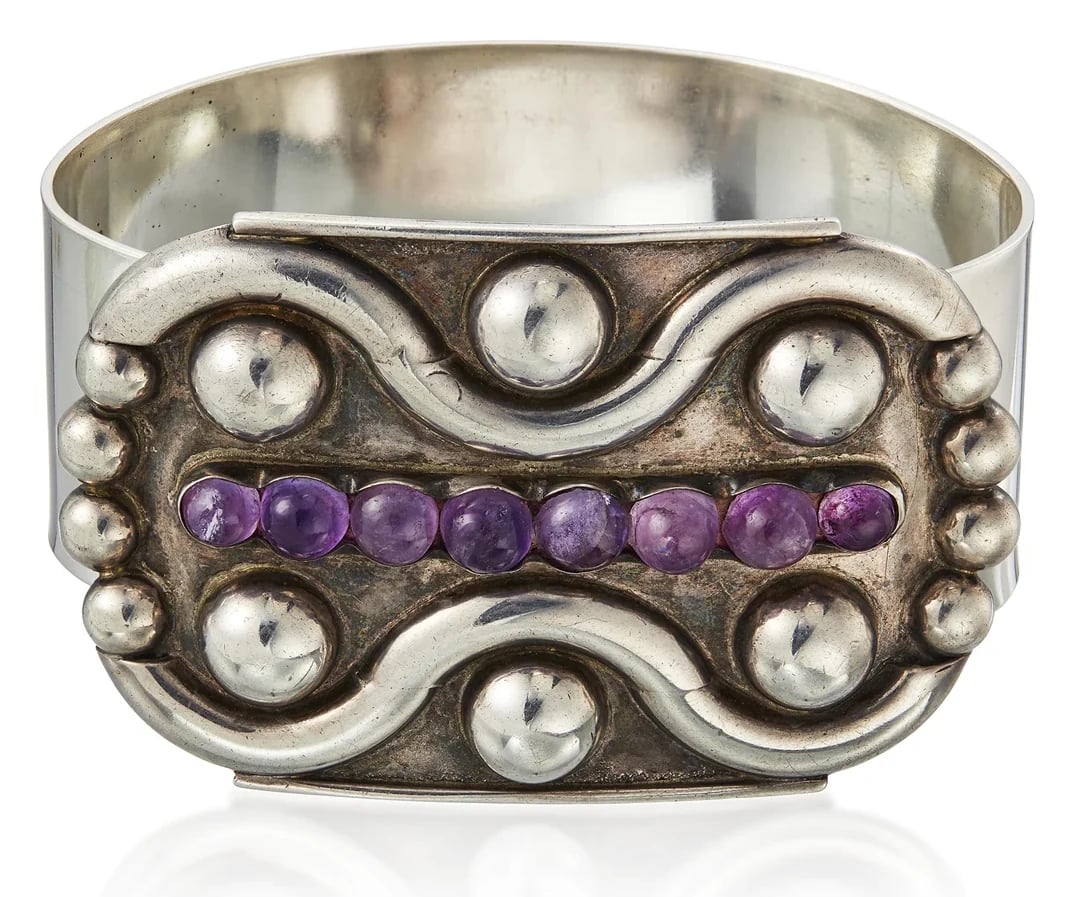
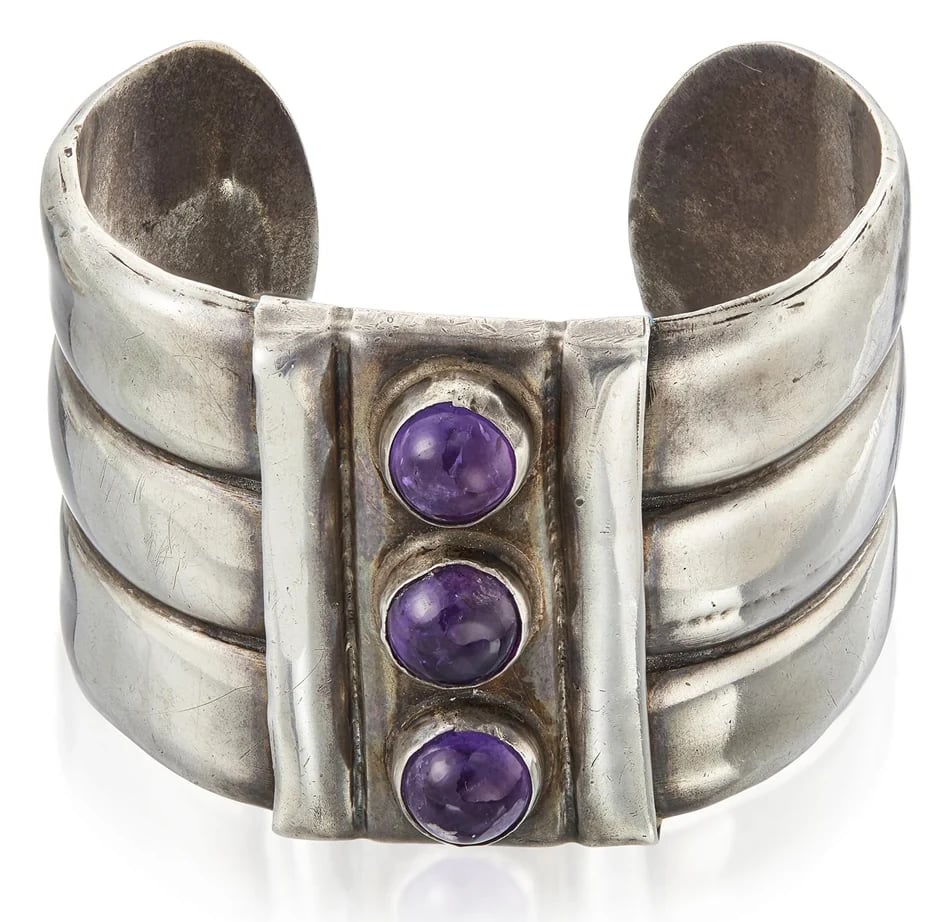
A gold cuff of this kind is the exception in a market that knows Pineda chiefly through amethyst-set silver suites and 970 bracelets. Its value lies in that rarity and in the quality of the design, a fully resolved sculptural statement that needs no gemstone to hold attention, and a reminder that the modernist confidence of Taxco could speak just as fluently in gold as in the silver that made its name.
Museum of Mexican Silver. “Wrapped Leaf Gold Cuff Bracelet.” Catalog no. MoMS-002093. https://museumofmexicansilver.com/pieces/antonio-pineda-gold-cuff-bracelet
See something wrong with this record? Suggest a correction and the piece details fill in automatically.
Antonio Pineda
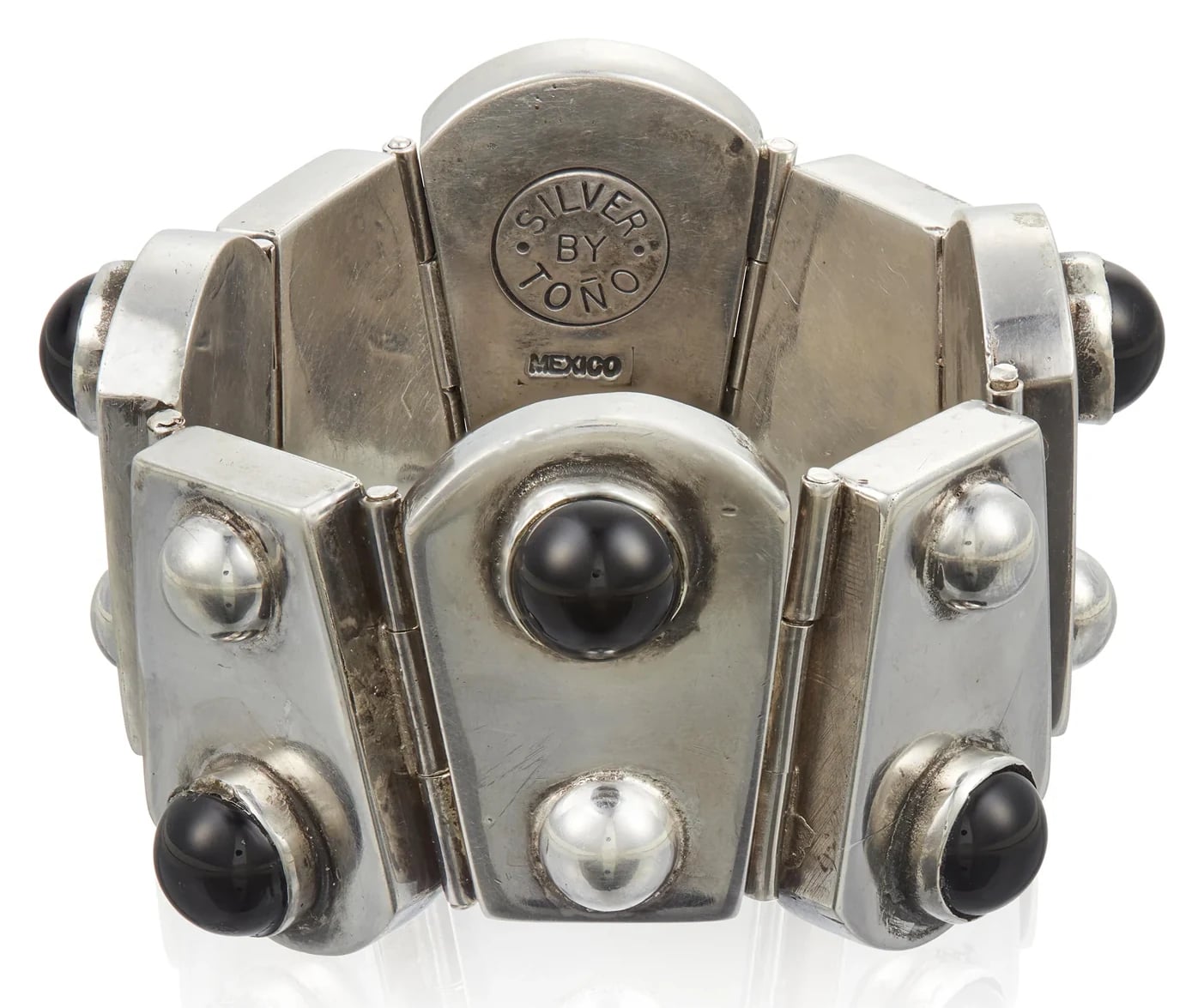
Onyx and Silver Link Bracelet
Silver