Saves instantly, no account needed. Already a member? Sign in.
A small silver fish carries a single turquoise cabochon along its body, and around that stone the surface breaks into the dense ornamental vocabulary that defines Matilde Poulat's work: coiled wire, tiny beaded clusters, and framing scrolls that fill the field rather than leave it plain. The pendant belongs to a design language Poulat built from Mexican colonial and popular sources, in which a piece of jewelry is treated as a surface to be embroidered in metal. The fish is a recurring motif in her repertoire, and here it functions as an armature for that ornamental density, with the turquoise reading as the one point of saturated color against the worked silver.
The construction depends on the relationship between the flat body of the fish and the raised elements applied across it. Poulat's characteristic method combined shaped silver with applied wirework and granulated or beaded accents, so that light catches the piece unevenly and the eye moves across a busy, tactile surface rather than a smooth one. Turquoise sits at the center of that composition as an opaque stone, chosen for its flat blue-green presence rather than for transparency or fire. That choice is consistent with Poulat's broader practice, which favored turquoise and coral, stones with a long history in Mexican devotional and folk ornament, set into silver that has been deliberately antiqued or oxidized in the recesses to deepen the sense of relief.
Matilde Poulat trained as a painter and designer at the San Carlos Academy before opening her shop in 1934, and she registered the name Matl, drawn from the Nahuatl word for water, as a trademark numbered 142093. Her position within the Mexican silver renaissance is distinct from the Taxco workshops. Working in Mexico City rather than Taxco, she developed a folk-inflected, densely ornamented style with little relationship to the geometric modernism of Spratling or Antonio Pineda. Her marks record this history: early stamps read MATL with fineness figures and Hecho en Mexico DF, while the registration number 142093 appears on pieces from roughly 1950 onward. After her death in 1960, her nephew Ricardo Salas continued the Matl designs, and pieces bearing the Matl mark together with MS-12 date to his later production. Attribution of any individual fish pendant therefore depends on which mark it carries, since the design vocabulary persisted across two hands and several decades.
As a museum object, the fish pendant documents an alternative current within twentieth-century Mexican silver, one rooted in colonial and popular ornament rather than in international modernist geometry. It shows how a painter's sensibility translated into metal, treating the small surface of a pendant as a composition to be filled and colored. For a collection built around the range of the silver renaissance, the piece marks the boundary where the movement drew on devotional and folk-art traditions instead of the abstraction associated with Taxco, and it preserves the specific ornamental signature that made Matl jewelry recognizable well beyond Poulat's own lifetime.
Museum of Mexican Silver. “Fish Pendant with Turquoise.” Catalog no. MoMS-002264. https://museumofmexicansilver.com/pieces/matl-fish-pendant-with-turquoise
See something wrong with this record? Suggest a correction and the piece details fill in automatically.
MATL (Matilde Poulat)
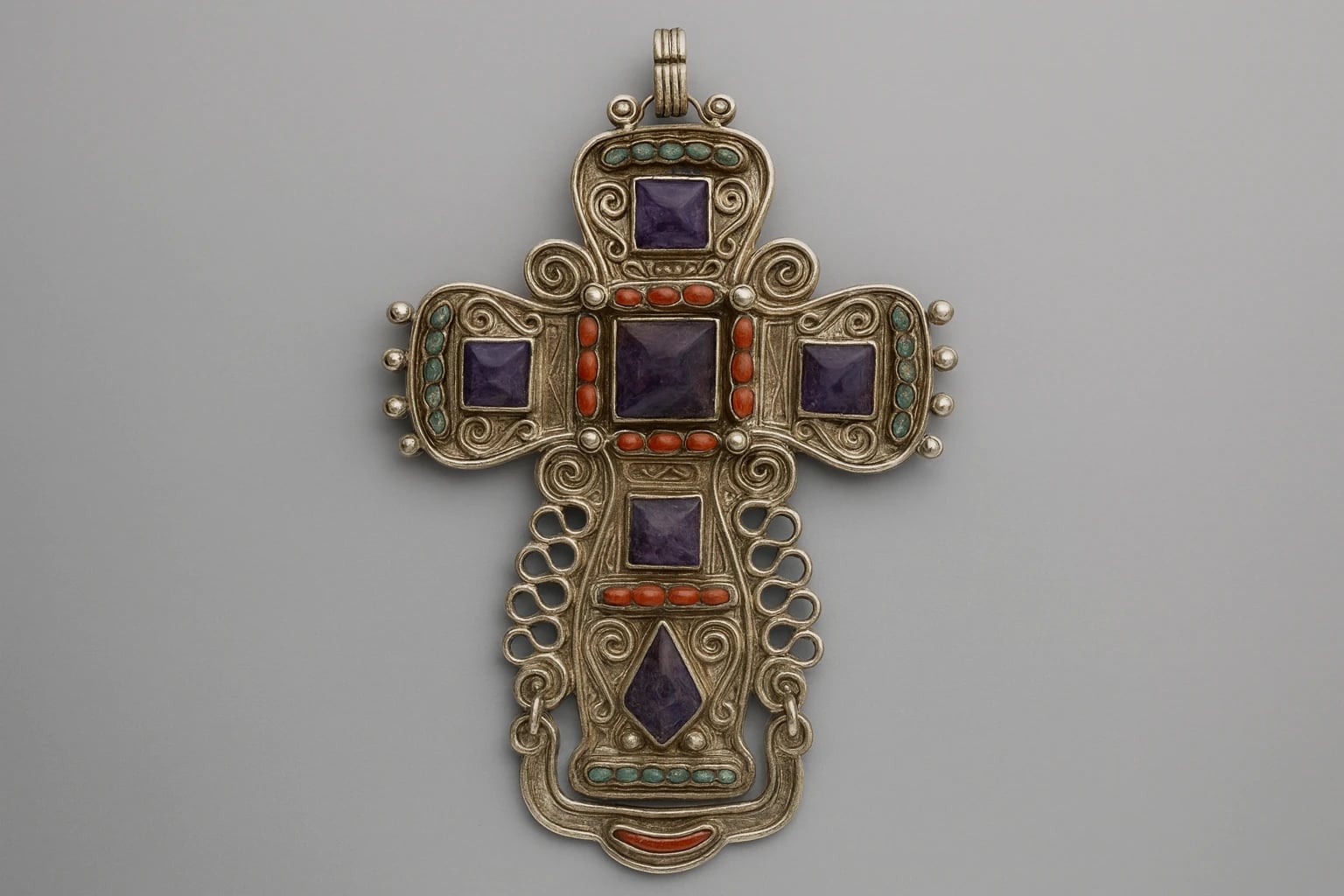
Cross Pendant with Amethyst, Coral, and Turquoise
1934 or later
Silver