Saves instantly, no account needed. Already a member? Sign in.
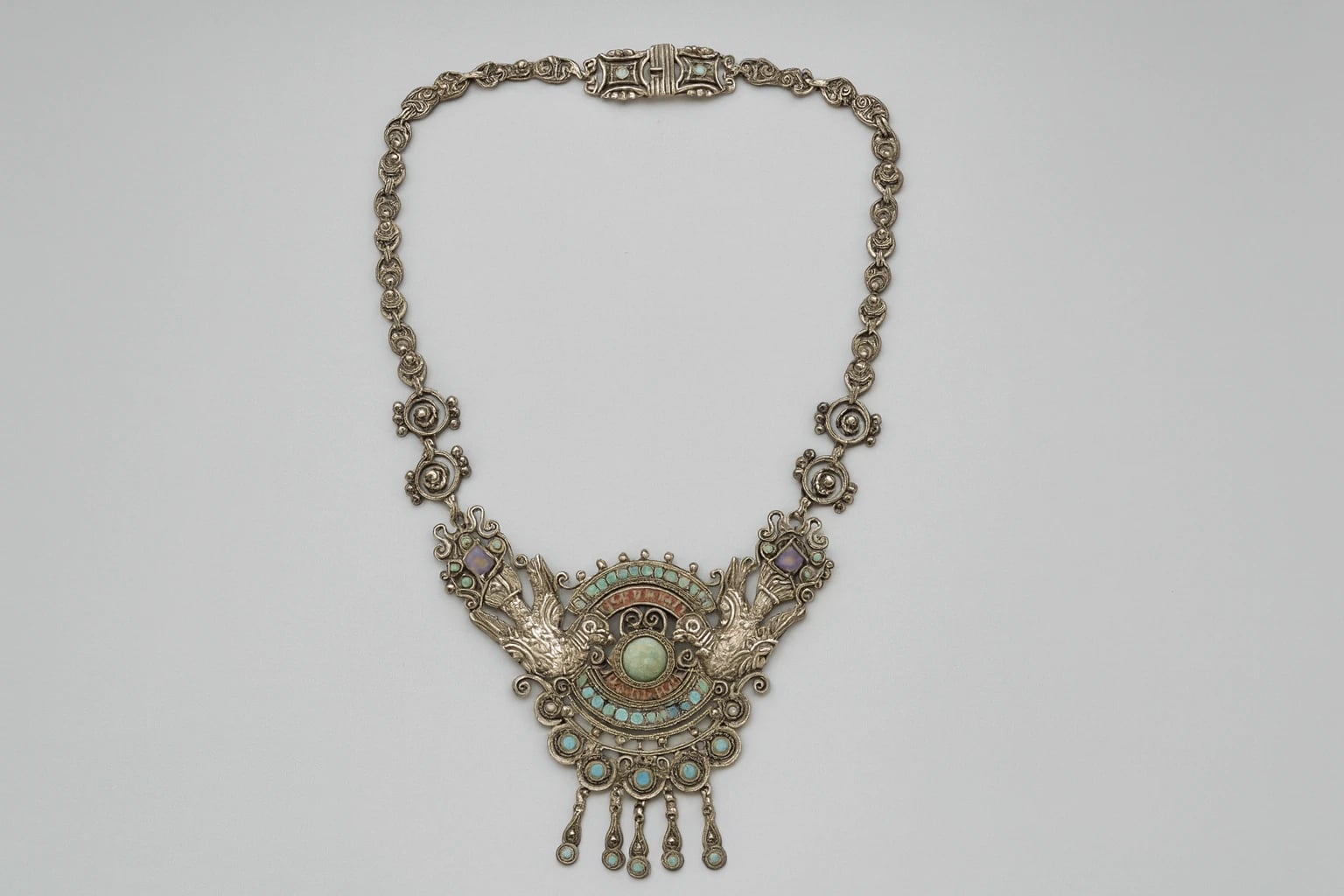
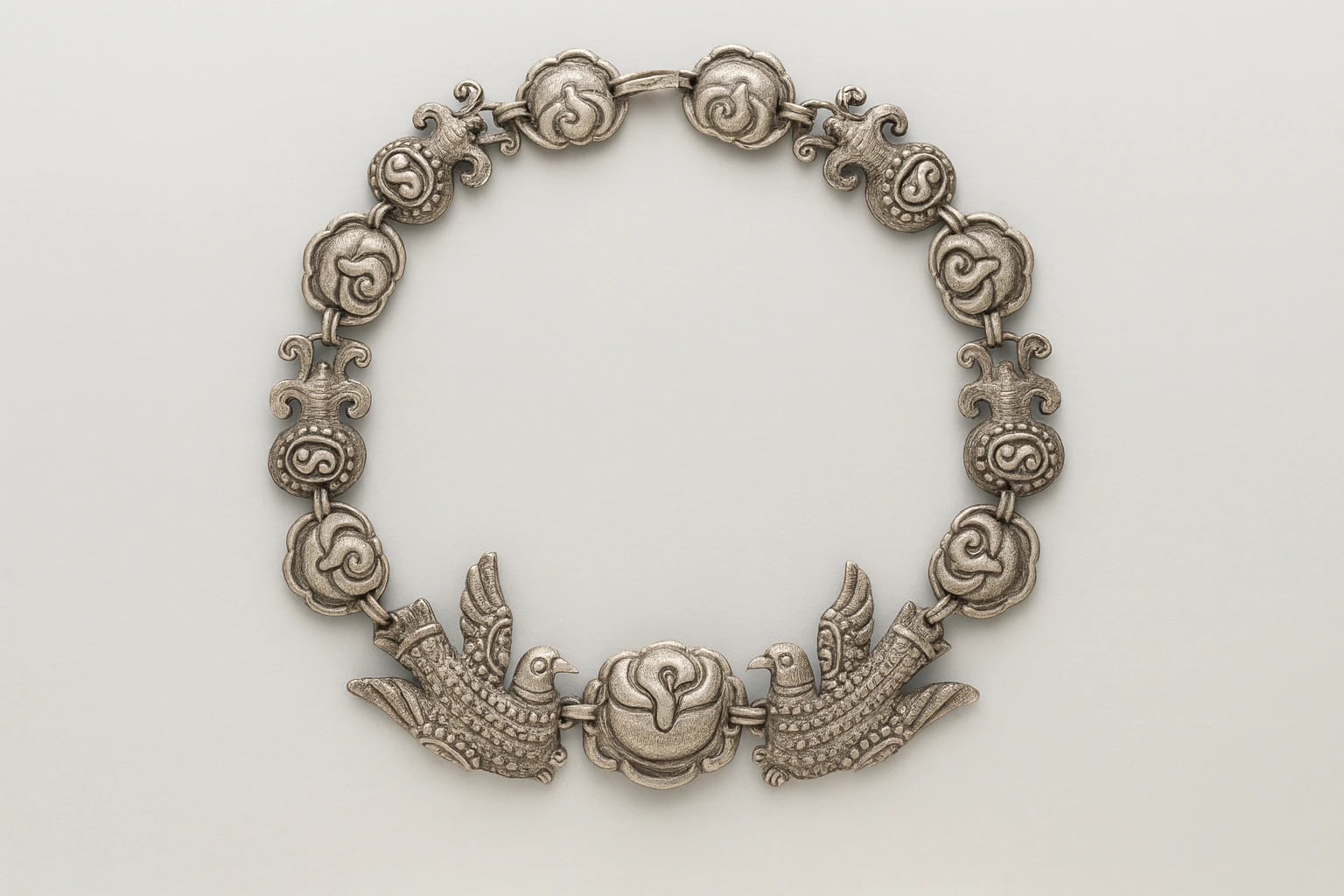
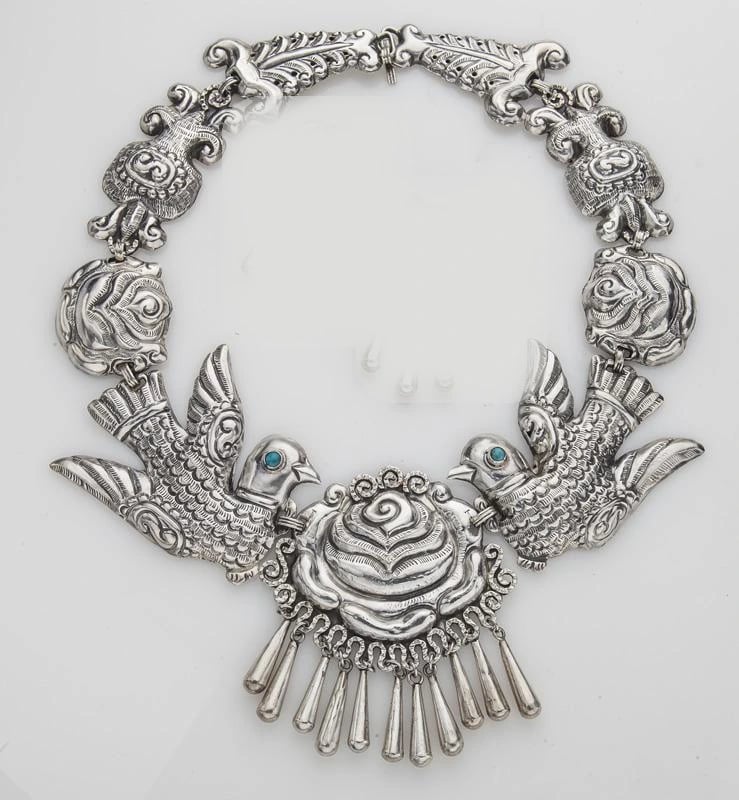
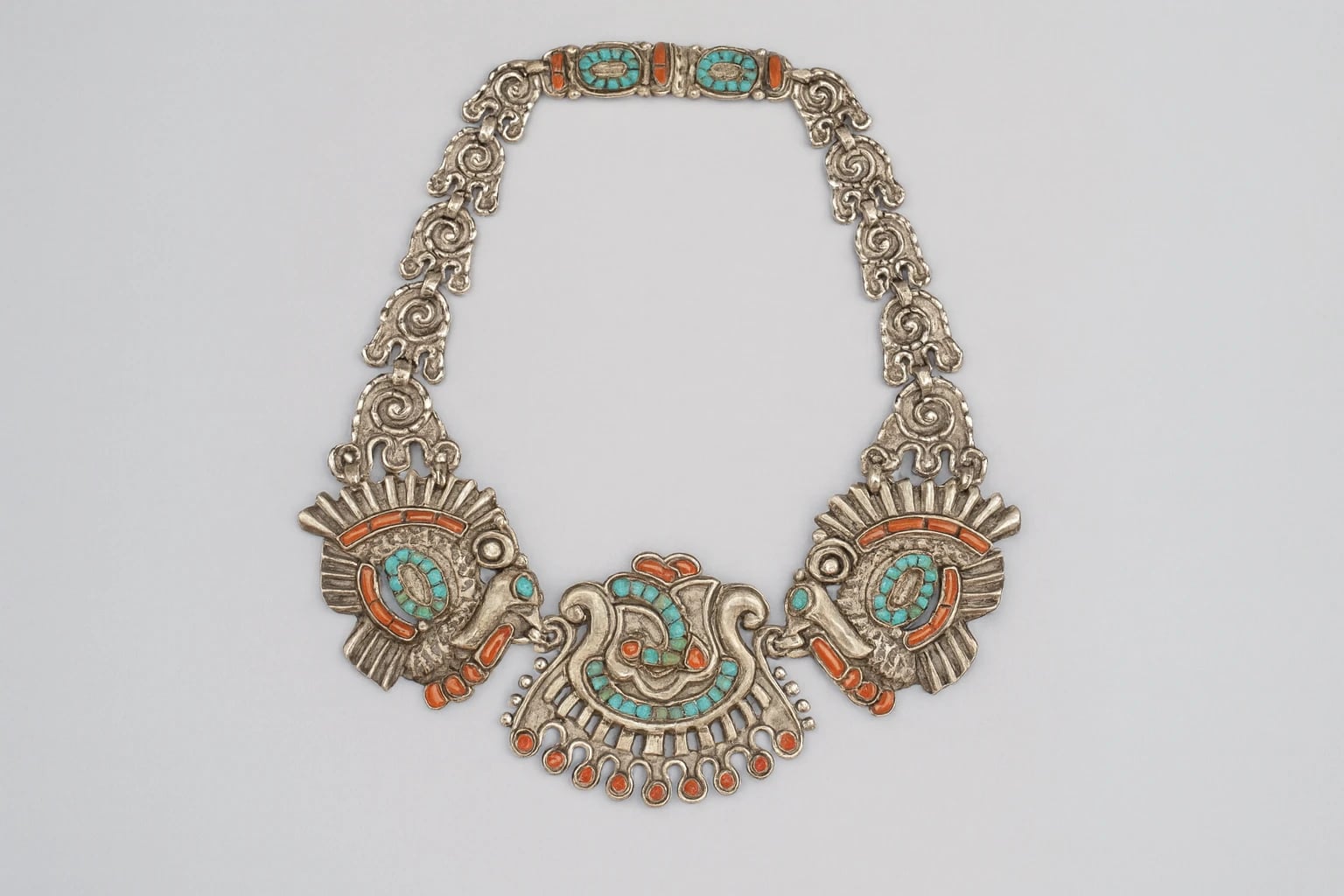
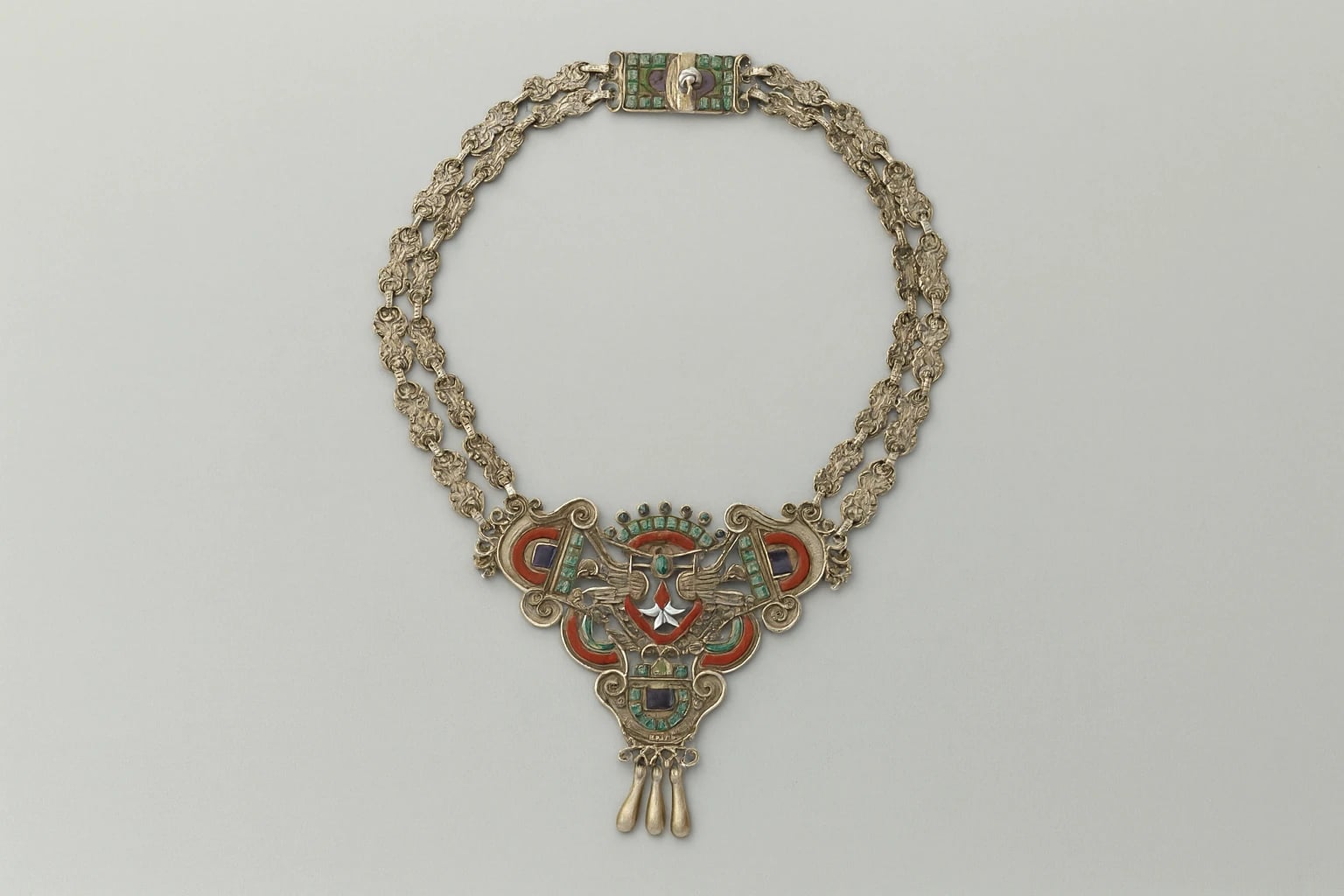
A pair of doves meets at a central rose, and the whole ornament fills with turquoise and coral set close against silver. This is the visual signature of MATL, the workshop Matilde Poulat built in Mexico City, and the dove and rose motif is among the most recognizable inventions of the Mexican silver renaissance. Where much Taxco work of the 1930s and 1940s pursued austere geometry, this necklace pursues density: silver scrollwork, beaded wire, and small stones packed until the metal reads as a garden rather than a grid. The pendant organizes its abundance around symmetry, two birds flanking a bloom, so that ornamental profusion never becomes disorder.
The construction depends on the interplay of worked silver and colored stone. Turquoise, opaque and cool, and coral, warm and equally opaque, are chosen for color rather than transparency, and they are bezel set among curling silver tendrils and applied granulation. The silver itself does the drawing: outlined feathers, a rounded rose at the center, and repeated scrolls that frame each stone. Poulat trained as a painter and designer at the San Carlos Academy before opening her shop in 1934, and that background is legible in the way the composition is built like a picture, with a clear center, balanced flanking forms, and a border that contains the field. The pendant hangs from a chain that carries the eye down to the heaviest concentration of ornament, placing the doves at the resting point on the chest.
MATL designs draw openly on Mexican colonial and popular sources rather than on European modernist reduction. The dove, the rose, the flowering scroll, and the small bright stones belong to the vocabulary of retablos, folk ornament, and church silver, recast at the scale of personal jewelry. Poulat registered the trademark Matl, a form of the Nahuatl word for water, as number 142093, and her marks range from an early block-letter MATL over a fineness figure to later script and etched-script stamps used through the 1930s and 1940s. After her death in 1960, her nephew Ricardo Salas continued the designs, at times supervising several dozen silversmiths, and later Salas-period pieces carry the Matl mark together with MS-12. Dating any single example therefore depends on reading the specific mark, since the design was conceived early and produced across decades by more than one hand.
Within a movement often defined by the pared geometry of Spratling and his circle, MATL represents the decorative, color-driven current of the same renaissance, one rooted in Mexican devotional and folk imagery rather than in imported abstraction. The dove and rose pendant is the clearest statement of that alternative, and it shows how postrevolutionary Mexican design could look to its own religious and popular past for a modern idiom. Held in a collection, such a necklace clarifies that the Taxco School and its Mexico City counterparts pursued more than one language at once, and that ornament packed with local color was a deliberate artistic position, not a failure of restraint.
Museum of Mexican Silver. “Dove and Rose Pendant Necklace with Turquoise and Coral.” Catalog no. MoMS-002214. https://museumofmexicansilver.com/pieces/matl-dove-and-rose-pendant-necklace-with-turquoise-and-coral
See something wrong with this record? Suggest a correction and the piece details fill in automatically.
MATL (Matilde Poulat)
Perched-Dove Pendant Necklace with Turquoise and Coral
1934 or later
Silver