Saves instantly, no account needed. Already a member? Sign in.
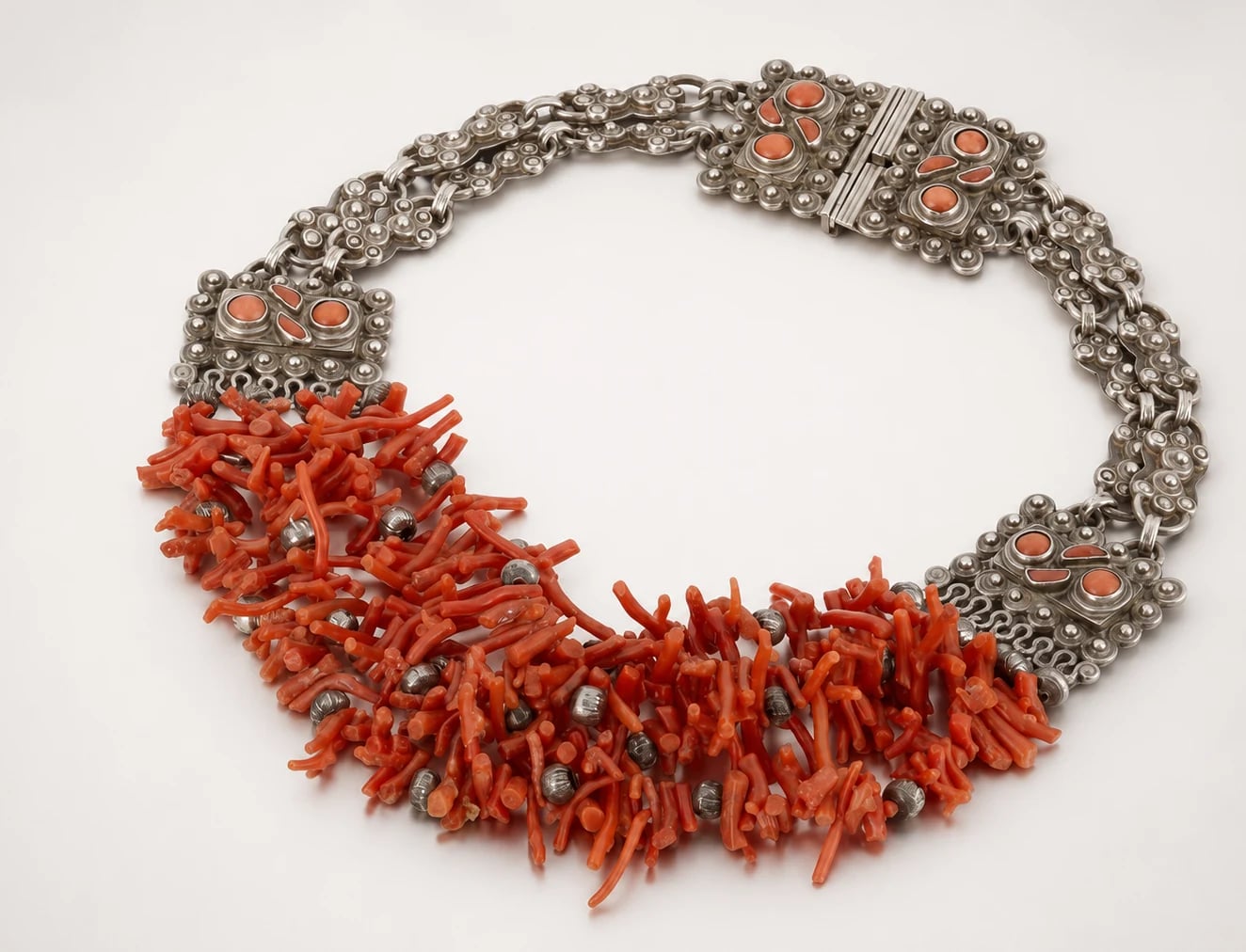
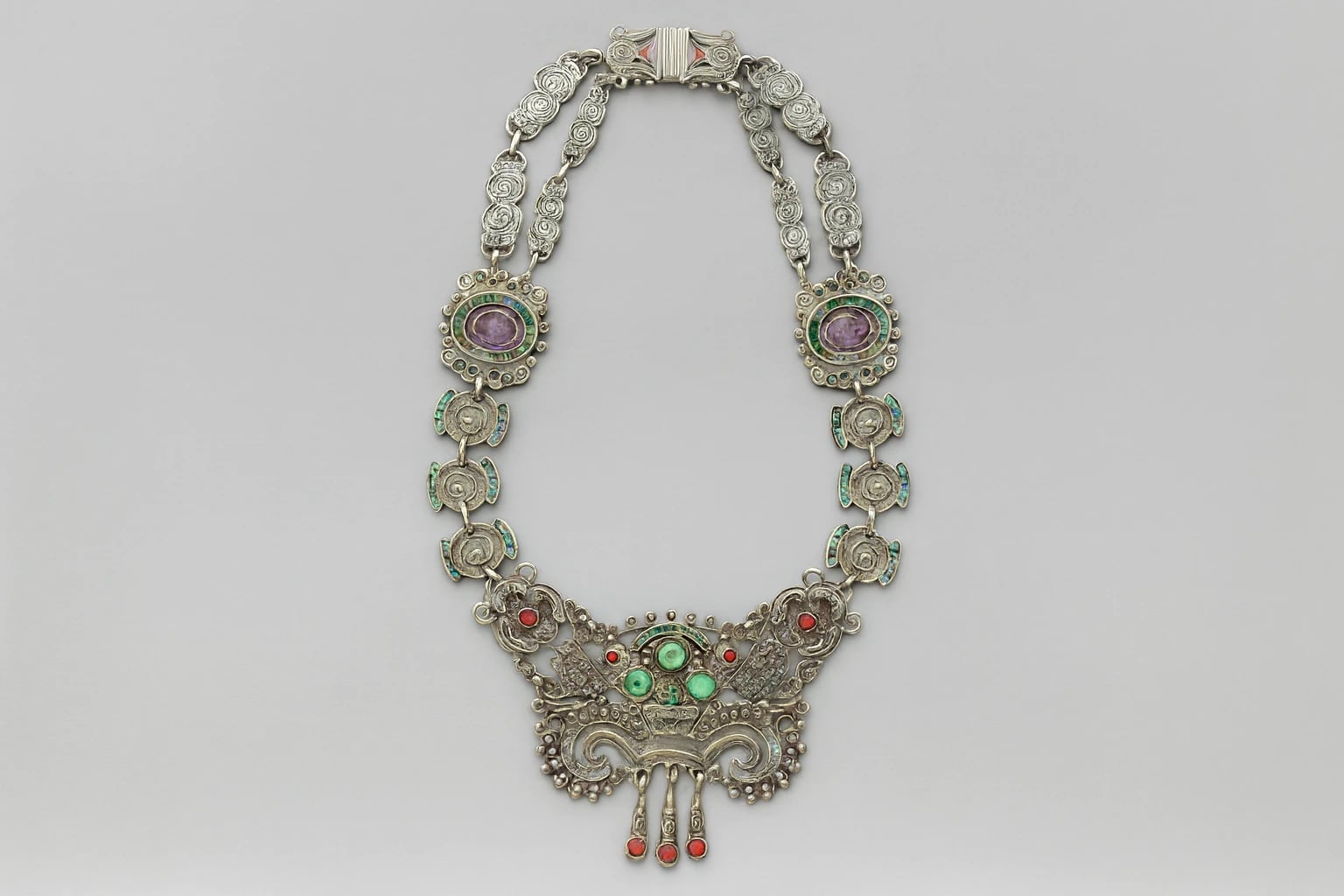
This MATL necklace turns coral into architecture. Four dense strands of red branch coral hang like a living fringe from an elaborate silver collar of linked panels, scroll connectors, raised beads, and cabochon-set stations. Its physical presence is unusually theatrical for a necklace: the coral does not merely accent the silver, it forms the lower body of the jewel, while the silver upper structure controls and frames the movement.
The design belongs squarely to the MATL vocabulary described by Morrill and Berk, who identify Matilde Eugenia Poulat's jewelry as intensely Mexican in William Spratling's 1955 assessment, marked by color, dense surface, applied wire, embossing, repousse, and the use of coral, turquoise, and amethyst quartz. Here, the coral branches supply the saturated color that Morrill and Berk associate with MATL silver, while the silver panels provide the workshop's characteristic complexity of surface. Rather than the spare geometric modernism often associated with Taxco, the necklace embraces abundance: granulated borders, cabochon settings, repeated loops, and articulated strands that make the object both ornament and small-scale sculpture.
MATL jewelry was rooted in the post-Revolutionary search for a specifically Mexican aesthetic. Morrill and Berk note that Poulat studied painting at the San Carlos Academy, introduced the MATL mark in 1934, and drew inspiration from Pre-Hispanic and pueblo sources, especially Mixtec goldwork from Monte Alban. Hougart records MATL as the mark of Matilde Eugenia Poulat and notes the later continuation of MATL designs by her nephew Ricardo Salas, with eagle numbers 1, 123, and 129, and the later MS-12 registration associated with Salas.
This necklace is significant because it presents MATL at full scale, not as a devotional pin, pendant, or small cabochon jewel, but as a major collar in which silver and coral are given equal structural force. Stromberg places Matilde Poulat among the generation of world-class designers who formed the Taxco School, alongside Spratling, Aguilar, Pineda, Margot van Voorhies, Los Castillo, Ana Núñez Brilanti, and others. Within that broader field, Poulat's contribution was distinct: she transformed Mexican folk, colonial, and Pre-Hispanic sources into a jeweled language of color, texture, and symbolic density.
Museum of Mexican Silver. “Red Coral Necklace.” Catalog no. MoMS-002173. https://museumofmexicansilver.com/pieces/matl-red-coral-necklace
See something wrong with this record? Suggest a correction and the piece details fill in automatically.
MATL (Matilde Poulat)
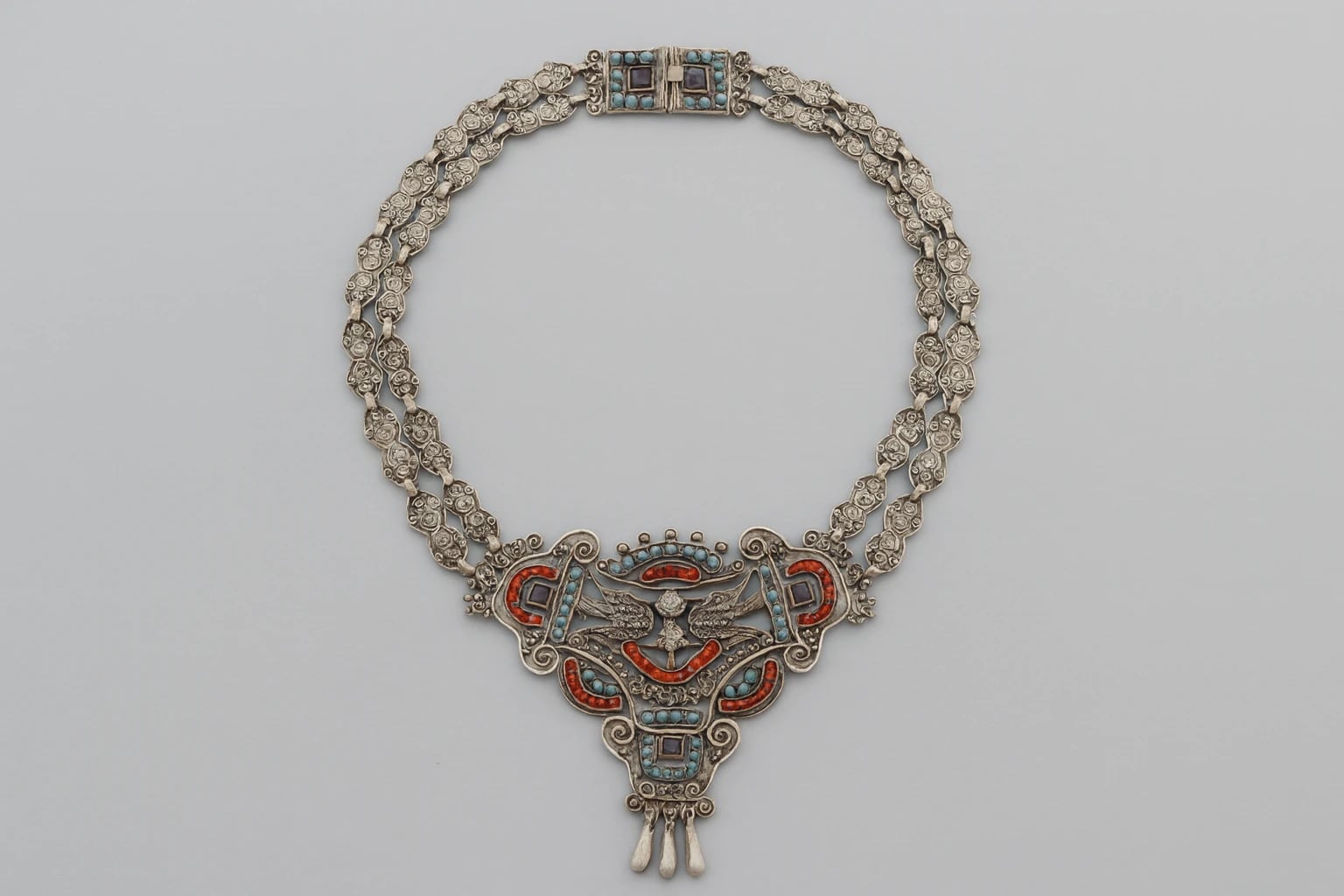
Dove Fringe Necklace with Turquoise, Amethyst, and Coral
1934 or later
Turquoise