Saves instantly, no account needed. Already a member? Sign in.
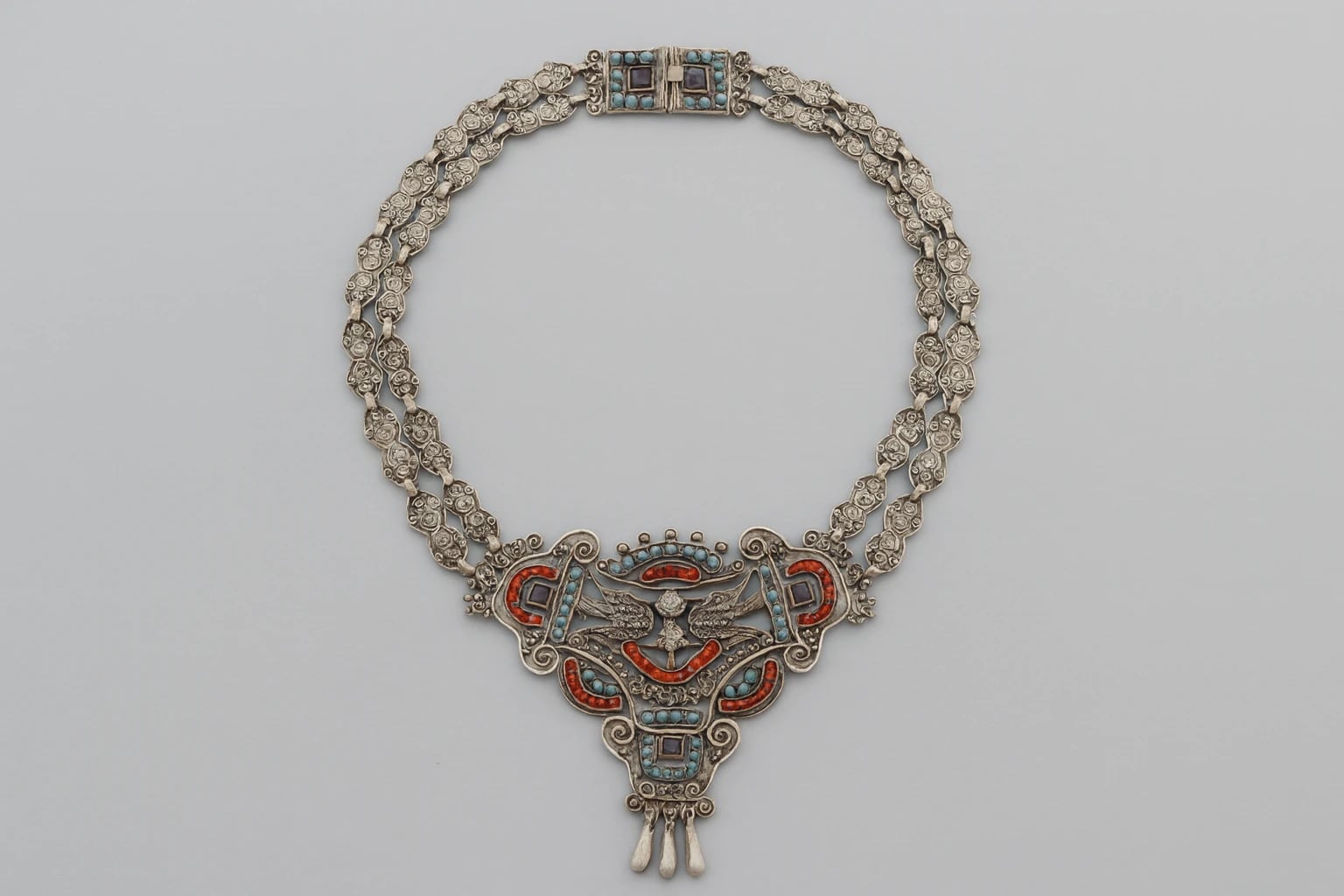
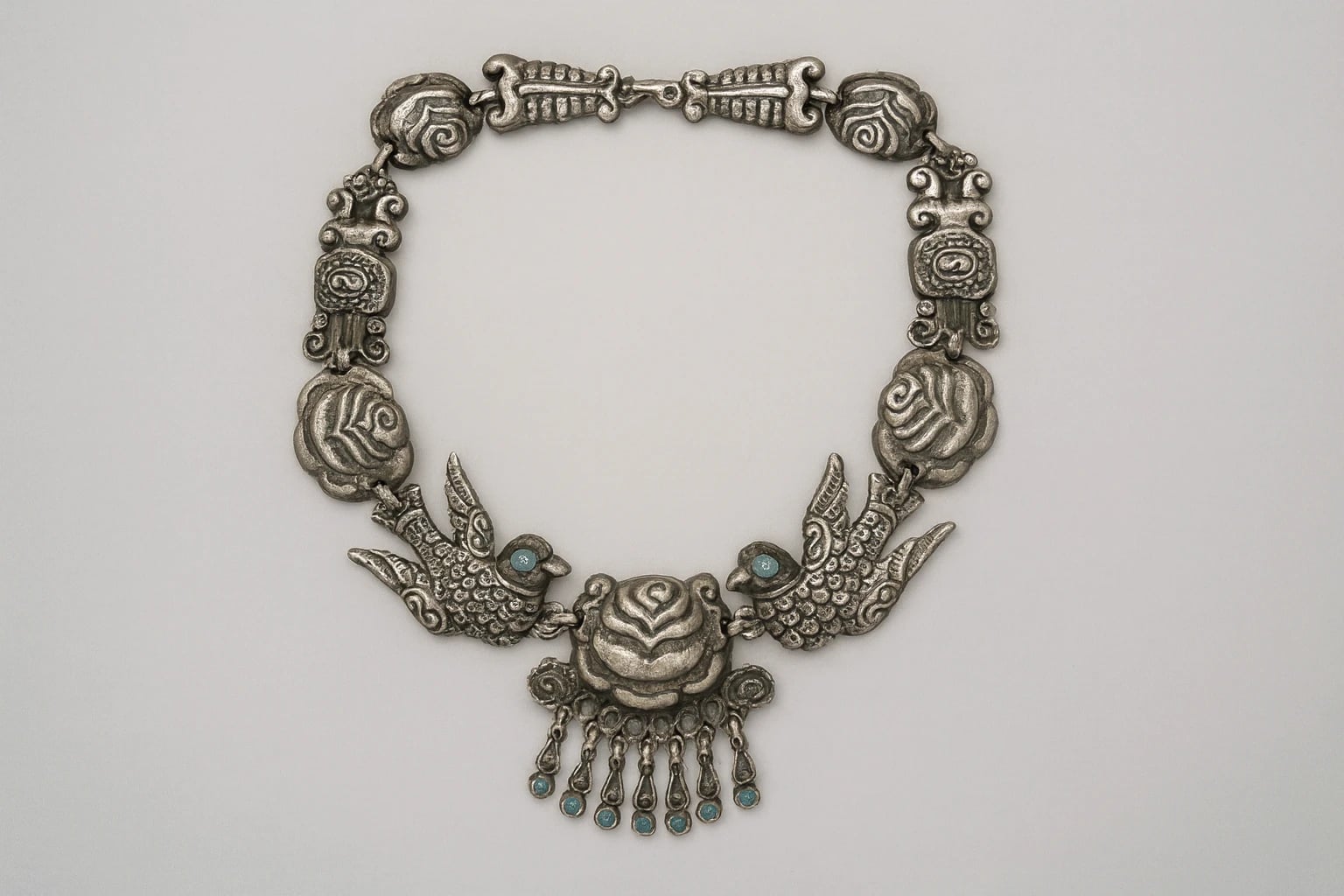
A dove with spread wings sits at the center of this necklace, ringed and studded with turquoise, and beneath it a fringe of small drops hangs free to catch light and movement. This is the visual language that made the MATL workshop recognizable: a densely worked silver ground, ornamental scrollwork built up around a central figure, and turquoise set as color rather than as precious incident. The dove is one of Matilde Poulat's signature motifs, and the necklace treats it as the organizing image from which the rest of the composition radiates outward and downward.
The construction depends on the relationship between a fixed centerpiece and a moving fringe. The central dove and its surrounding frame read as a single dense field, silver curls and beading packed tightly around the bird, with turquoise punctuating the design in small clustered settings. Below, the suspended drops break that density into rhythm, so the lower edge of the necklace shifts and glints as the wearer moves while the upper structure holds its shape against the body. Turquoise carries the color argument throughout. Its opaque blue reads clearly against the busy silver, and the stones are distributed to lead the eye toward the dove rather than to sit as isolated luxury. This is decorative silver conceived by a painter, and the handling of pattern and color reflects that training.
Matilde Poulat studied at the San Carlos Academy and worked as a painter and designer before opening her Mexico City shop in 1934, and her jewelry drew openly on Mexican folk and colonial devotional imagery rather than on the austere geometry associated with much of the Taxco School. The dove, floral scrollwork, and dense repoussé-like surfaces place her work within a Mexican revivalist current that valued ornament, narrative, and popular religious motifs. The "Matl" name, taken from an Aztec word for water, was registered as trademark number 142093, a number that appears on the workshop's silver. After Poulat's death in 1960, her nephew Ricardo Salas continued the Matl designs and his own until his death in 2006, at peak production supervising several dozen silversmiths who fabricated and assembled the pieces. The recorded marks span this long history, from the early script MATL stamps of the 1934 to 1948 period through the M. Regis 142093 marks of the 1950s and the later MS-12 registrations Salas used after 1980, so a Matl dove necklace should be understood as a design that was produced across decades under more than one hand.
Within a collection, a MATL dove necklace documents a strand of the Mexican silver renaissance that ran parallel to, and distinct from, the modernist geometry of Spratling, Pineda, and their circle. Poulat demonstrated that a painter's sense of ornament and a repertoire of Mexican devotional and folk imagery could sustain an internationally recognizable silver style built on figure, color, and dense surface. The dove necklace, with its fixed emblem and its mobile fringe of turquoise and silver, shows how that language balanced a static central image against a moving lower edge, and it records a workshop tradition that outlived its founder and remained continuously in production.
Museum of Mexican Silver. “Dove Fringe Necklace.” Catalog no. MoMS-002217. https://museumofmexicansilver.com/pieces/matl-silver-dove-fringe-necklace
See something wrong with this record? Suggest a correction and the piece details fill in automatically.