Saves instantly, no account needed. Already a member? Sign in.
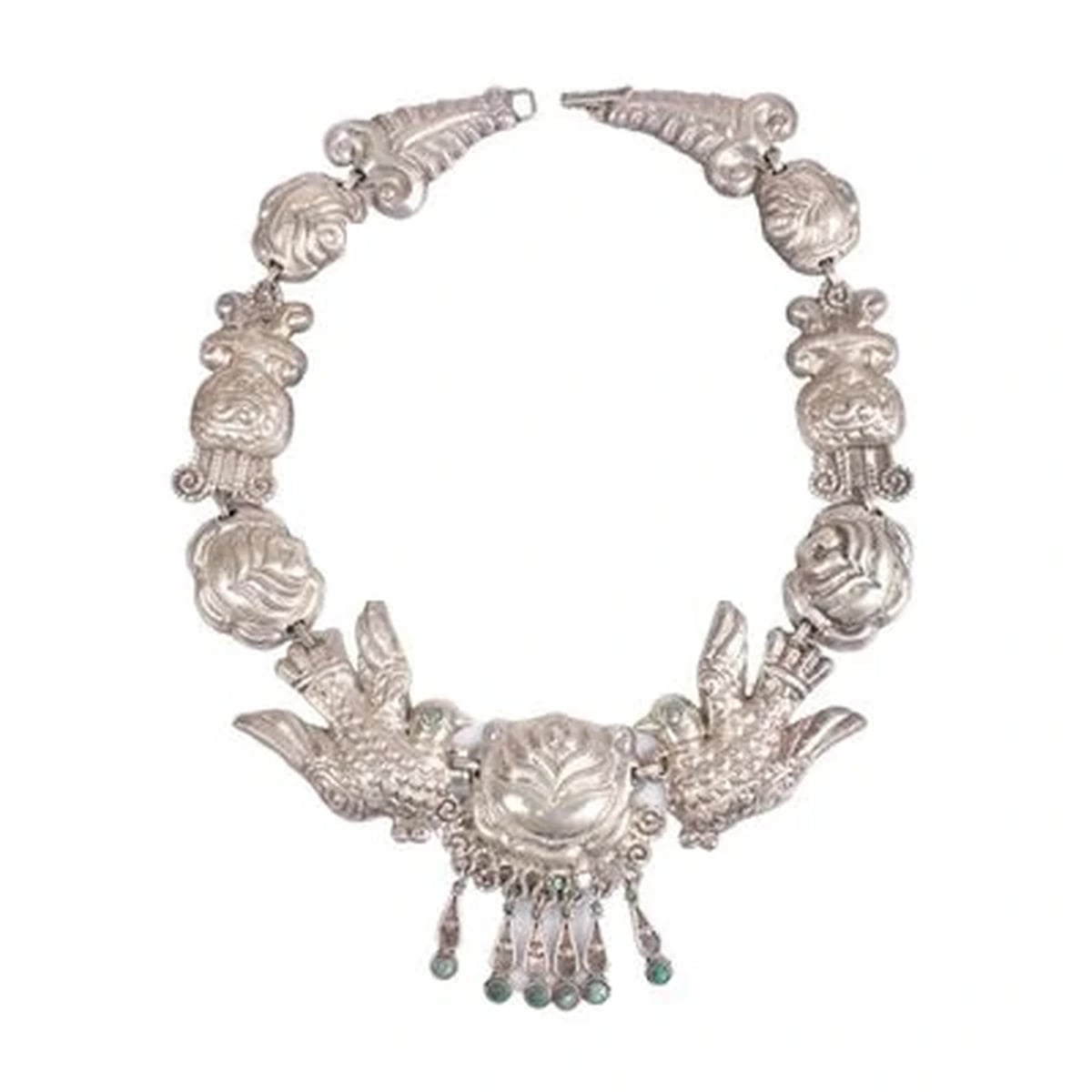
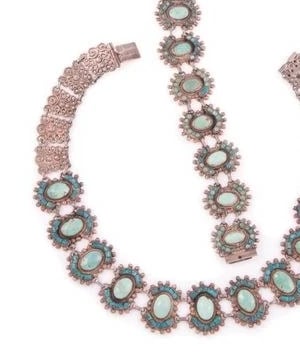
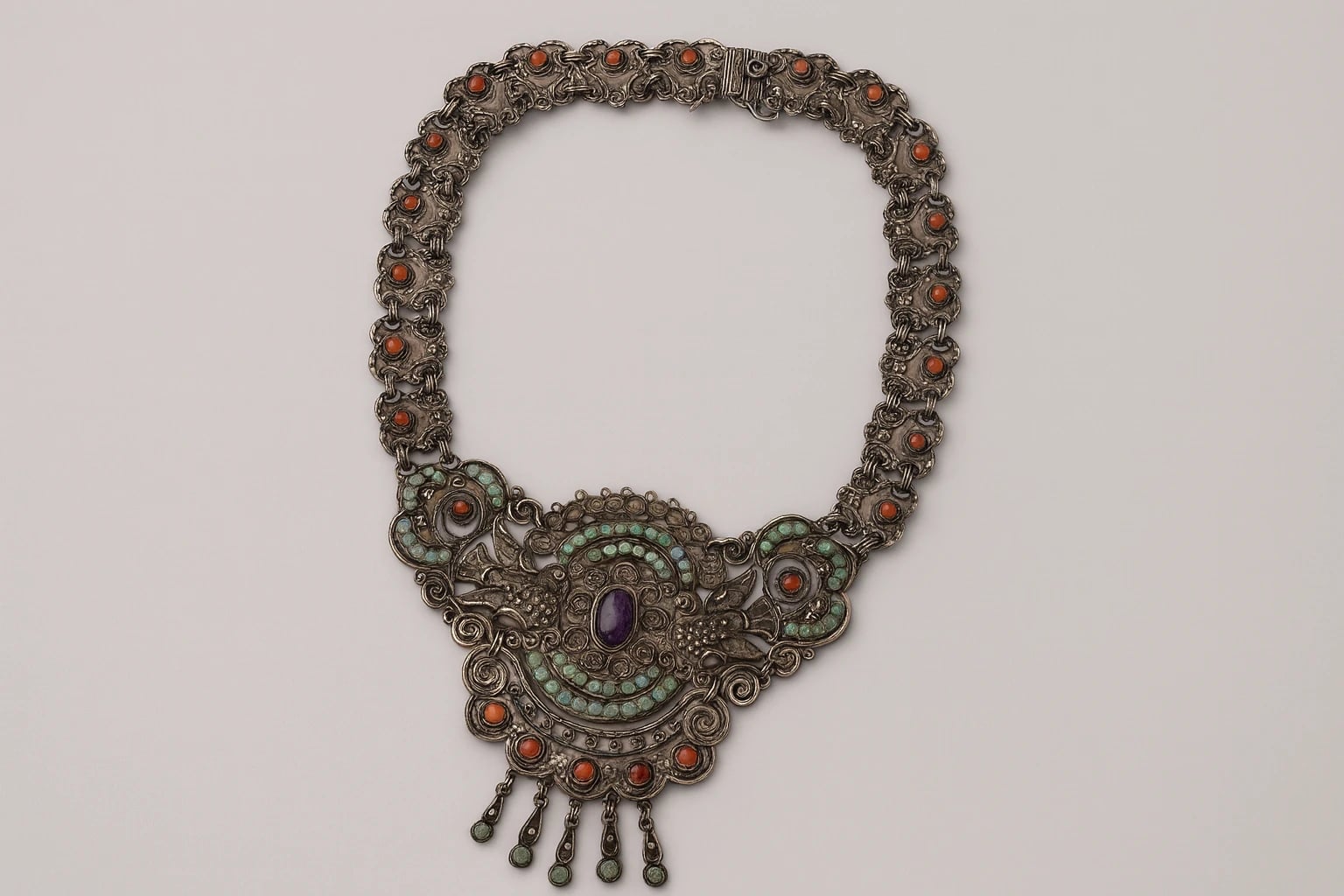
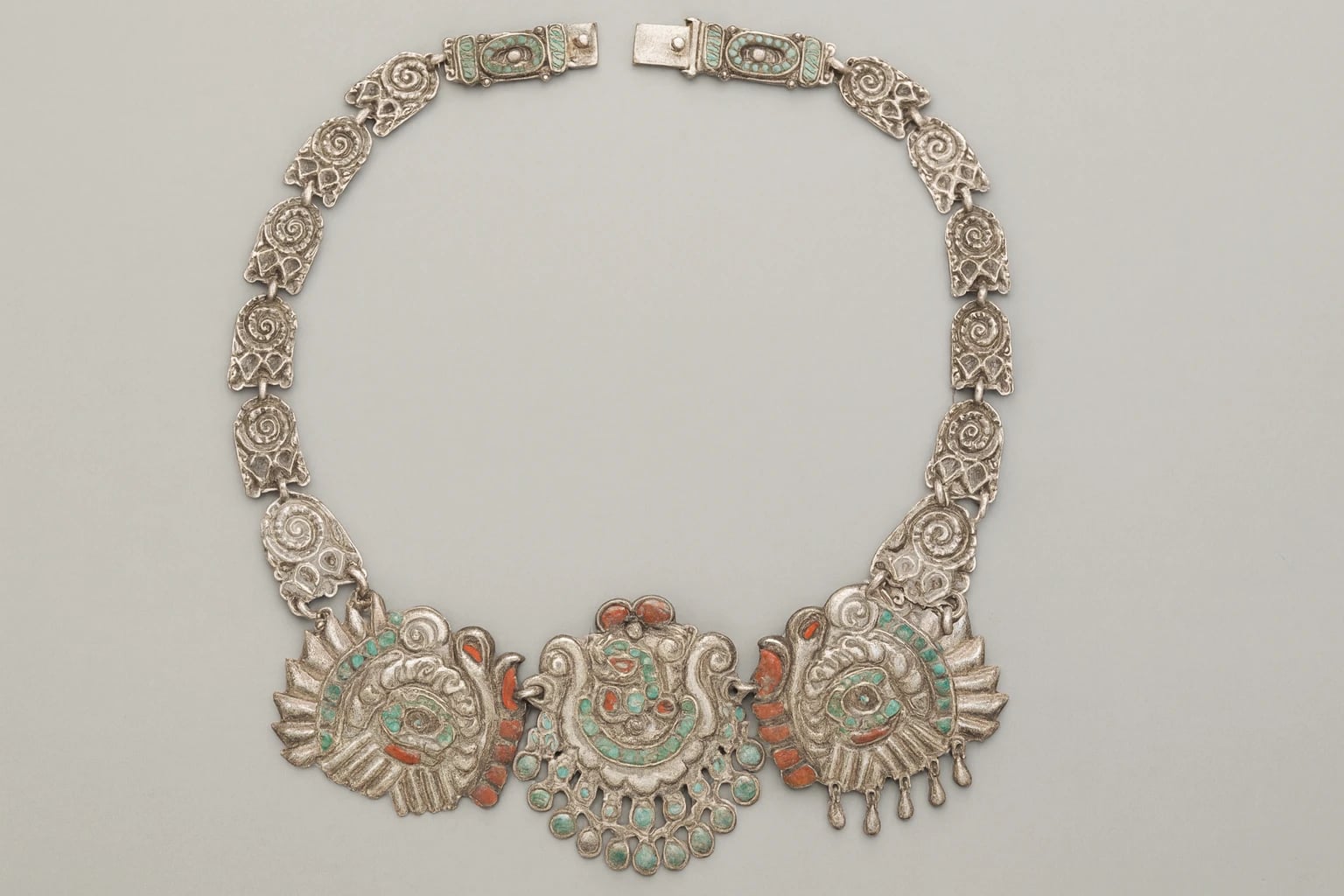
A dense mosaic of turquoise, set against smaller stones and framed in silver, gives this MATL necklace its particular voice: color used not as accent but as structure. Where much Taxco silver of the period treats stones as punctuation within a metal composition, Matilde Poulat inverted the priority, letting turquoise carry the surface and reducing silver to the scaffolding that holds and outlines it. The result is a devotional richness closer to Mexican colonial and folk ornament than to the austere geometry then emerging from workshops like Spratling's Las Delicias.
The composition draws on a vocabulary Poulat made unmistakably her own. Her designs favor symmetry organized around a central axis, with paired birds, blossoms, and scrolling foliage that recall retablo frames and the ex-voto tradition. Turquoise here supplies the dominant field, its opaque blue-green broken by the contrasting hardstone, so that the eye reads pattern and color before it reads metalwork. The stones are held in a way that emphasizes their density and matte surface against the reflectivity of the silver borders, a deliberate play of opacity against shine that gives the piece its warmth. This is ornament conceived by a painter: Poulat trained at the San Carlos Academy and worked as a painter and designer before opening her shop in 1934, and the necklace organizes color and silhouette with a picture-maker's instinct for framing.
Poulat registered "MATL," a variation of an Aztec word for water, as a trademark, number 142093, and built a body of work that stood apart from the modernist mainstream of the renaissance. Rather than translating European or North American modernism into silver, she looked to Mexican popular and colonial sources, folk jewelry, church ornament, and native stones, and shaped them into a recognizable personal style. That style proved durable enough to outlive her. After her death in 1960 her nephew Ricardo Salas continued producing MATL designs, eventually supervising a workshop of several dozen silversmiths and carrying the mark forward until his own death in 2006. The persistence of these designs across three generations of production speaks to how fully Poulat had defined a formal language, one distinct enough that later Rivera workshops were known to work "in the style of MATL."
Dating a MATL object depends on reading the mark rather than the design, since the same compositions recur across decades. The early script and block marks with fineness notations belong to the 1934 to 1948 period, while the etched registration marks citing 142093 appear from roughly 1950 onward, and post-1980 Salas production adds the MS-12 registration. Without the specific hallmark, this necklace should be understood as an example of a MATL design rather than dated to a single year of the maker's life. What it documents is the alternative that Poulat offered within the silver renaissance: a maker who kept color, symmetry, and Mexican devotional imagery at the center of her work when many of her contemporaries were stripping them away, and who was rare among the movement's leading figures in being a woman who founded and directed her own shop.
Museum of Mexican Silver. “Shell-Link Necklace with Turquoise and Hardstone.” Catalog no. MoMS-001472. https://museumofmexicansilver.com/pieces/matl-turquoise-hardstone-necklace
See something wrong with this record? Suggest a correction and the piece details fill in automatically.
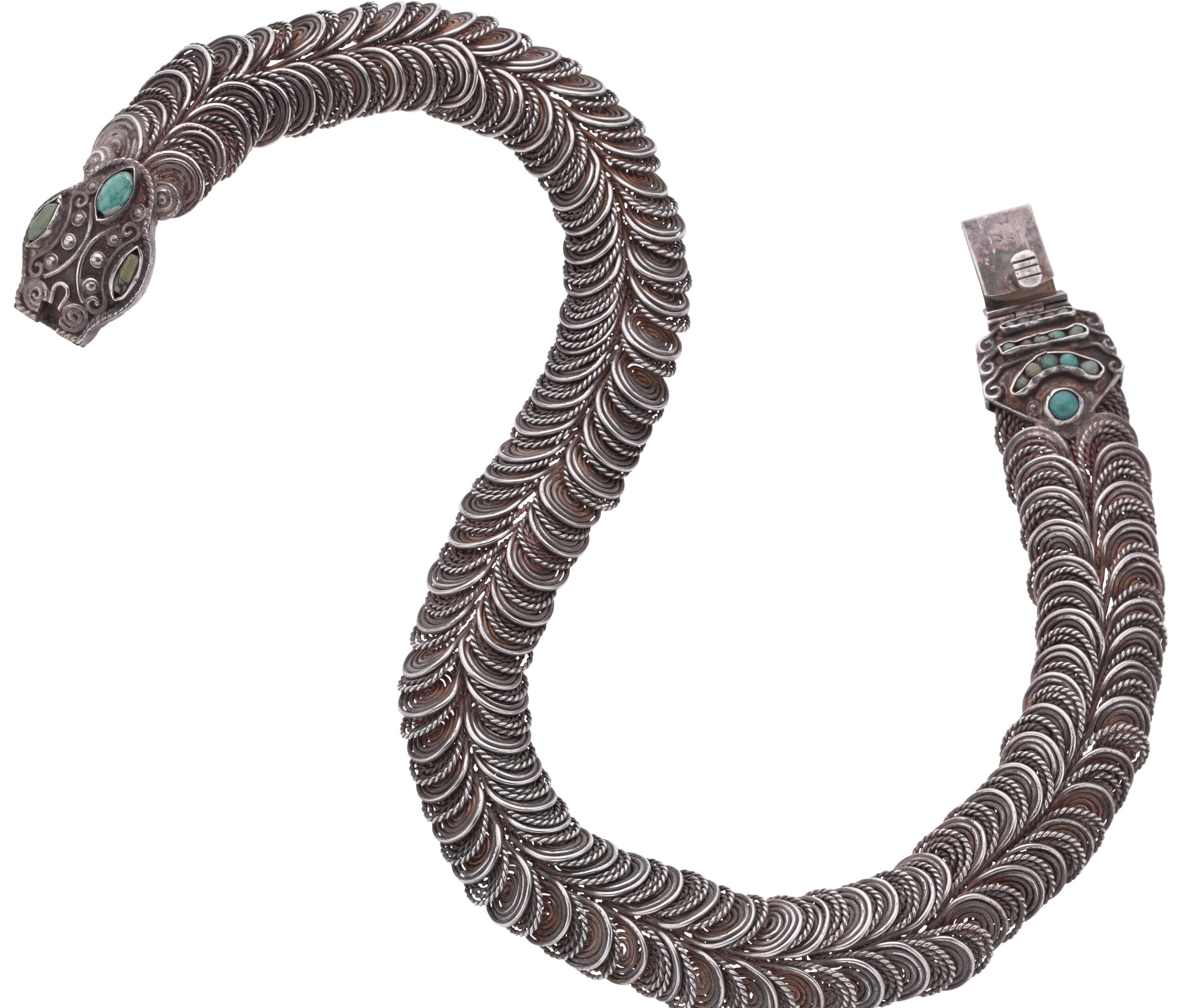
MATL (Matilde Poulat)
Snake Necklace with Turquoise
1934 or later
Turquoise