Saves instantly, no account needed. Already a member? Sign in.
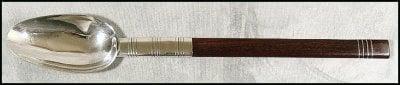
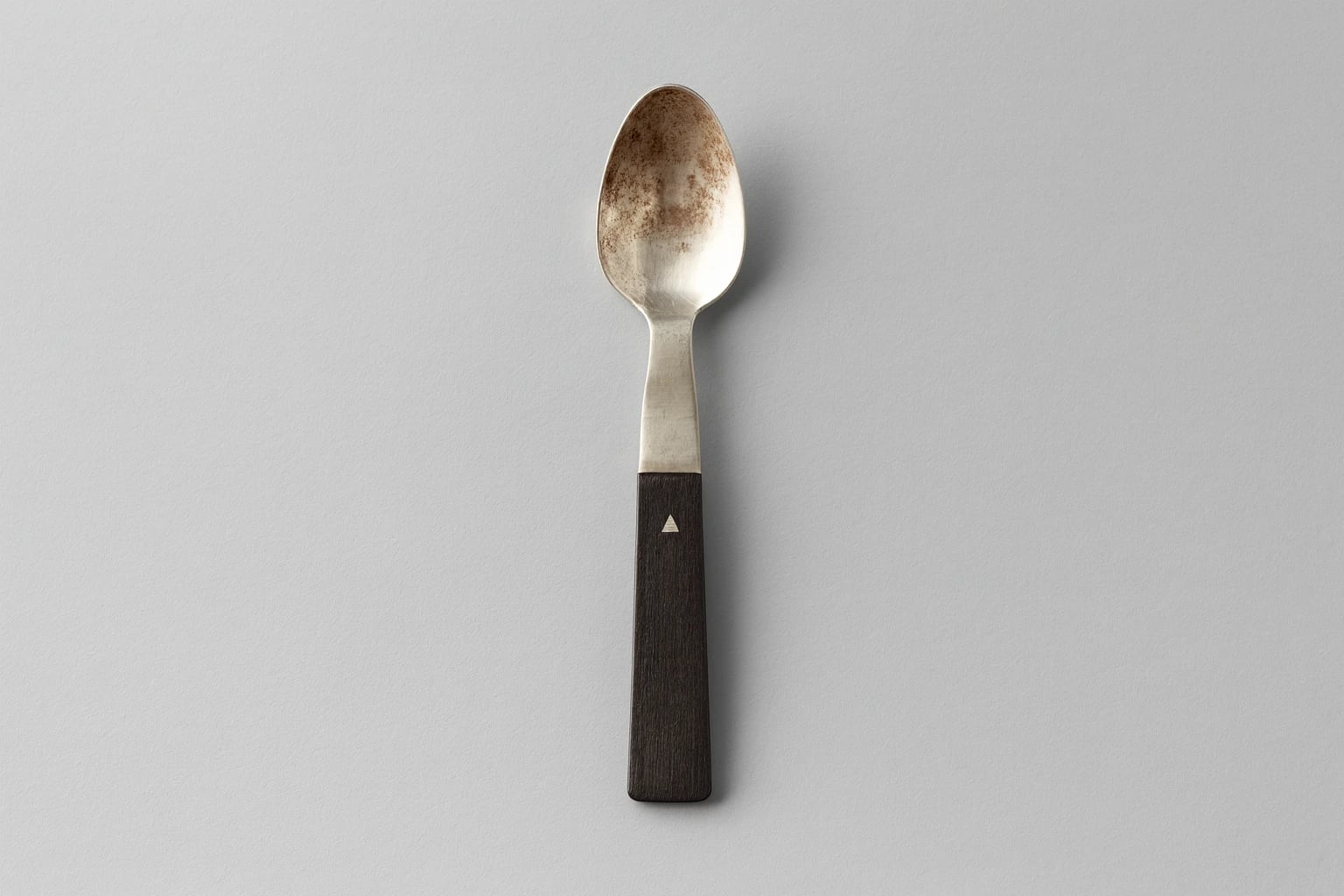
A silver triangle set flush into a rosewood handle governs this spoon. The wood tapers toward the bowl, and just above the joint three incised horizontal lines cross the handle, marking the transition from grip to service. The triangle reads as pure geometry against the grain of the rosewood, its straight edges and points held within a form that is otherwise organic and warm. Nothing decorates the piece beyond this inlay and the three lines. The design depends on the meeting of two materials and the discipline of a single geometric accent.
The construction joins silver and rosewood as equal partners rather than treating the wood as a mere handle for a silver implement. The triangle is inset, meaning the silver sits level with the surrounding wood surface, a technique that requires the metal and the wood to be fitted precisely so that neither stands proud of the other. This flush setting keeps the surface continuous under the hand and lets the triangle function as drawing rather than as applied ornament. The three incised lines repeat the language of the straight edge, echoing the triangle's geometry in a quieter register and drawing the eye toward the point where wood gives way to the working silver of the bowl. The dark rosewood absorbs light where the polished silver returns it, so the small triangle carries visual weight out of proportion to its size.
The spoon belongs to Spratling's first design period, the years between the 1931 founding of the Taller de Las Delicias and the mid-1940s, when the workshop developed the vocabulary that shaped the wider renaissance. Spratling's combination of silver with native hardwoods was one of the distinguishing habits of this period, a way of building Mexican materials into functional objects and of setting geometric silver against natural texture. The taller system he organized allowed designs like this one to be produced under his direction by trained smiths, so the piece reflects both his design authority and the collaborative execution that characterized Las Delicias. Gobi Stromberg and others have described how this workshop structure made experimentation central to Taxco's silver age, and a hollowware object as reduced as this spoon shows that experiment applied to the ordinary tools of the table.
Tableware occupies a smaller place in the published record than Spratling's jewelry and larger hollowware, yet these implements demonstrate that his geometric thinking extended to the most utilitarian objects. The inset triangle and the three incised lines translate the modernist interest in clean form and material contrast into something meant to be held and used daily. As a record of the first design period and of Spratling's silver-and-rosewood work, the spoon documents how the Taxco School carried modern design into the domestic interior, one functional object at a time.
Museum of Mexican Silver. “Inset Silver Triangle Spoon.” Catalog no. MoMS-000497. https://museumofmexicansilver.com/pieces/spratling-3071
See something wrong with this record? Suggest a correction and the piece details fill in automatically.
Wrapped Wire Salad Spoon
First Design Period: 1931 - 1946
Silver