Saves instantly, no account needed. Already a member? Sign in.
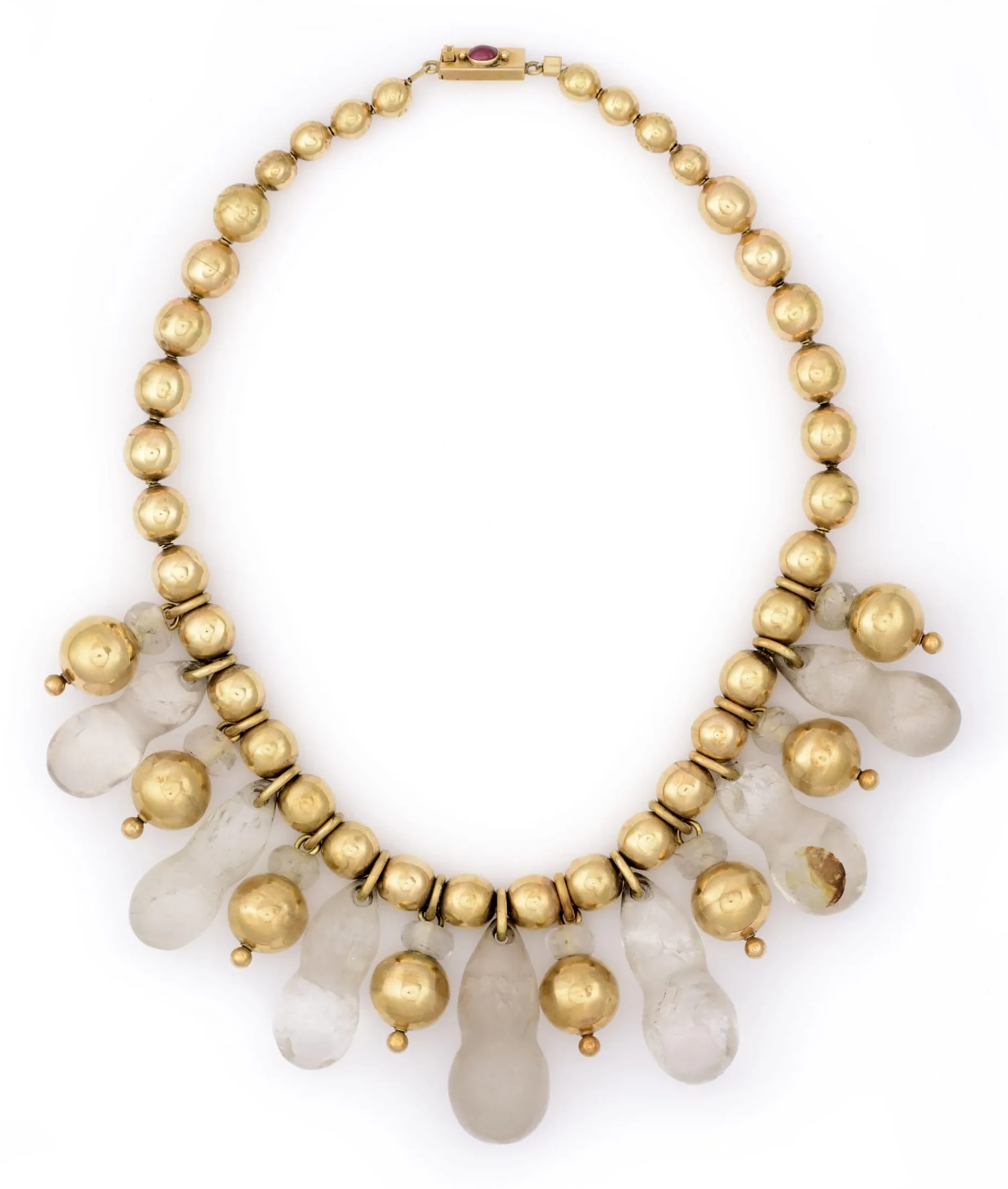
The necklace is organized as a collar of gold spheres, with its weight and visual emphasis gathered along the lower curve. From that arc hang clear crystal drops and larger gold terminals, each suspended from small loops and spacer elements that allow the pendant fringe to separate from the main strand. A ruby set into the rectangular clasp brings a small concentration of color to the back of the necklace, a private accent rather than the central display. At 7 1/4 by 6 3/4 inches, the work is compact, but its materials give it a ceremonial density unusual within the better-known silver production of Taxco.
William Spratling’s design depends on contrast: rounded gold beads against irregular crystal forms, polished metal against cloudy translucence, disciplined repetition against the slight asymmetry of mineral surfaces. The gold beads produce a steady rhythm around the neck, while the crystal drops interrupt that order with suspended volumes of light. Their forms are not cut into identical jewels. They retain a softened, water-worn character, which makes the necklace feel less like a conventional parure than an assemblage of precious matter. The lower fringe would have moved with the wearer, but the design does not rely on delicacy. It has the frontal clarity of a pectoral and the bodily intimacy of a necklace.
LACMA identifies the work as an Ancient-Style Necklace, made in Taxco circa 1965, and records that the Southern California painter Millard Sheets purchased it from Spratling for his wife, Mary Baskerville Sheets. That ownership matters because the necklace belonged to a circle in which Mexican modernism, collecting, travel, architecture, and the ancient arts of Mexico were closely entangled. Sheets and Spratling shared an interest in Mesoamerican art, and LACMA notes that Sheets owned two other Spratling works now in its collection. The necklace therefore records not only a personal gift, but also an artistic friendship shaped by the effort to bring ancient Mexican aesthetic values into modern life.
The Mixtec reference in the necklace is not a matter of copying a single ancient object. It belongs to a longer Spratling practice in which archaeological forms, codices, clay stamps, metallurgy, and stones became sources for modern design. Penny Morrill and Carole Berk describe how the imagery and aesthetic approach of Monte Albán continued to inform Spratling and other Taxco designers. This necklace, made late in Spratling’s career and in gold rather than silver, returns to that source through material presence: bright metal, suspended mineral drops, and a collar format that places precious substances in direct relation to the body.
Museum of Mexican Silver. “Ancient-Style Necklace with Rock Crystal and Ruby.” Catalog no. MoMS-002269. https://museumofmexicansilver.com/pieces/spratling-ancient-style-gold-necklace-lacma-m2018-68-62
See something wrong with this record? Suggest a correction and the piece details fill in automatically.
Within the history of the Mexican silver renaissance, the necklace is valuable precisely because it stands slightly to one side of silver. Hougart notes that Spratling had begun using gold in some designs by the 1950s, and this circa 1965 work shows how far his Taxco vocabulary could travel without losing its structure. The object is not a silver jewel translated into gold. Its meaning depends on gold’s ancient associations and on the cloudy transparency of crystal, with the ruby clasp held as a concentrated point of warmth. In a museum collection, it broadens the understanding of Spratling’s late work and of Taxco itself, where modern jewelry could carry archaeological memory through material, rhythm, and wear.
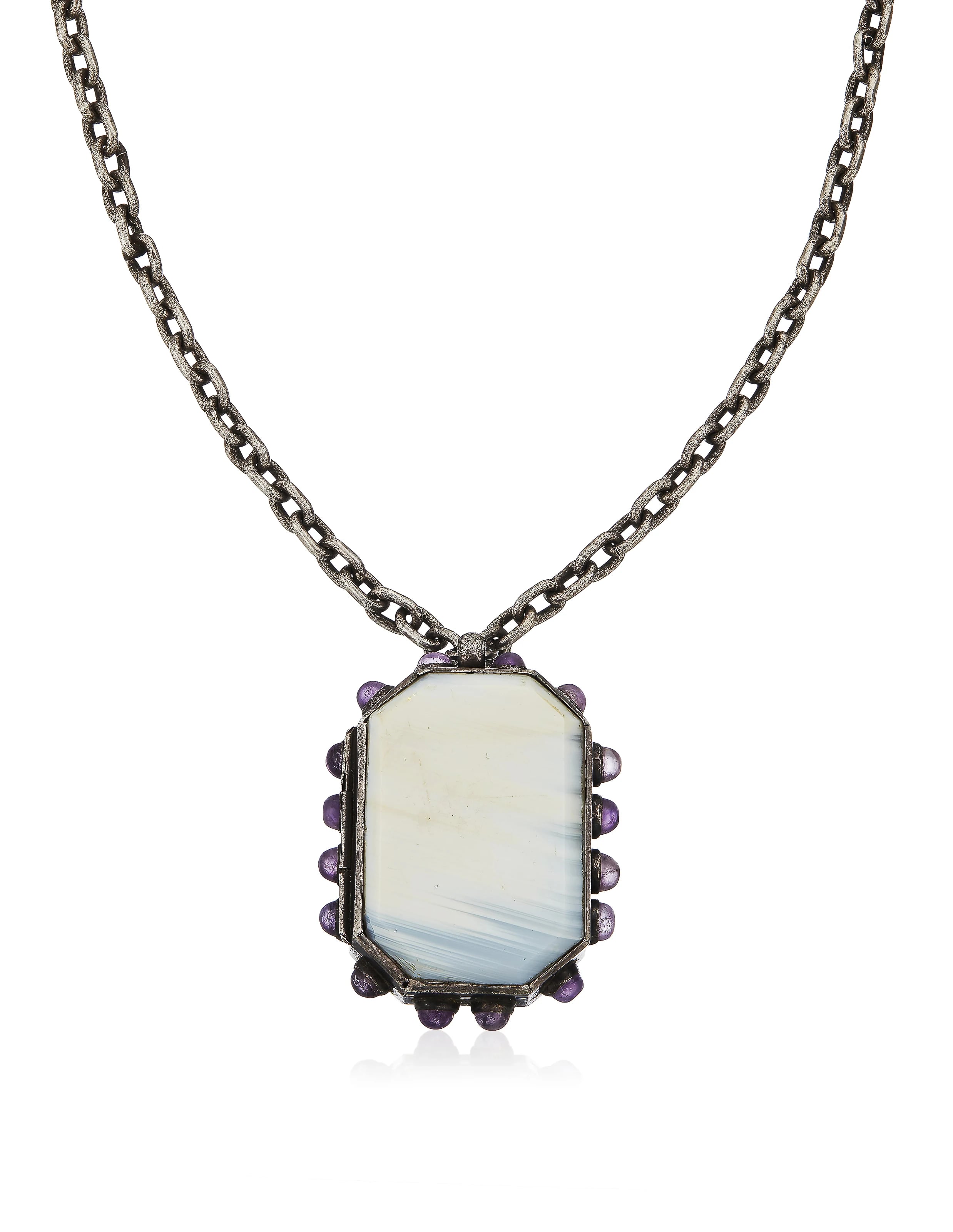
William Spratling
Agate and Amethyst Locket Necklace
Silver