Saves instantly, no account needed. Already a member? Sign in.
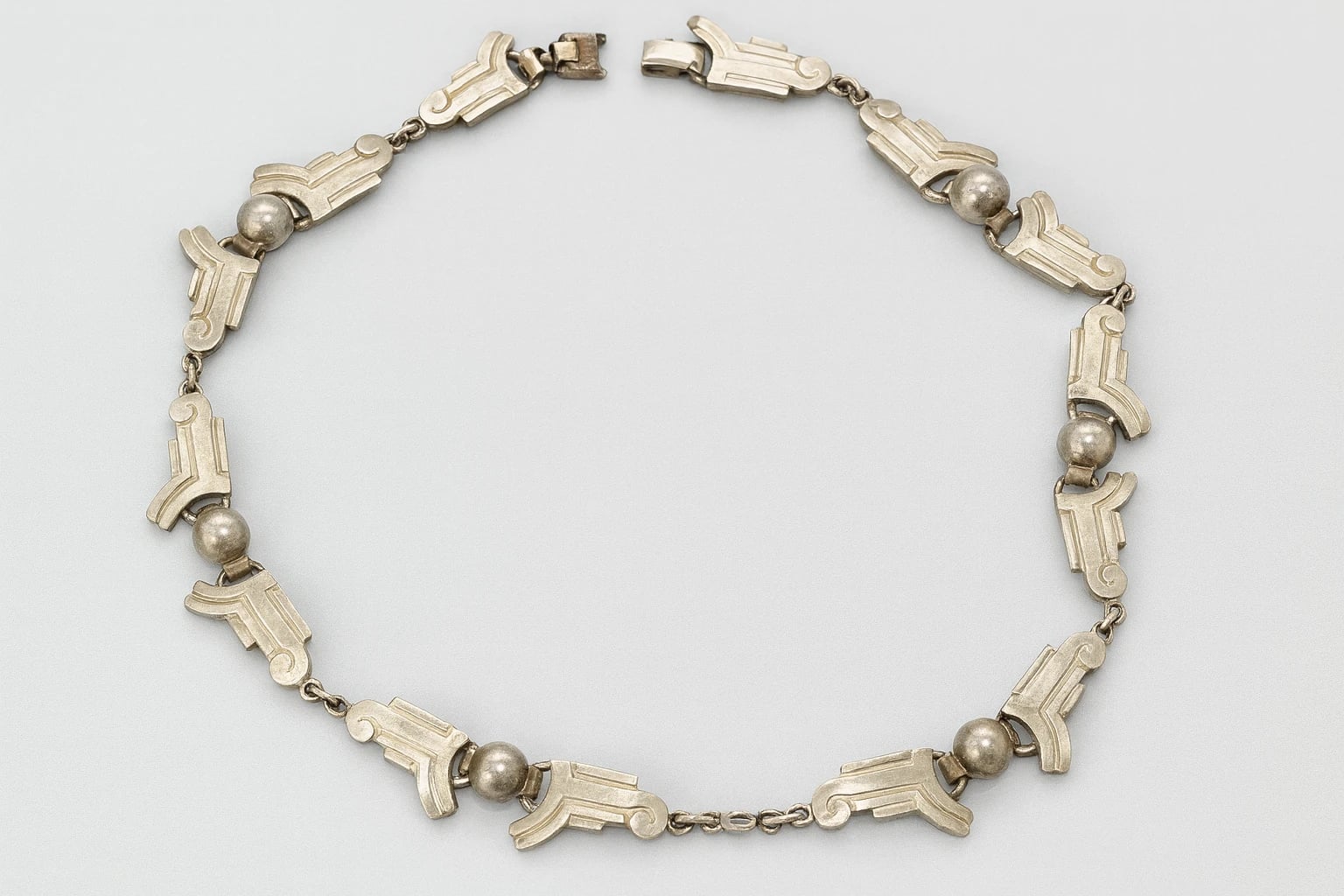
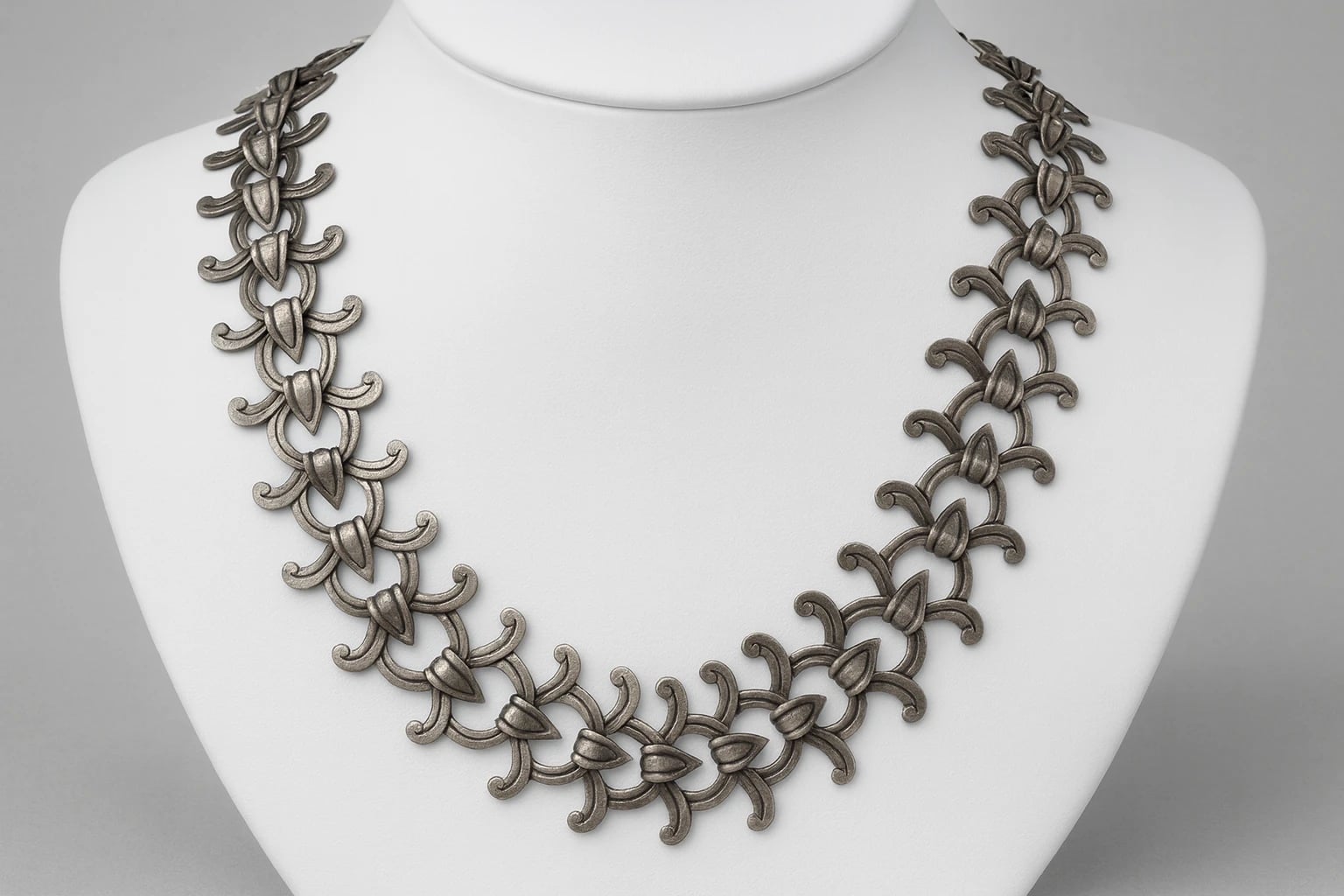
Design number 23 places this suite among the earliest numbered work of Platería Victoria, the Taxco house that Ana Núñez Brilanti opened in 1940, and it shows her workshop already thinking in systems rather than single ornaments. The necklace and matching bracelet are built from one repeated link, a stylized fleur-de-lis in which a pointed central bud rises between two upturned scrolls beneath an arched connecting curve. That single unit generates a collar, a bracelet, and, when the two are joined, an opera-length necklace. For a designer who would become best known for silver on copper and for hollowware, this all-silver suite documents her first concern: cut form, line, and modular construction, worked out at the very start of the shop's numbered production.
Each link earns its place in the sequence through controlled variation rather than mechanical sameness. Parallel grooves score the raised surfaces of the bud and scrolls, and the patina settles into those cuts, so that a darker linear rhythm runs through the bright metal and keeps the wide links from reading as flat plaques. Open space is structural. The arched curve of each unit leaves the center pierced, which lets the necklace bend cleanly around the collar while preserving the silhouette of every element. The necklace comprises 29 links and measures 21 1/2 inches long by 1 1/2 inches wide; the bracelet comprises 9 links at 7 inches. The module has been scaled to work in two bodily registers, as a broad collar with a steady architectural cadence and as a bracelet whose short circumference compresses that cadence around the wrist, and the clasping system joins the parts without interrupting the pattern. Articulation, repetition, and adaptability become the ornament itself.
The mark, Victoria, Taxco, Mexico arranged in a circle with the design number above, belongs to the workshop's earliest marking practice. Hougart records the pre-eagle Victoria stamps in use from 1940 to 1945, before the national assay eagle appeared, and this example carries no eagle, consistent with a 1940s date. The low design number should not be pressed into an exact year, but following Morrill and Berk's observation that lower numbers generally indicate earlier work, it supports a position near the founding of the shop. Brilanti's documented early stamps carry numbers in the sixties; a design numbered 23 sits below even those, at the formative edge of Victoria's output.
Brilanti came to silver from teaching, having taught drawing, painting, and sculpture at a school for industrial and manual arts in Mexico City before her family moved to Taxco. Morrill records that when she brought an early necklace to William Spratling, he teased her that it looked as though a dog had chewed it and told her it needed refining and finishing; she then learned to smooth and polish silver by hand, since no polishing machines yet existed in the town. This suite reads as that lesson absorbed. Its grooves are crisp, its edges resolved, and its repeated units alike enough to sustain the pattern yet shaped and open enough to move. The firm advertised exclusive designs by Brilanti executed by artist silversmiths under her personal direction, and the suite depends on exactly that structure: a designer's drawing translated into disciplined, repeatable handwork. Her sources ranged across Mexican history and the natural world, but the fleur-de-lis link is not a quotation of any single motif. Its interest lies in the conversion of a decorative vocabulary into modern structure, where a scroll becomes a hinge, a groove becomes a line of shadow, and a repeated link becomes a flexible system worn on the body.
Museum of Mexican Silver. “Fleur-de-Lis Necklace.” Catalog no. MoMS-002339. https://museumofmexicansilver.com/pieces/victoria-brilanti-necklace-bracelet-combo
See something wrong with this record? Suggest a correction and the piece details fill in automatically.
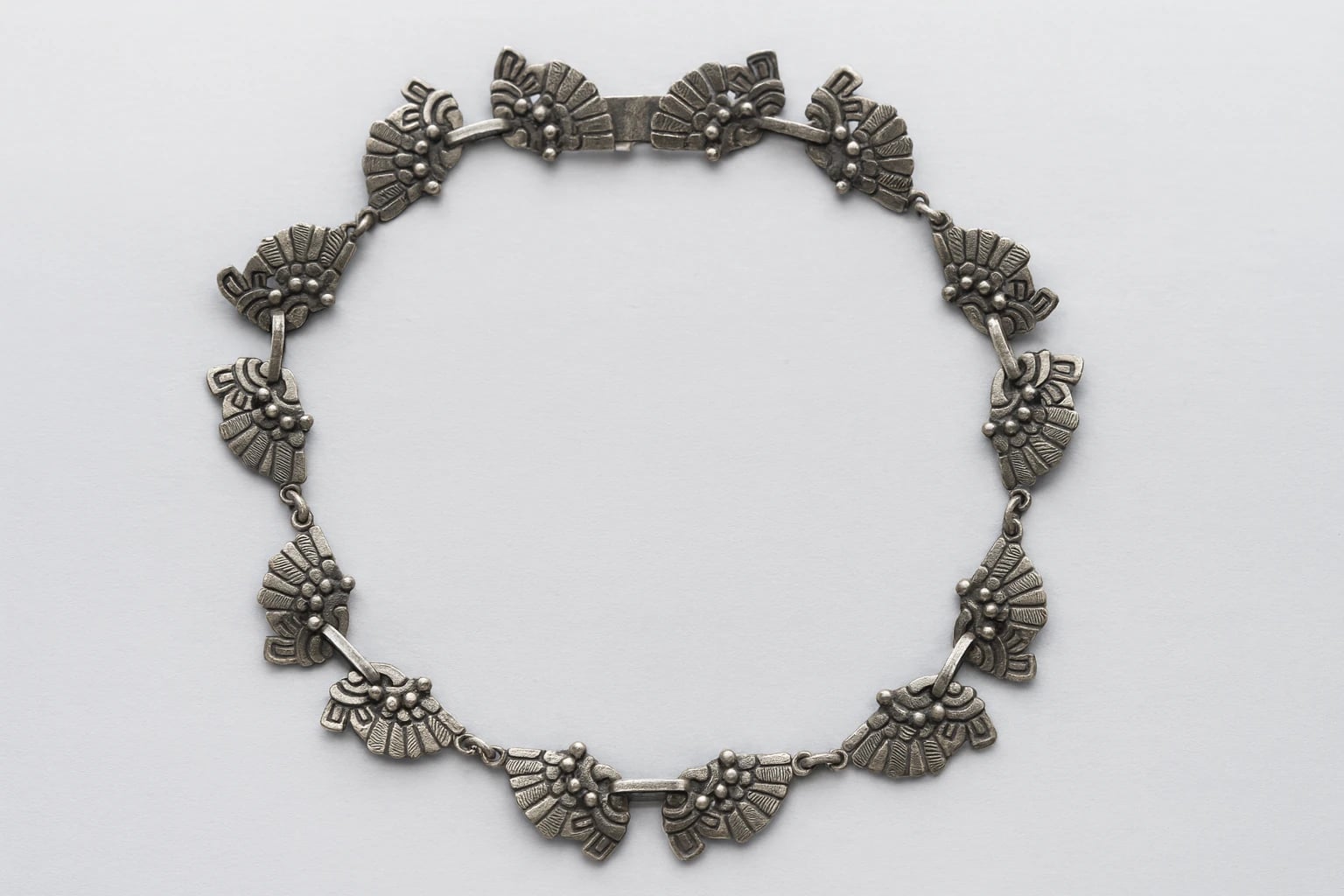
Ana Núñez Brilanti (Victoria de Taxco)
Fan Necklace
Silver