Saves instantly, no account needed. Already a member? Sign in.
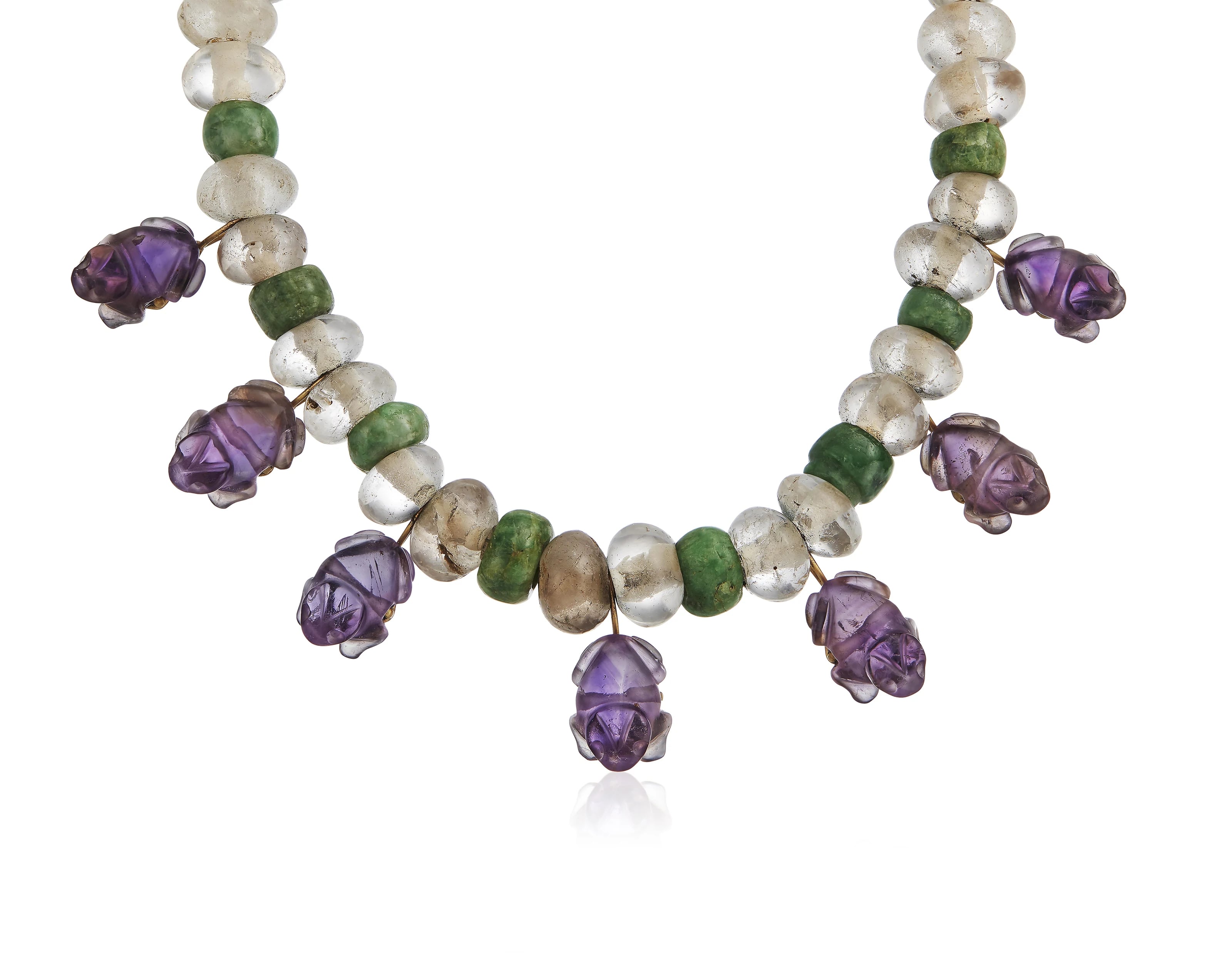
Strung from a single fall of carved amethyst frogs, this necklace belongs to the last and most personal phase of William Spratling's career, the gold work of the 1960s in which each piece was made as a unique object rather than a production model. Where the silver from the Taller de las Delicias was designed to be repeated, these late necklaces in 18-karat gold and carved hardstone were one-offs, signed simply WS over 18K. What makes this example matter is that it gathers, in a single wearable line, the two impulses that drove Spratling's whole project: a fascination with ancient Mexican form and an instinct for translating it into something a living person could put on.
The design is unforced. Rondelles of rock crystal quartz and green jade alternate across the strand, their slightly irregular, hand-finished surfaces giving the necklace the look of something excavated rather than fashioned, and from the front edge hang seven amethyst frogs, each carved in the round in a crouching posture and suspended on gold so that they swing as a fringe. The frog was no decorative whim. In Mesoamerican belief the frog and toad were emblems of water, rain, and fertility, creatures that vanished into the earth in the dry season and returned with the rains, and they recur throughout pre-Columbian carving and goldwork; rendered here in amethyst against the watery clarity of the quartz and the maize-green of the jade, the motif reads as a deliberate, literate borrowing rather than a generic exotic.
That borrowing was central to how Mexican jewelry remade itself in the years after Spratling settled in Taxco. Scholars have traced how Taxco's makers, and the local smiths who learned from them, turned to pre-Columbian motifs for the tourist and collector market and sometimes set ancient jadeite beads directly into their work, drawing on the spectacular archaeological finds of the early 1930s for both authority and imagery (Stromberg, Antonio Pineda, 2008, p. 25; Morrill & Berk, Mexican Silver, 1994, p. 135). Spratling's late gold pieces are the most refined expression of that current: he was no longer adapting an idiom for sale but composing privately with gold and stone, marking each result WS 18K. The broad, substantial strand here, terminating in gold beads, is a strong and characteristic survivor of that final chapter.
Museum of Mexican Silver. “Carved Amethyst Frog and Jade Necklace in Gold.” Catalog no. MoMS-002097. https://museumofmexicansilver.com/pieces/william-spratling-amethyst-jade-and-rock-crystal-quartz-frog-necklace
See something wrong with this record? Suggest a correction and the piece details fill in automatically.
William Spratling
Hardstone and Silver Necklace
Silver