Saves instantly, no account needed. Already a member? Sign in.
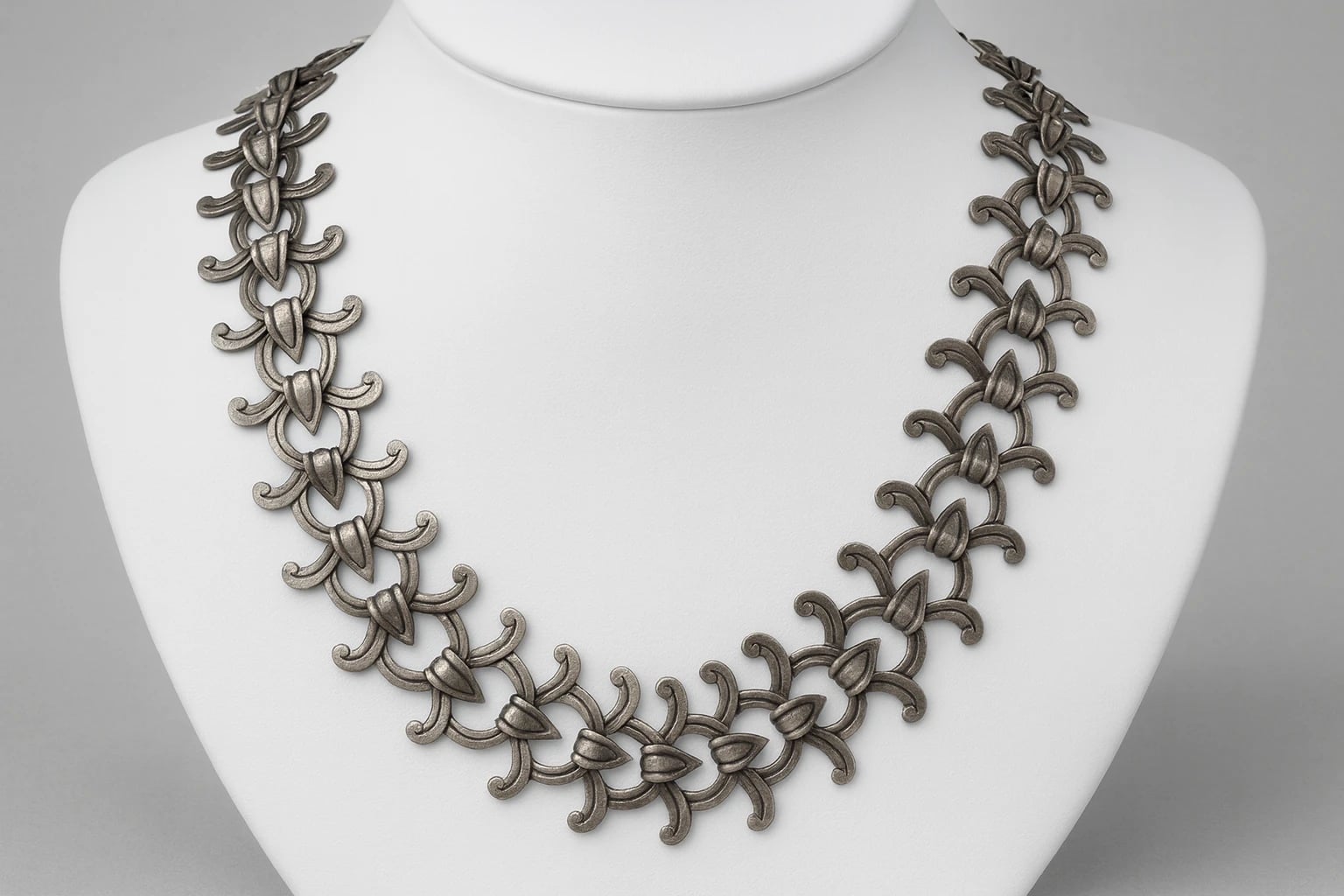
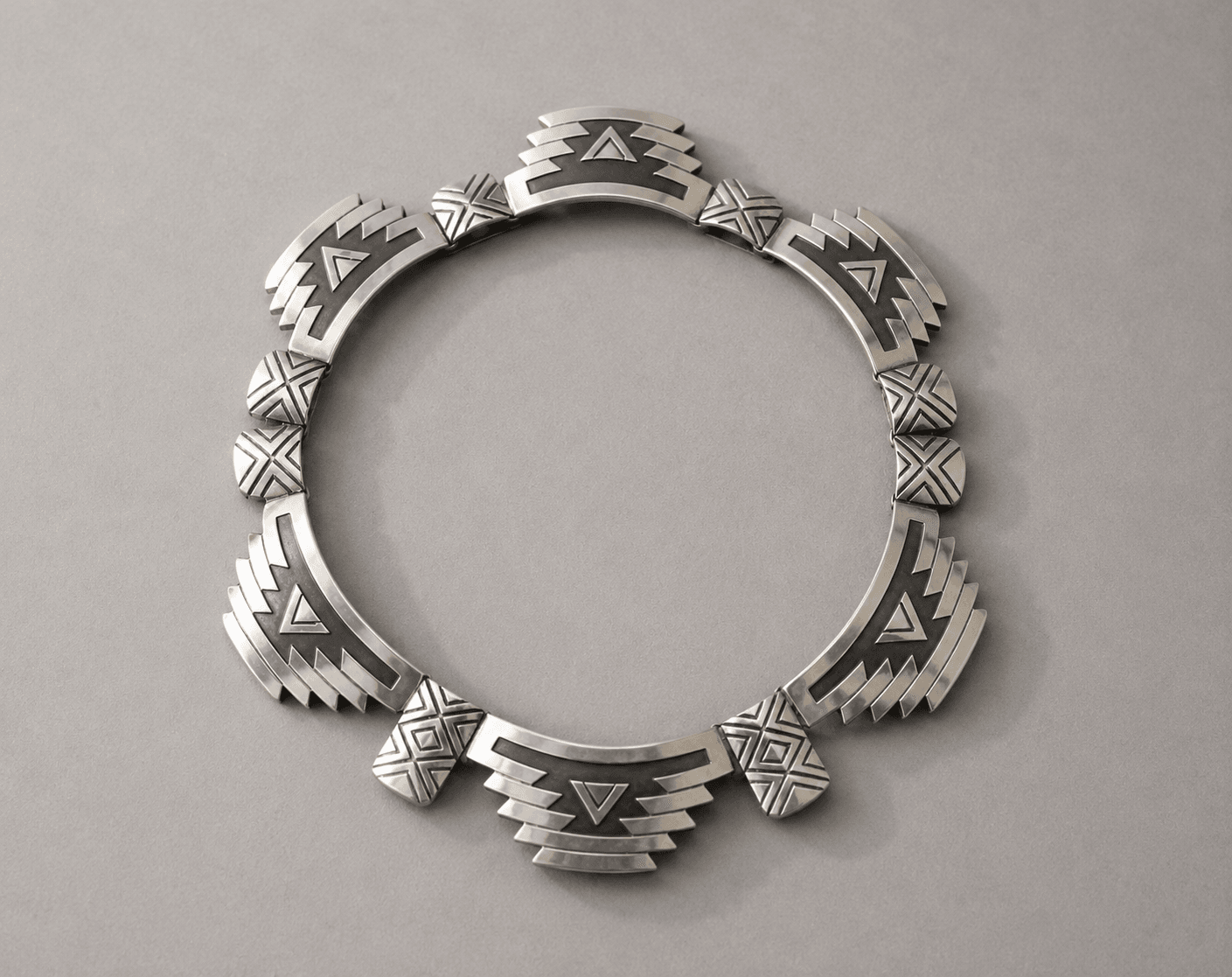
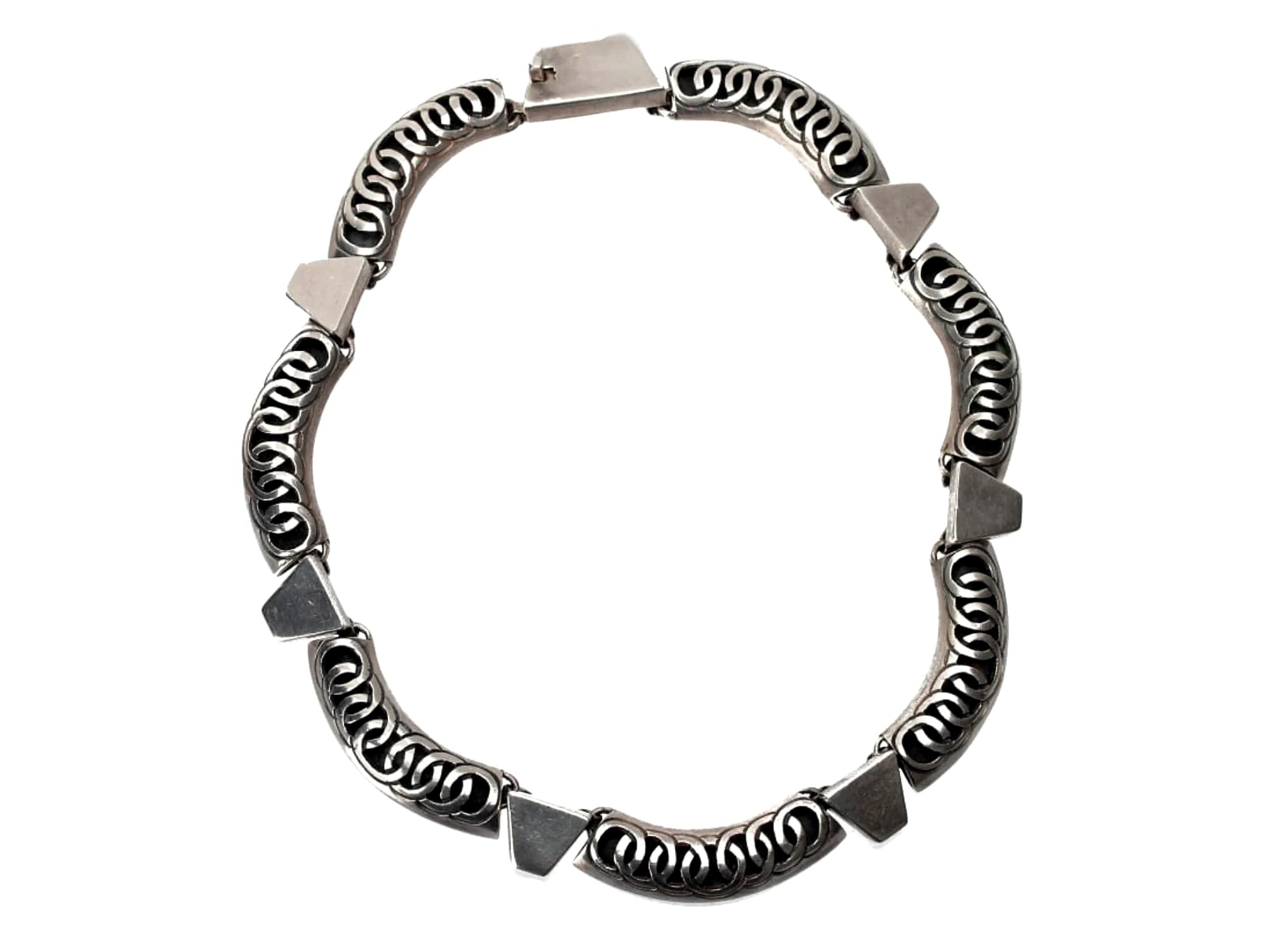
The necklace is a disciplined exercise in movement: curved sterling links are pierced into paired S-scrolls, their recessed channels darkened by oxidation, then set in rhythm against plain faceted connector plaques. The reverse shows the engineering plainly—broad, smooth-backed sections joined by small hinges—while the clasp link carries the model number 62, the circular VICTORIA MEXICO TAXCO shop mark of Ana María Núñez de Brilanti, an eagle assay stamp, and STERLING. Its power lies in that balance between ornament and restraint: each scroll link is open and animated, yet the necklace remains architectural, close to the neck, and emphatically modern.
Within Victoria’s work, the design belongs to Ana Núñez Brilanti’s broad language of handwrought Taxco jewelry rather than to a single borrowed motif. Morrill describes “Victoria” as both the original name of Brilanti’s shop and her signature mark, noting that her motifs and metal combinations were “varied and dynamic,” and that whether working in hollowware, copper, or silver necklaces, she pursued excellence in technique and presentation. Here the effect is achieved not through stone or mixed metal, but through pierced silver, relief edges, and controlled oxidization: the blackened voids make the scrolls read almost as drawing, while the polished rims catch the light as the necklace turns on the body. The alternating plaques keep the pattern from becoming floral or Rococo; they pull the scrollwork back into the geometric discipline that marks the strongest mid-century Taxco collars.
The marks are especially important. Morrill records that Brilanti launched Victoria in 1940 after encouragement from other Taxco silversmiths, including Margot, and that William Spratling and Antonio “Chato” Castillo were helpful in the workshop’s early development. The eagle assay stamp on this necklace places it in the era when the Mexican government mark was used to assure buyers of quality; Morrill explains that each silversmith was assigned a numbered eagle stamp and that the system was later replaced by the T-number. Comparable eagle-period Victoria jewelry appears in the market with the same circular Victoria mark and numbered designs: a Brilanti “Double Angel” suite, design 53, marked Victoria Taxco Mexico, sterling, and eagle 12, has the Platería Victoria marks dated to circa 1948–1958.
Museum Significance
This necklace is a compact statement of why Ana Núñez Brilanti matters within the Taxco school. She was not merely a shop proprietor but an artist-director of a major taller, one of the women whom Morrill identifies as artists and businesswomen who conceived designs, directed manufacture, and built retail networks in Mexico and the United States. The necklace’s crisp piercing and clean articulation embody the workshop standard Morrill attributes to Victoria: Brilanti’s insistence that no poorly made piece be sold, and her belief that silverwork was exacting labor rather than merchandise to be sold by weight.
Museum of Mexican Silver. “Design 62 Scroll Link Necklace.” Catalog no. MoMS-002049. https://museumofmexicansilver.com/pieces/victoria-taxco-design-62-scroll-link-necklace
See something wrong with this record? Suggest a correction and the piece details fill in automatically.
Its significance is also historical. Victoria closed its shop in 1975 and liquidated the workshop in 1978, at which time Morrill records that it still numbered fifty silversmiths. That makes an eagle-stamped, model-numbered Victoria necklace more than a decorative collar: it is evidence of the mature workshop system before its decline. Recent auction records show that Brilanti’s necklaces and suites continue to circulate in the design market, but usually as isolated examples rather than as deeply documented workshop objects. For the Museum of Mexican Silver, model 62 preserves the Victoria vocabulary at its most wearable—modernist, technically exact, and unmistakably Taxco.
Ana Núñez Brilanti (Victoria de Taxco)
Fleur-de-Lis Necklace