Saves instantly, no account needed. Already a member? Sign in.
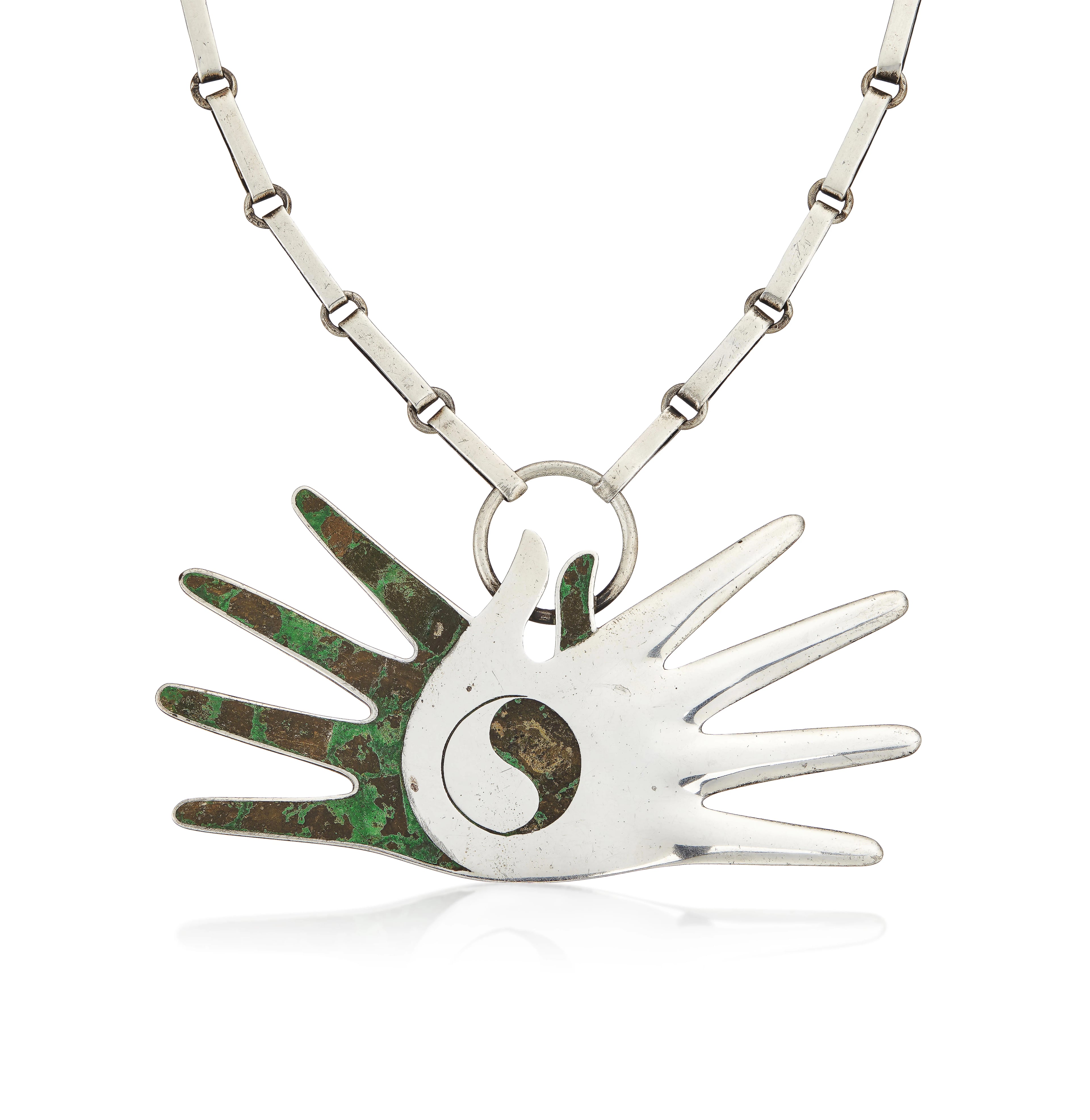
Among the conceptual jewels William Spratling worked and reworked across his career, the opposed-hands design holds a particular place, and this necklace is one of its less common resolutions. The motif recurs over decades in different materials, a 1951 example pairing the winged hands with tortoise shell and later versions of the 1960s set with green malachite, so the model can be traced across the arc of his output. Carrying the script-WS mark of the 1956-62 workshop, the piece documents both a signature motif and a precise moment in the evolution of Spratling's marks and standards, making it a resonant object for understanding the mature phase of the Taxco silver master.
Two hands, fingers splayed wide, reach toward one another across the breadth of the pendant, one rendered in bright planished silver and its opposite filled with mottled green hardstone, the seam between them resolving at center into a small inlaid yin/yang roundel. The composition turns a pair of human hands into an emblem of balance and complement, positive against negative, polished metal against earthbound stone, and hangs from a chain of slender silver bar links that lets the broad pendant float at the breastbone. The pendant measures 13.0 by 7.3 centimeters on a necklace of 39.0 centimeters, at once a piece of body sculpture and a meditation, the kind of object in which Spratling collapsed the distance between ornament and idea.
The hand is among the motifs he returned to throughout his life. As early as the late 1930s the Taller de las Delicias produced a series of brooches, cuffs, bracelets and necklaces depicting a woman's hand in silver holding a carved amethyst flower, elegant hands with lace cuffs that the scholarship ties to Valentin Vidaurreta's appreciation of the Mexican colonial period (Morrill, 1996, p. 84). The opposed yin/yang hands of this later design are a separate, modernist resolution of that long fascination, paring the motif down to silhouette and symbol. The pairing of bright sterling with stone inlay likewise belongs to a documented house language, the hand-decorated and pendant necklaces that were retail staples in the Taxco shops (Morrill, 1996, p. 36).
The marks place the piece firmly in Spratling's late maturity. After mid-century he was again permitted to register his name in Mexico and adopted the stamp reading WILLIAM SPRATLING TAXCO MEXICO .925 over his script initials, the so-called script-WS mark in use from about 1956 to 1962, with an eagle 30 assay stamp struck partially indistinct. By that period the 980 silver standard of the early Spratling y Artesanos years had long been abandoned in favor of sterling (Morrill, 1994, p. 53; Morrill, 1996, p. 208). The broad pendant, the inlay seated cleanly into the silver, and the architecture of the bar-link chain are all consistent with the well-organized Taxco workshop production of those years.
Museum of Mexican Silver. “'Hands' Hardstone Necklace.” Catalog no. MoMS-002082. https://museumofmexicansilver.com/pieces/william-spratling-hands-hardstone-necklace
See something wrong with this record? Suggest a correction and the piece details fill in automatically.
William Spratling
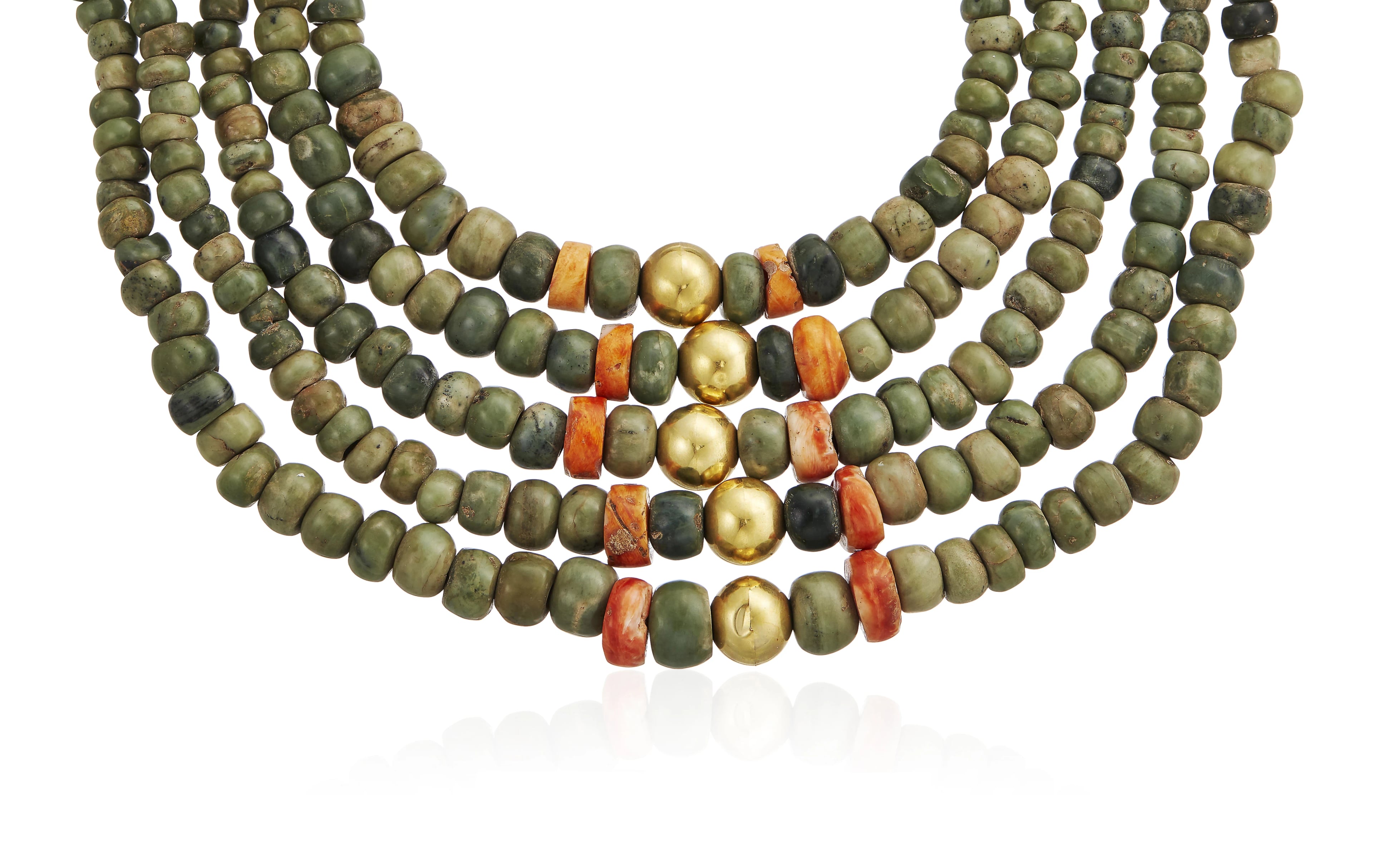
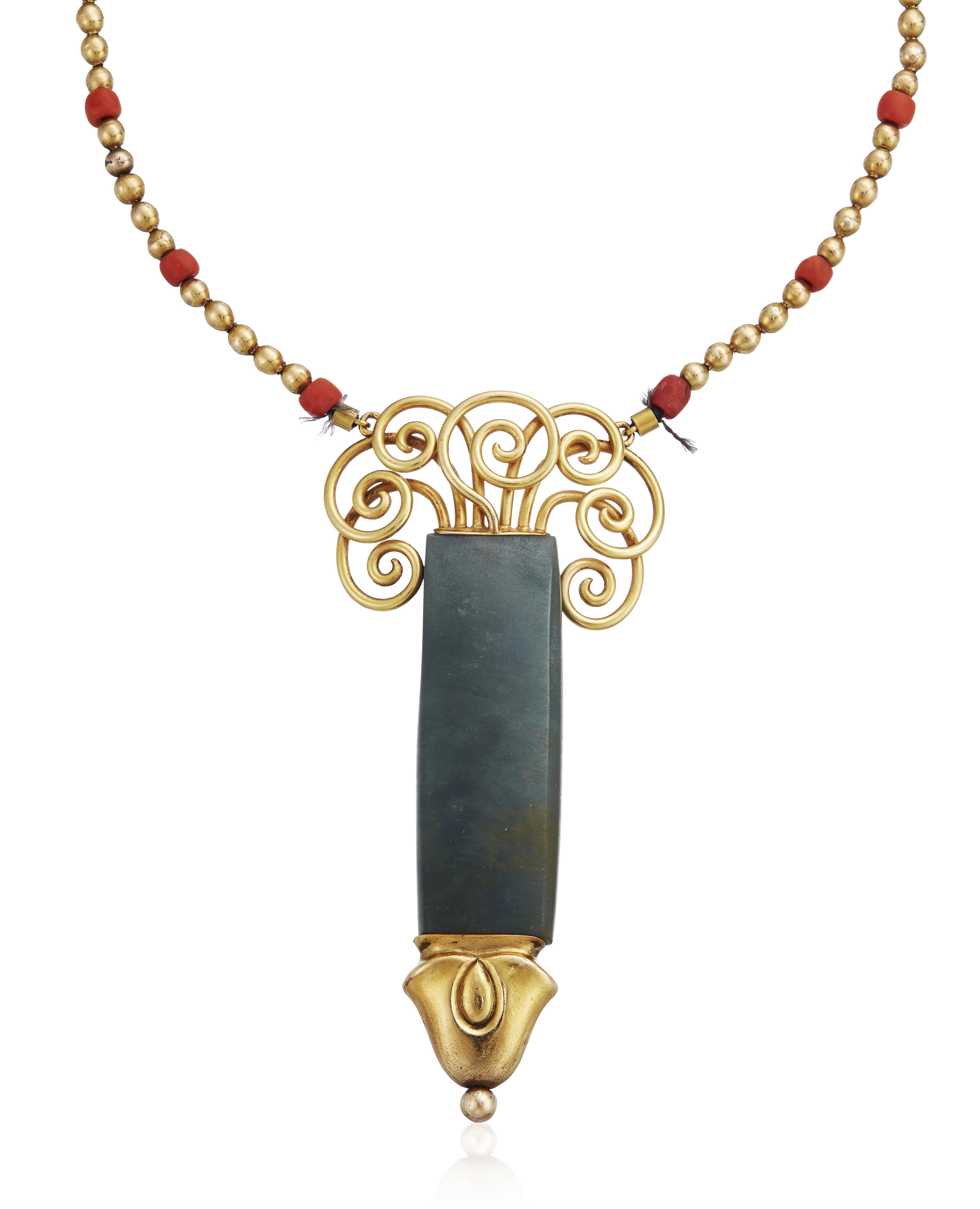
Jade and Coral Pendant Necklace
18k yellow gold