Saves instantly, no account needed. Already a member? Sign in.
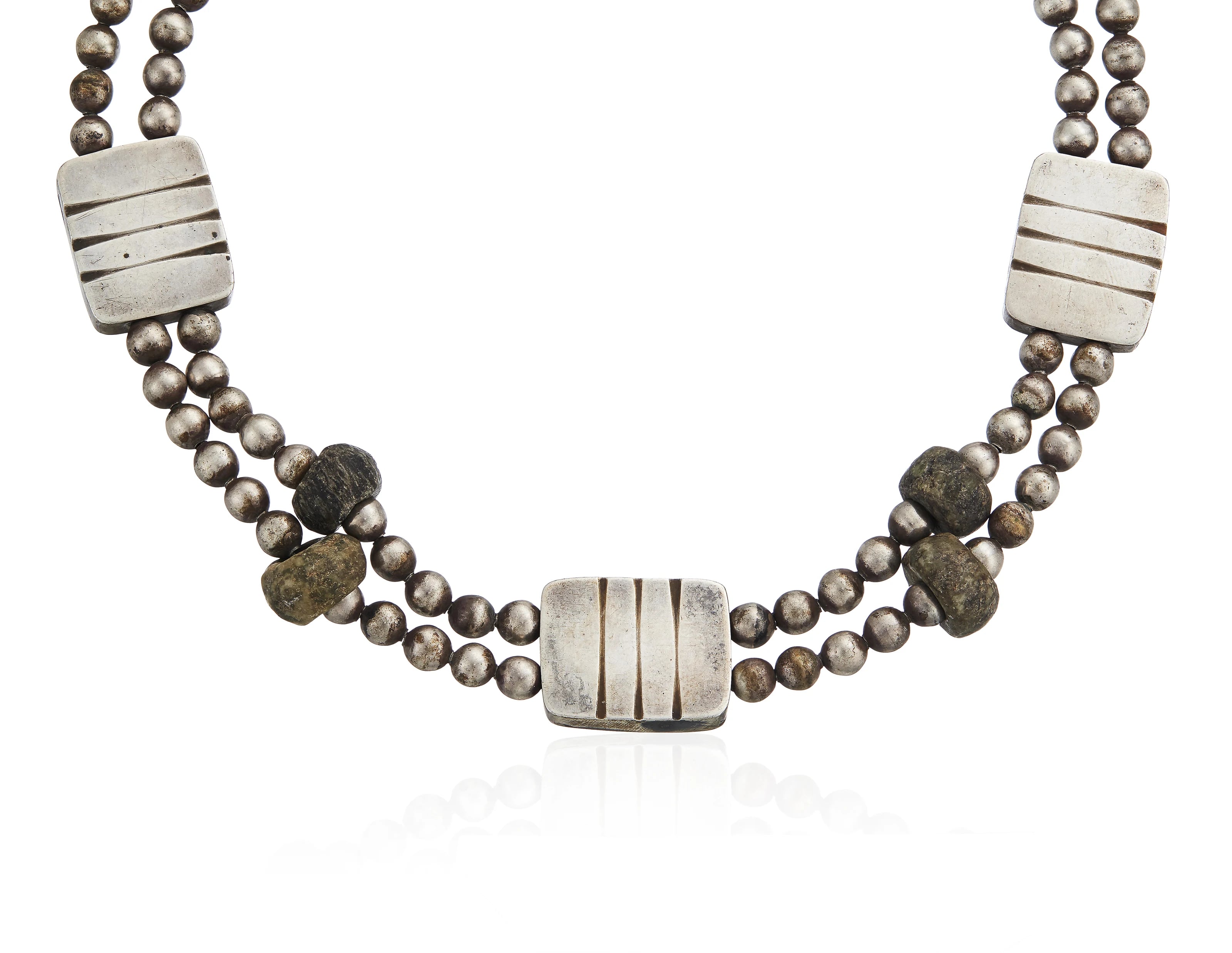
A first-period Spratling necklace is among the most direct evidence we have of how the Taxco silver revival actually began: as an object made by hand, marked by hand, in the few years before the workshop on the Calle de las Delicias grew into an industry. This double strand of silver beads, punctuated by three deeply grooved rectangular stations and a scatter of irregular hardstone beads, carries the conjoined WS struck twice along with TAXCO and 980, the constellation of marks that places its making at the very end of the first decade of production. It is a working piece rather than a presentation jewel, and its importance lies precisely there: it shows the early shop translating pre-Columbian and indigenous bead traditions into something a North American clientele could wear, in the years when that translation was still being invented.
The design reads as deliberately archaic. Spratling built his early vocabulary out of pre-Columbian sources, taking motifs from ancient design and rendering them in a form accessible to an American audience and clientele, and relying on local materials and existing craft resources rather than imported ornament (Stromberg, Antonio Pineda, 2008, p. 27). Here that impulse appears in the strung silver beads themselves, an idiom rooted in indigenous and ancient Mexican adornment, and in the rough, unfaceted hardstone beads left close to their natural state. Against them the three rectangular silver stations are crisply geometric, their parallel incised grooves catching light in a way that sets refined metalwork against raw stone. The interplay is characteristic of the period's best work, where a strong, simple silhouette is given emphasis through contrast and oxidized shadow.
The marks themselves date the piece. Spratling stamped each design with a joined WS based on the brand he used for his horses, insisting on the mark to identify the silver of his workshop with his name and his growing reputation, and he paired it with 980, signifying a silver content higher than sterling, twenty parts copper to nine hundred and eighty parts silver, a standard he preferred (Morrill, Mexican Silver, 1994, p. 39). The particular form of the conjoined WS used here belongs to the closing years of the first period, immediately before Spratling replaced it with the circular mark carrying his full name around 1940, after which the simple struck initials of the early shop gave way to a more formal trademark. A necklace bearing the doubled early WS together with TAXCO and 980 therefore sits squarely in that brief, formative window.
Museum of Mexican Silver. “Hardstone and Silver Necklace.” Catalog no. MoMS-002059. https://museumofmexicansilver.com/pieces/william-spratling-hardstone-and-silver-necklace
See something wrong with this record? Suggest a correction and the piece details fill in automatically.
It has close kin in the published record. Penny C. Morrill illustrates a Spratling assemblage necklace of 980 silver and obsidian, described expressly as a pre-Columbian necklace, comparable in spirit to the early strung work coming out of the same circle (Morrill, Silver Masters of Mexico, 1996, p. 15). Pieces of this kind, combining hand-rolled silver beads with stone in the late 1930s and early 1940s, are the substrate from which the entire Taxco school grew, and a securely first-period example carrying the full early mark set is a meaningful survival from the moment the movement was finding its voice.
William Spratling
Picture Jasper and Silver Bead Necklace
Silver