Saves instantly, no account needed. Already a member? Sign in.
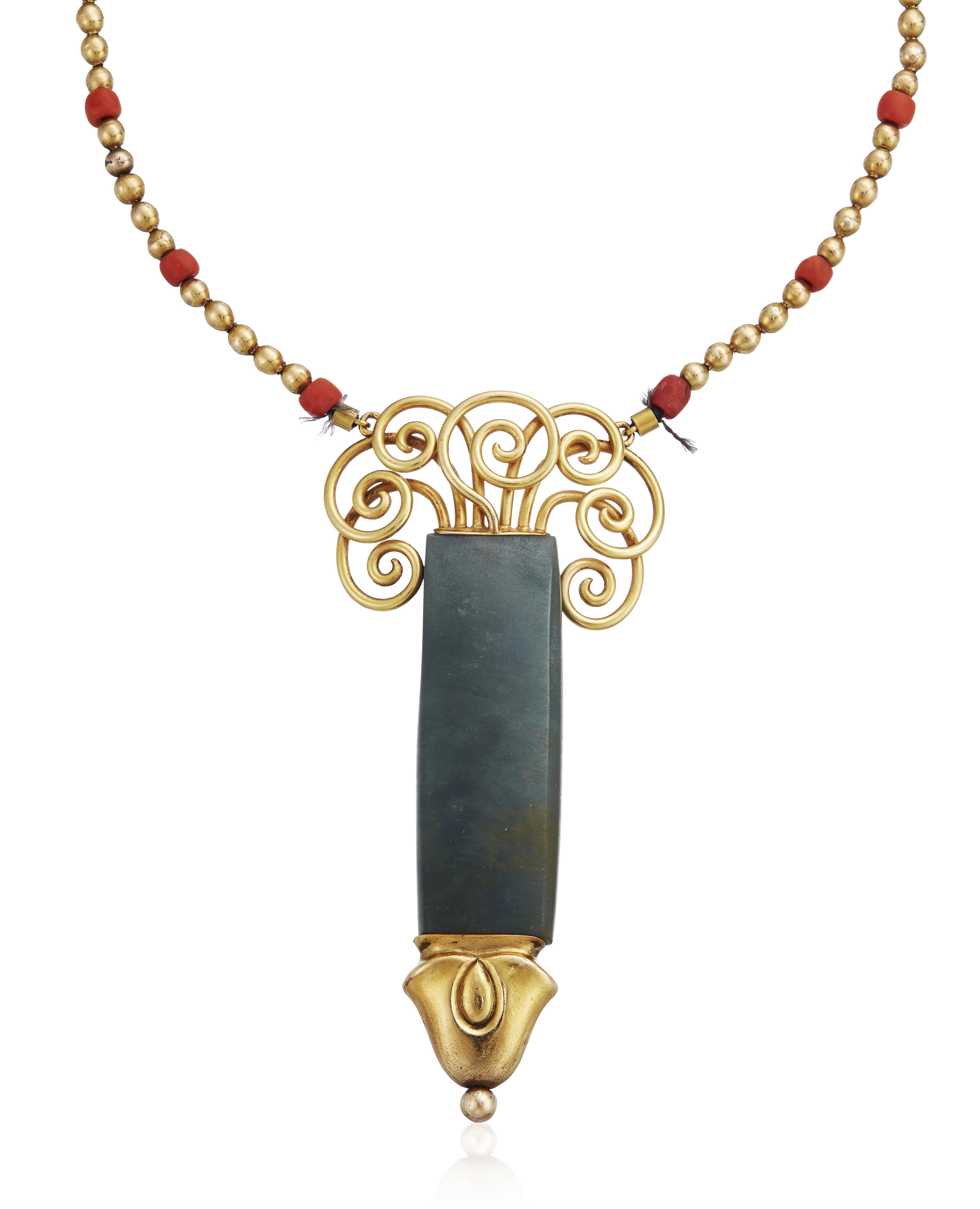
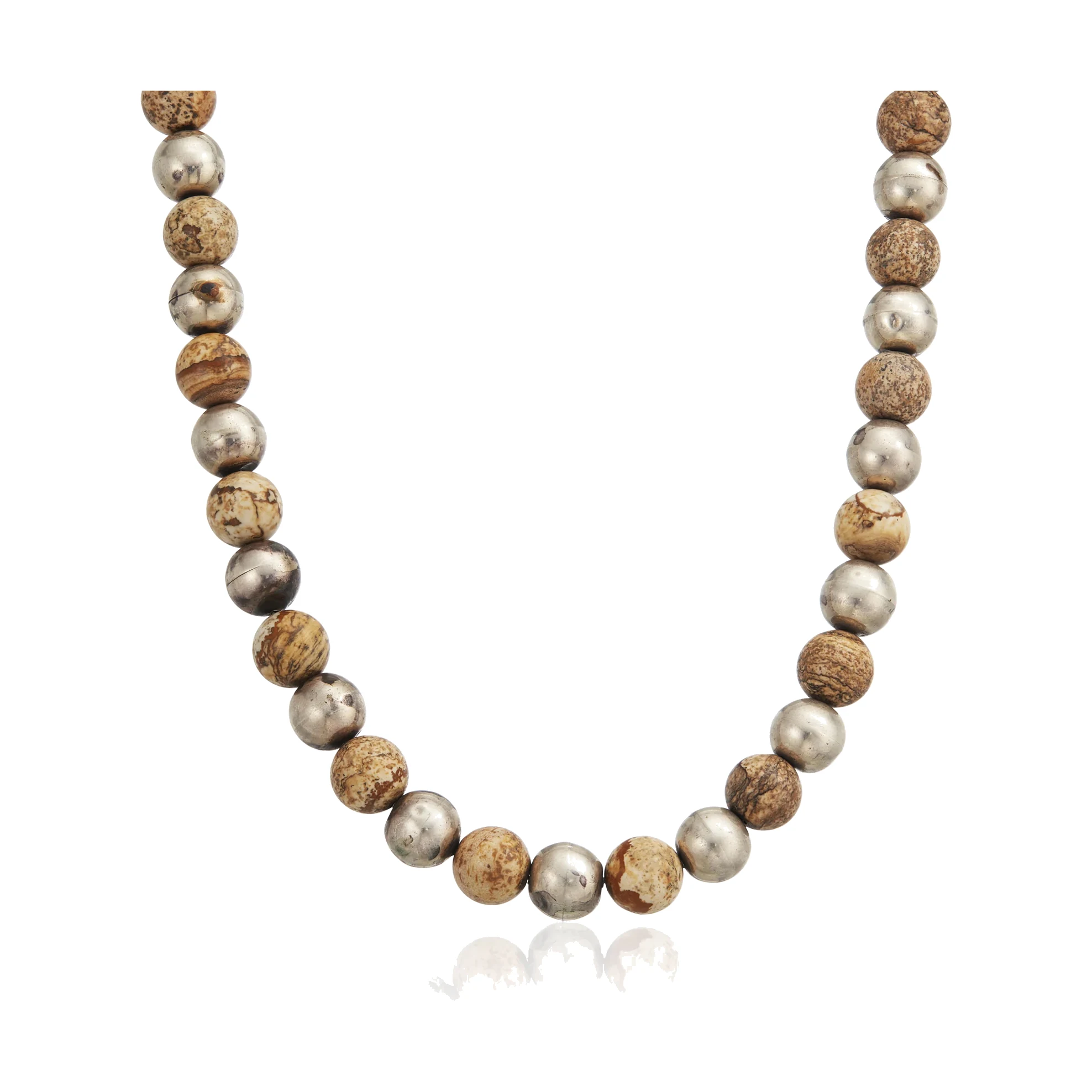
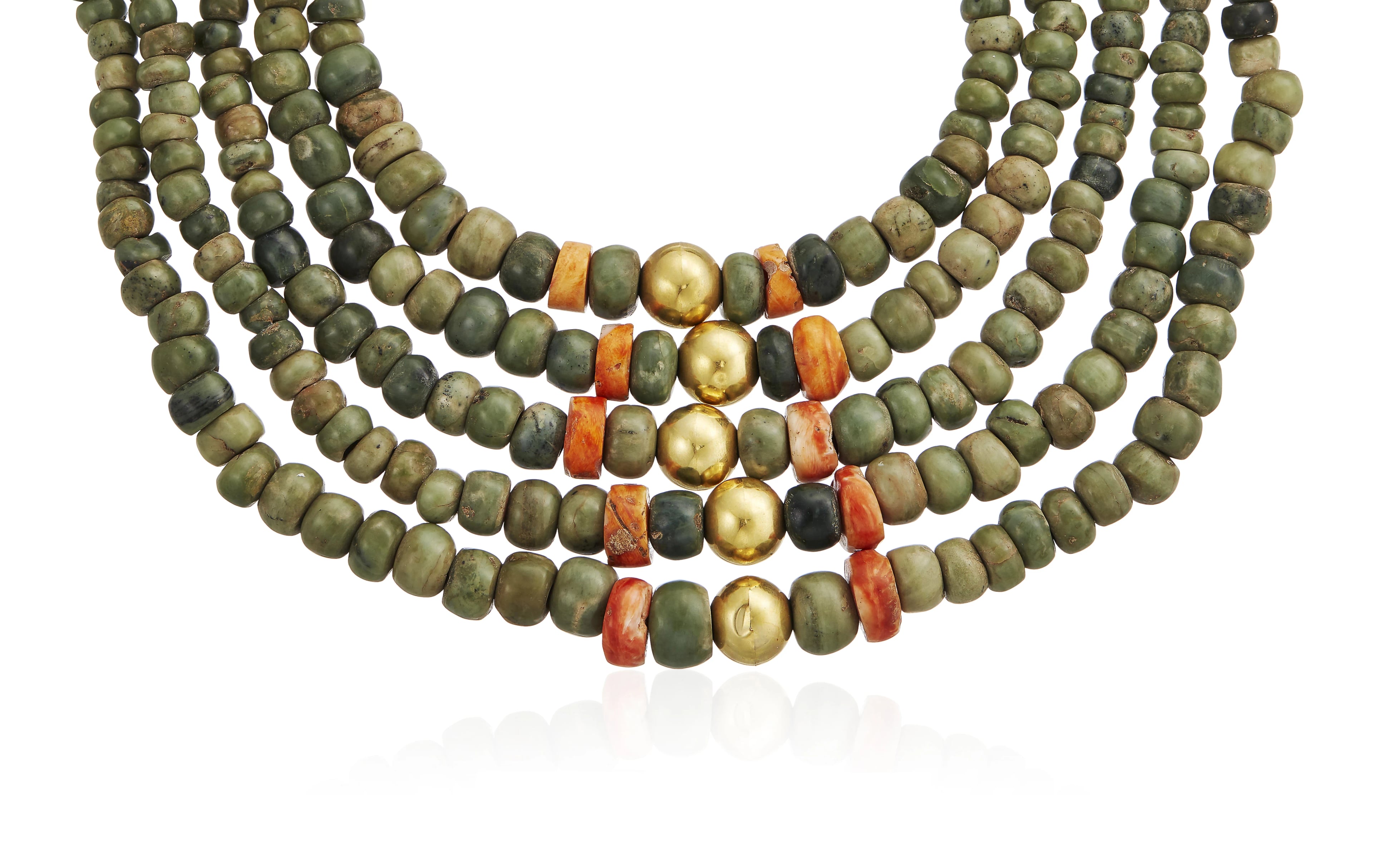
Five strands of graduated green hardstone beads, gathered into gold at each terminal and interrupted by ten spiny oyster rondels, organize this necklace around color and grade rather than around a central pendant or a worked metal form. The beads climb from roughly five and a half millimeters to nearly thirteen, so the strands thicken toward the center of the chest and taper toward the clasp. William Spratling built the piece in eighteen karat gold rather than the silver that carries his name in most collections, and the choice matters: the warm metal reads as punctuation among the green stone and the orange red oyster, not as the dominant material. The design depends on quantity and gradation, on the way many small units accumulate into a weighty, mobile mass across the throat and collarbone.
The construction is essentially additive, and Spratling controls it through rhythm. Green hardstone provides the field, an even, opaque green that shifts subtly with the size of each bead. Against that field the ten spiny oyster rondels supply the only strong contrast, their orange red saturation set off by small gold beads that frame and separate them. Spiny oyster, harvested from the Pacific and Gulf coasts, was a shell prized in ancient Mesoamerica for exactly this color, and its pairing with green stone recalls the green and red juxtapositions of much older Mexican ornament without copying a specific object. The five strands graduate in length from thirty six to fifty three centimeters, so they nest rather than tangle, each strand riding at a different height. At two hundred forty grams gross, the necklace carries real weight, and that weight is distributed through the many beads rather than concentrated in a single element.
The WS mark and the eighteen karat gold place the piece within Spratling's later production, the years after 1950 when he worked increasingly in gold and pursued material experiments beyond the Taxco silver idiom. His interest in beadwork and in stones of local and regional origin runs through this period, and his writing from the same years shows him thinking about beaten gold set with regional materials as a serious market for objects of quality. The reliance on strung graduated beads also connects to the older Guerrero goldworking traditions that predated his arrival, the filigree and multicolor gold jewelry documented among the region's craftsmen, and to the practice, noted in the same literature, of incorporating ancient beads and Pre-Columbian motifs into work made for a wider audience. Spratling's contribution here is compositional rather than sculptural: he selects, grades, and sequences existing bead and shell forms into a resolved whole.
Museum of Mexican Silver. “Hardstone and Spiny Oyster Necklace.” Catalog no. MoMS-002096. https://museumofmexicansilver.com/pieces/william-spratling-hardstone-and-spiny-oyster-necklace
See something wrong with this record? Suggest a correction and the piece details fill in automatically.
Within a collection built largely on Spratling's silver, this necklace documents the gold side of his practice and his sustained attention to stone and shell as primary expressive material. It shows a designer better known for architectural silver forms working instead through color, gradation, and the accumulation of small units, and it preserves his use of spiny oyster, a material with deep regional and ancient associations, as the single chromatic accent in an otherwise green and gold composition. The piece records a phase in which Spratling treated jewelry as an arrangement of materials rather than a worked metal object.
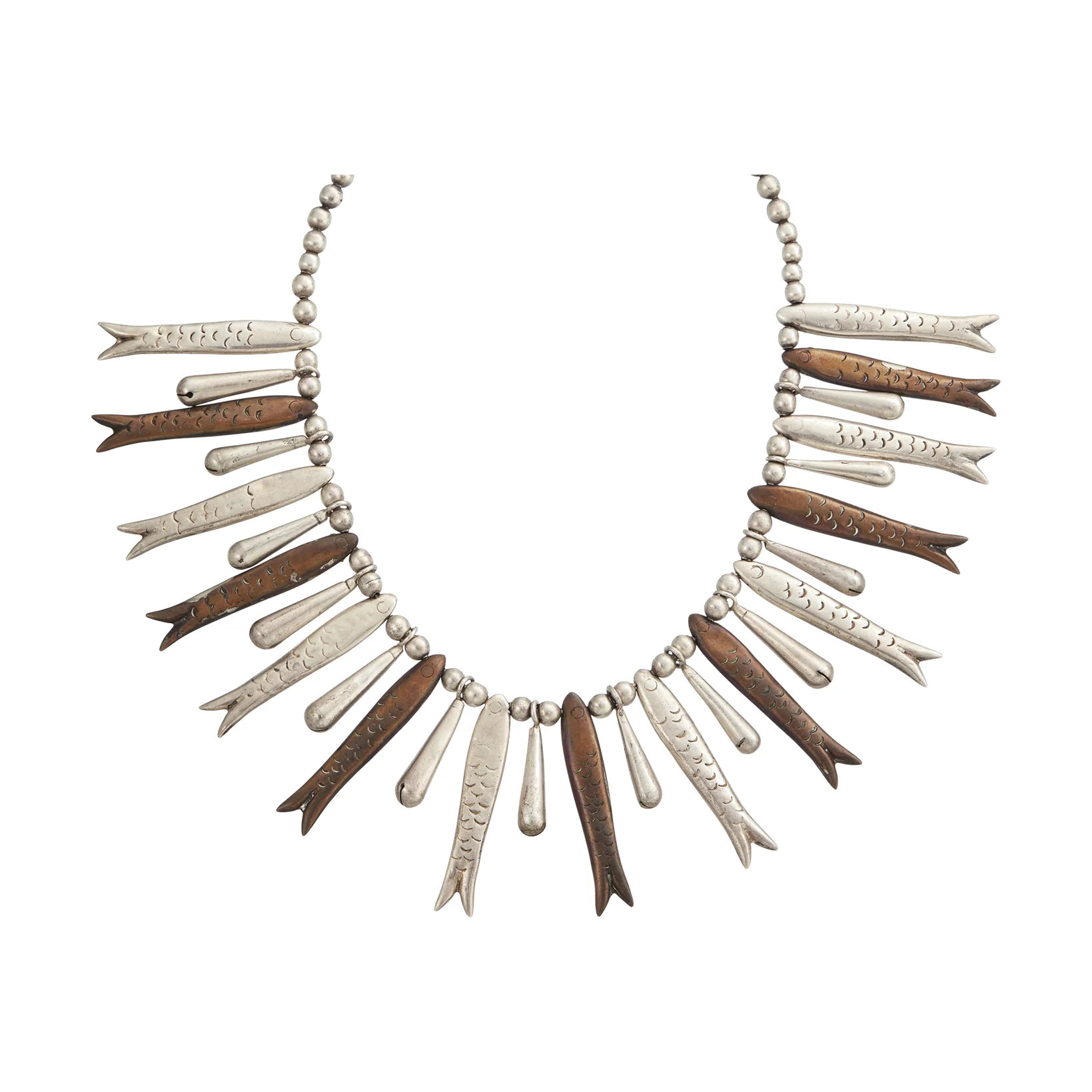
William Spratling
Silver and Copper Fish Necklace
Silver