Saves instantly, no account needed. Already a member? Sign in.
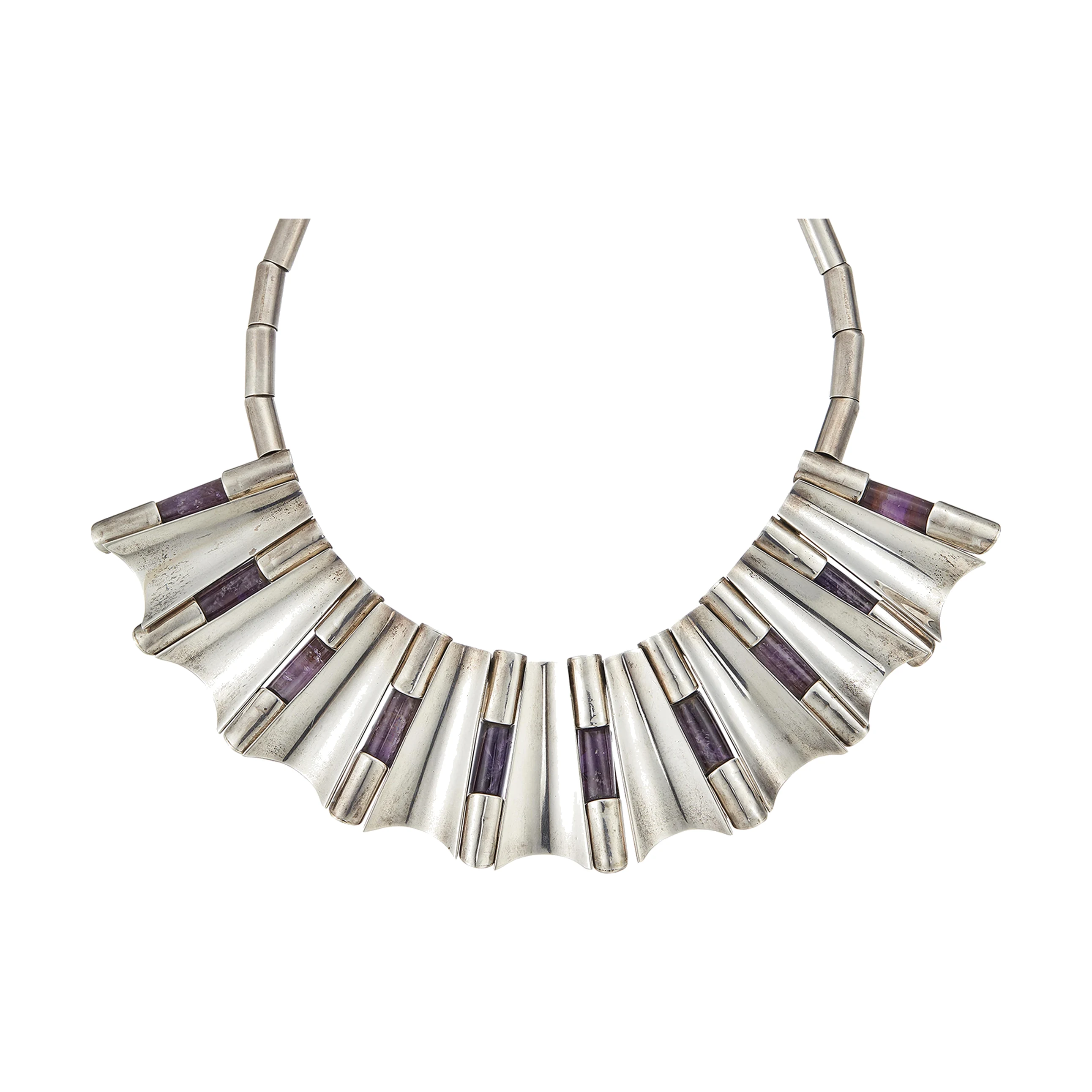
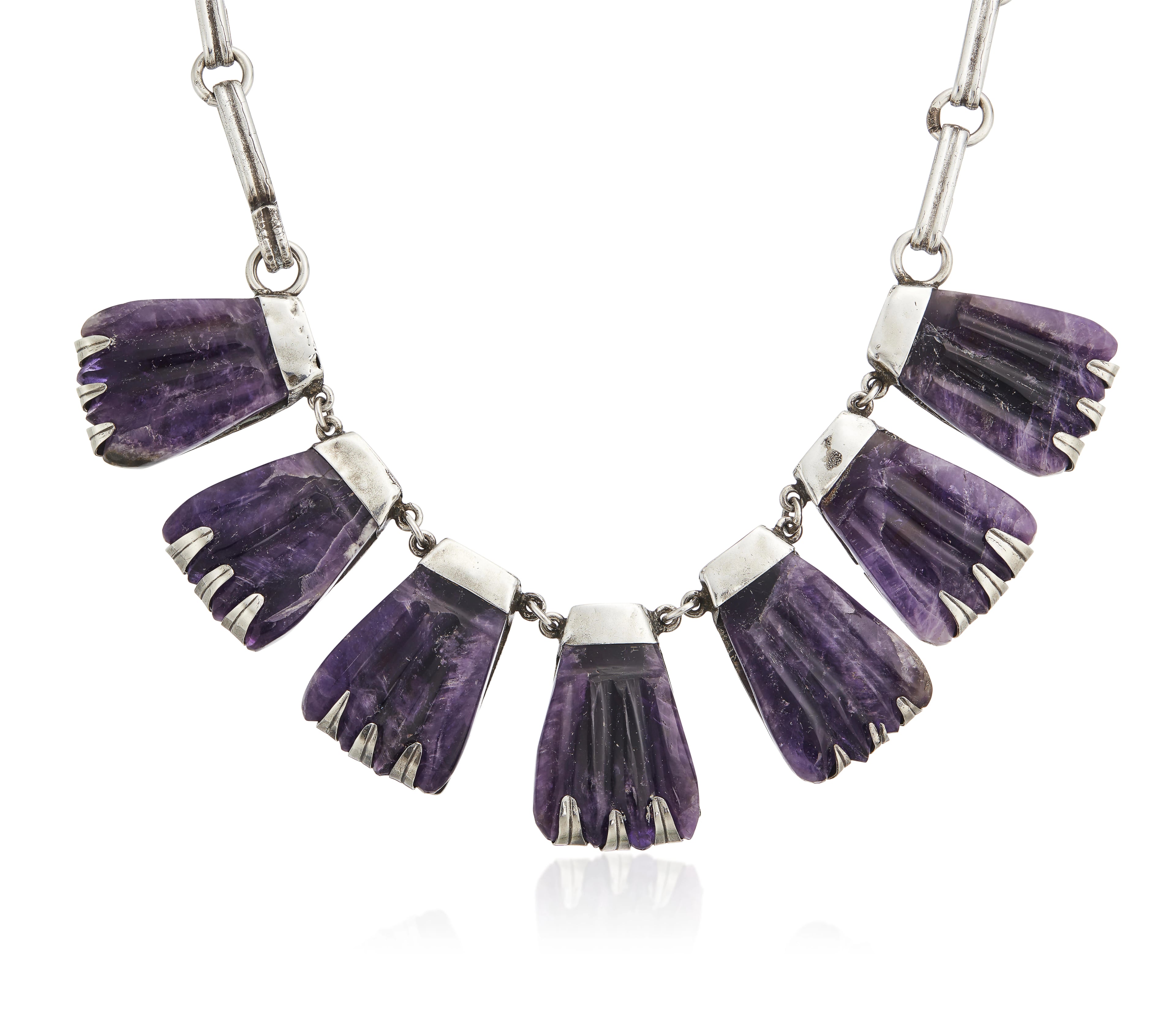
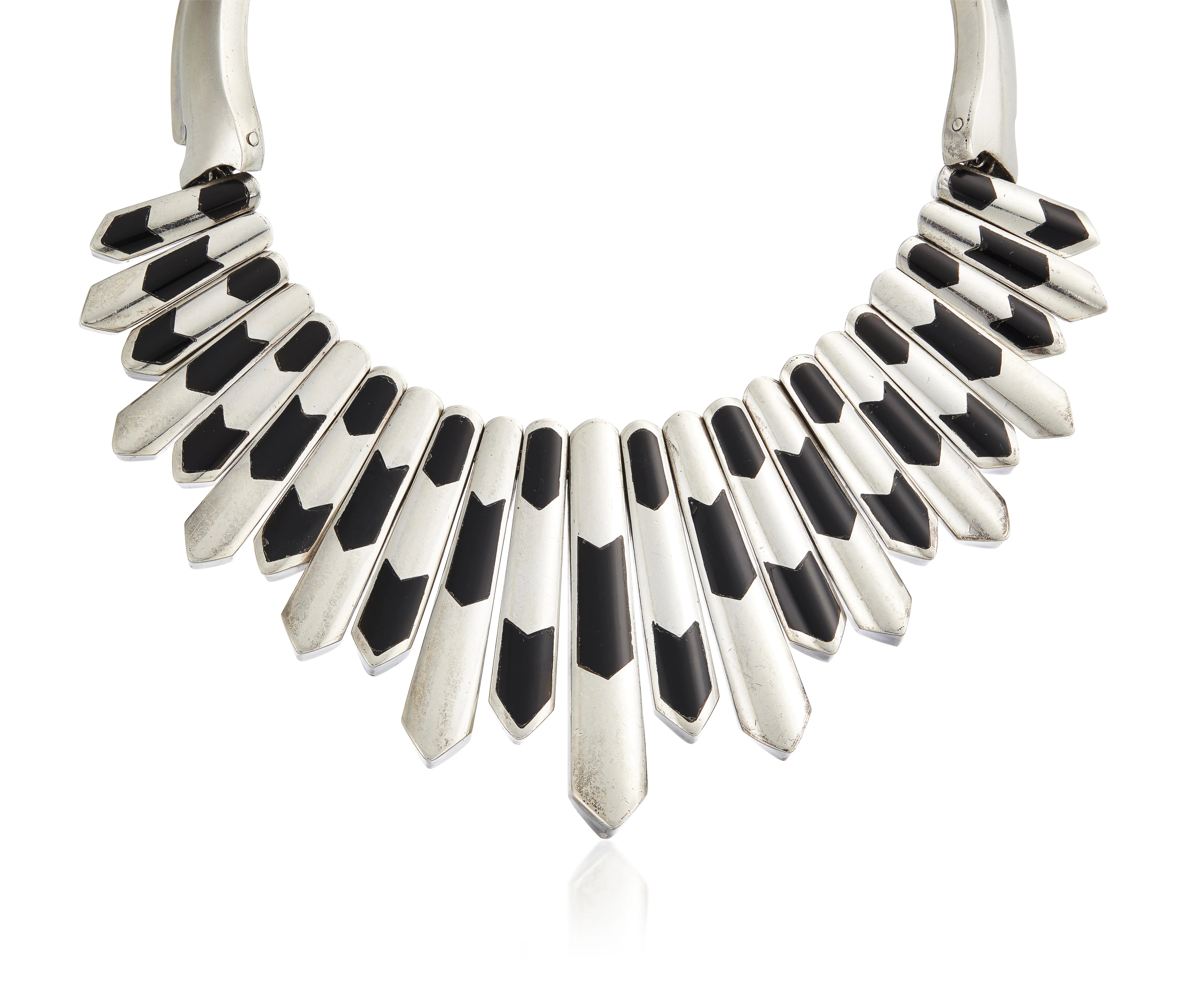
A graduated bib of tapered, lance-shaped silver elements falls from a hinged collar, each plaque inlaid with black onyx cut into crisp chevrons and bands so the whole splays like a sunburst or a feathered breastplate across the chest. It is an ambitious, fully resolved statement piece rather than a quiet daytime ornament, and it shows Antonio Pineda working at the height of his powers: the geometry is severe and architectural, yet the construction is engineered to move and sit against the body. Pieces of this scale and finish sit at the upper end of his necklace output and are exactly the kind of bold, sculptural work that carried the Taxco "Silver Age" into the international design conversation.
The fabrication and the marks place it squarely in his mature workshop. The piece carries the ANTONIO crown signature with HECHO EN MEXICO, the eagle assay stamp, and the 970 fineness mark — the same cluster of marks that recurs across Pineda's documented mid-1950s production, where the crowned ANTONIO, the eagle, and the 970 standard appear together on necklaces and bracelets of this period (Penny C. Morrill, Silver Masters of Mexico: Héctor Aguilar and the Taller Borda, 1996, pp. 180-181). The 970 standard, a silver slightly finer than sterling, was Pineda's preferred alloy, and the small Mexican eagle mark instituted in 1948 to register Taxco's workshops is the assay he used through these years. Against the bright, hand-finished silver, the onyx is set flush as inlay rather than as raised cabochons, a discipline that keeps the design planar and graphic — the simplified, abstracted geometry that defined his version of Mexican modernism.
Pineda founded his own taller in Taxco in 1941 and built a reputation, recognized well beyond Mexico, for marrying pre-Columbian formal economy with the hard-edged vocabulary of Art Deco and mid-century modernism. The breadth and quality of that output was the subject of "Silver Seduction: The Art of Mexican Modernist Antonio Pineda" at the Fowler Museum at UCLA in 2008-2009, an exhibition of nearly two hundred works that included more than fifty necklaces alone. A graduated onyx-and-silver bib of this kind belongs to that body of major neckwear: substantial in the hand, theatrical on the body, and unmistakably his.
Record data: Materials now read 970 silver and onyx; the field previously recorded silver alone, although the note describes the onyx inlay and the 970 mark. The title has been changed from the generic "Onyx and Silver Necklace" to Onyx-Inlaid Fringe Collar Necklace, which identifies the form. The Antonio crown mark with the 970 standard is recorded in the Marks field and dates the object to 1953 or later; the eagle assay stamp described in the note was instituted in 1948. No design number is legible in the material held for this example, so the field is left empty rather than guessed at.
Museum of Mexican Silver. “Onyx-Inlaid Fringe Collar Necklace.” Catalog no. MoMS-002054. https://museumofmexicansilver.com/pieces/antonio-pineda-onyx-and-silver-necklace
See something wrong with this record? Suggest a correction and the piece details fill in automatically.
Citations: the note cites Penny C. Morrill, Silver Masters of Mexico: Héctor Aguilar and the Taller Borda (1996), pp. 180-181, for the mark cluster, but References previously listed Stromberg only. The Morrill volume has been added so that the citation in the prose is matched by an entry in References.
Antonio Pineda
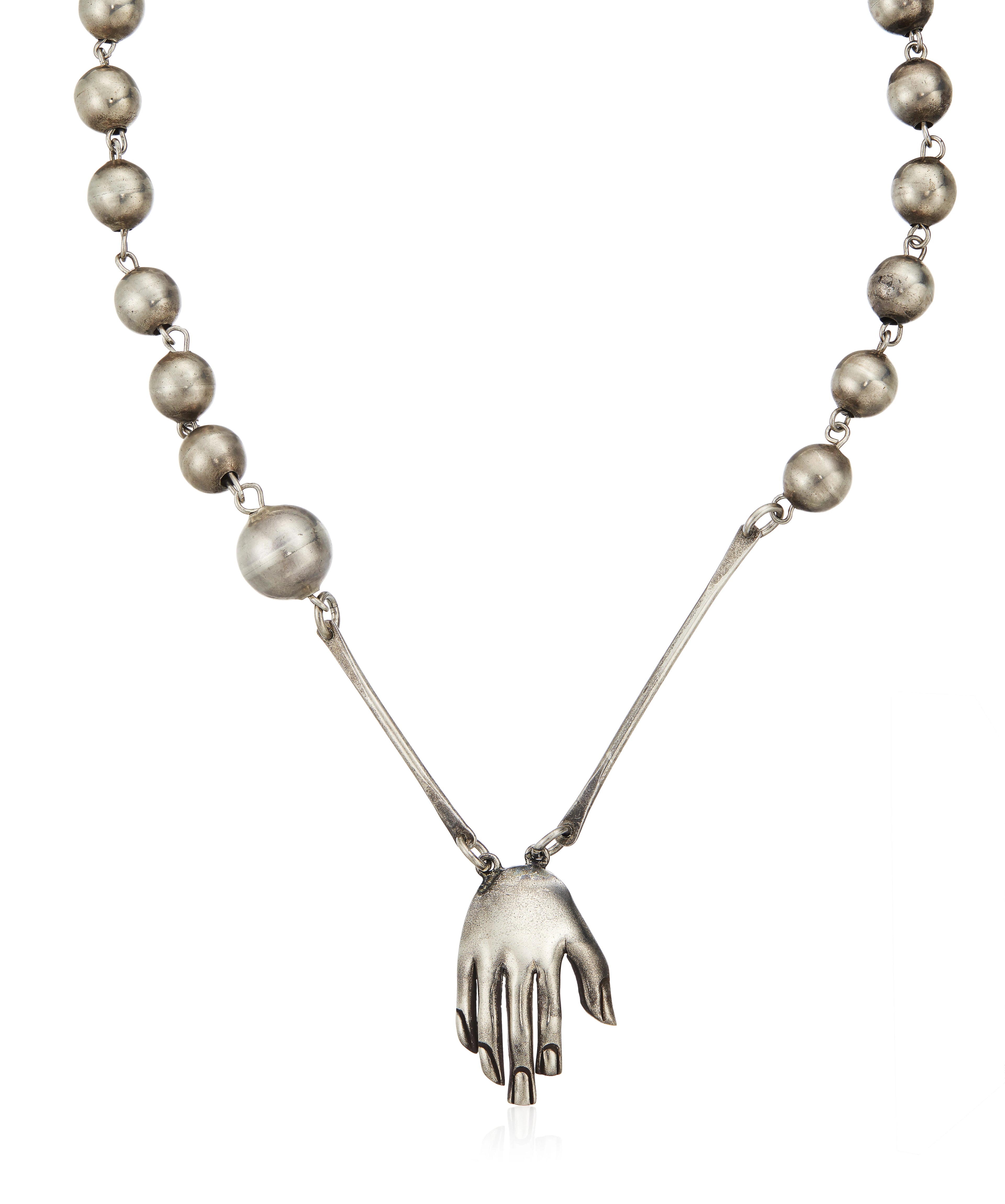
Hand Pendant Necklace
Silver