Saves instantly, no account needed. Already a member? Sign in.
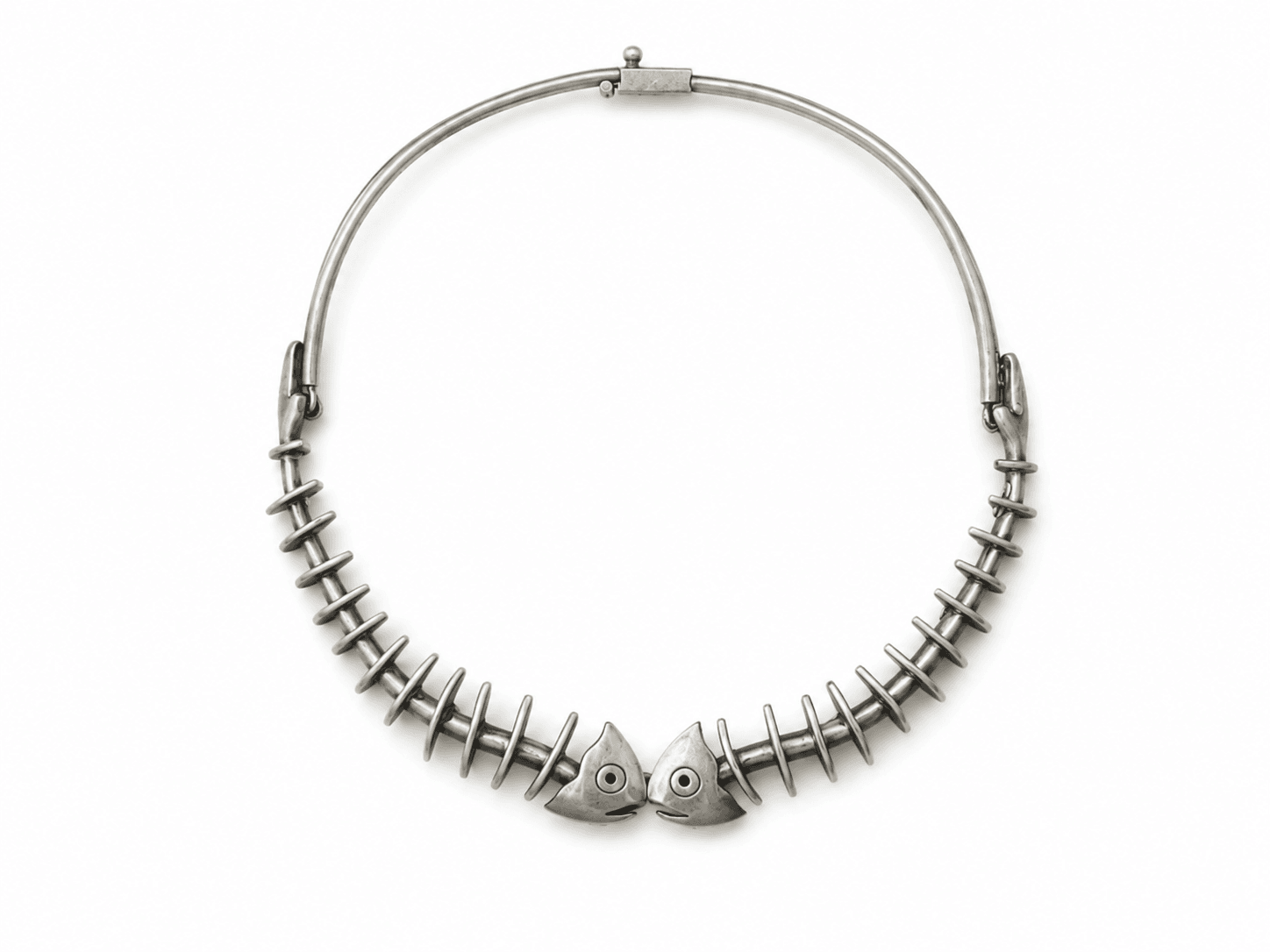
Two fish meet nose to nose at the throat, their heads polished and pivoting on a spine of graduated silver rib-bones that flexes the whole length to the curve of the neck. The skeletal fish — a fish stripped to its bones and then set gleaming — is among the most recognizable conceits in Antonio Pineda's repertoire, mid-century wit carried off with structural seriousness rather than caricature.
Each bone is a discrete cast element threaded along a curved central bar, so the band articulates and sits close as a collar rather than hanging as a chain. The ribs lengthen as they near the center, drawing the eye toward the two confronting heads where the design resolves; the effect is all rhythm and taper, line answering line toward the symmetrical clasp.
The necklace is worked in 970 silver, the high-purity alloy Pineda favored, and carries the full anatomy of marks: the Antonio-Taxco crown, the 970 fineness stamp, the TAXCO MEXICO origin mark, and the government eagle — the cluster Stromberg lays out as the signature of a Pineda piece. At roughly 41 centimeters it sits as a collar, holding the confronting fish at the throat.
Pineda came up through the Taxco school, apprenticing in William Spratling's orbit before opening his own workshop in 1941 and building it into one of the town's major modernist studios. The skeletal fish belongs to that mature output, a motif he returned to across a family of forms — necklace, cuff, brooch, earrings — the articulated spine its most ambitious carrier.
Record data: the marks described in this note — the Antonio crown with the 970 fineness stamp, TAXCO MEXICO and the government eagle — are now recorded in the Marks field, and the 970 standard is entered under Materials. The date is entered as 1953 or later, which is what the crown-and-970 cluster supports. The length of approximately 41 cm is entered as a structured dimension, flagged as approximate. Fabrication is recorded under Techniques: cast rib elements threaded along a curved central bar, hand-finished.
Still outstanding: an exact citation. Stromberg's Silver Seduction is added to References as the source for the mark cluster and for Pineda's skeletal-fish family, but the specific page and figure for this necklace has not been identified, and the record should carry that page reference once it is. The 41 cm figure should also be replaced by a measurement taken from the object.
Museum of Mexican Silver. “Sculptural Fish Skeleton Necklace.” Catalog no. MoMS-002108. https://museumofmexicansilver.com/pieces/antonio-pineda-skeletal-fish-necklace
See something wrong with this record? Suggest a correction and the piece details fill in automatically.
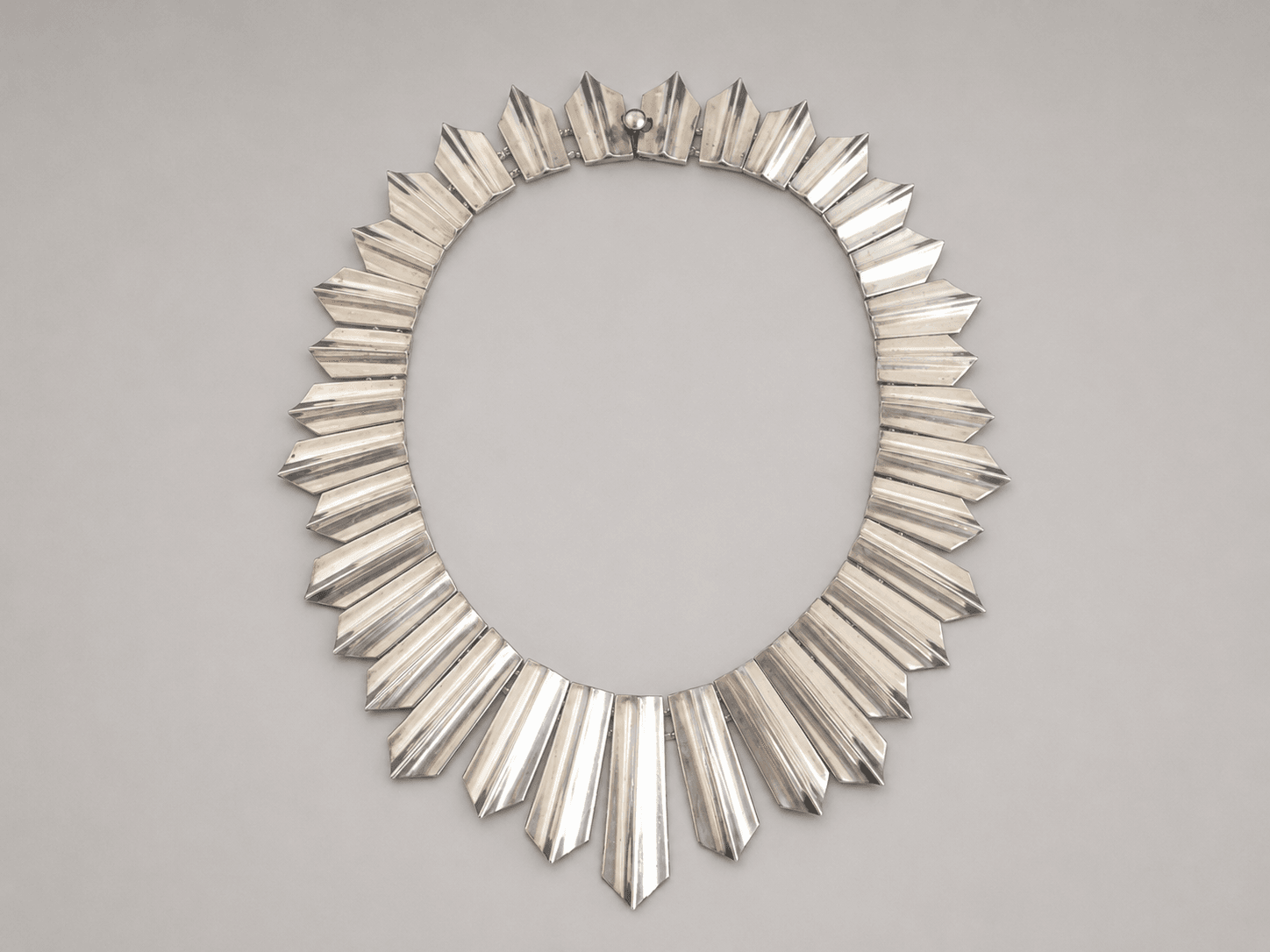
Antonio Pineda
Zig Zag Chevron Necklace
1953 or later
970 silver