Saves instantly, no account needed. Already a member? Sign in.
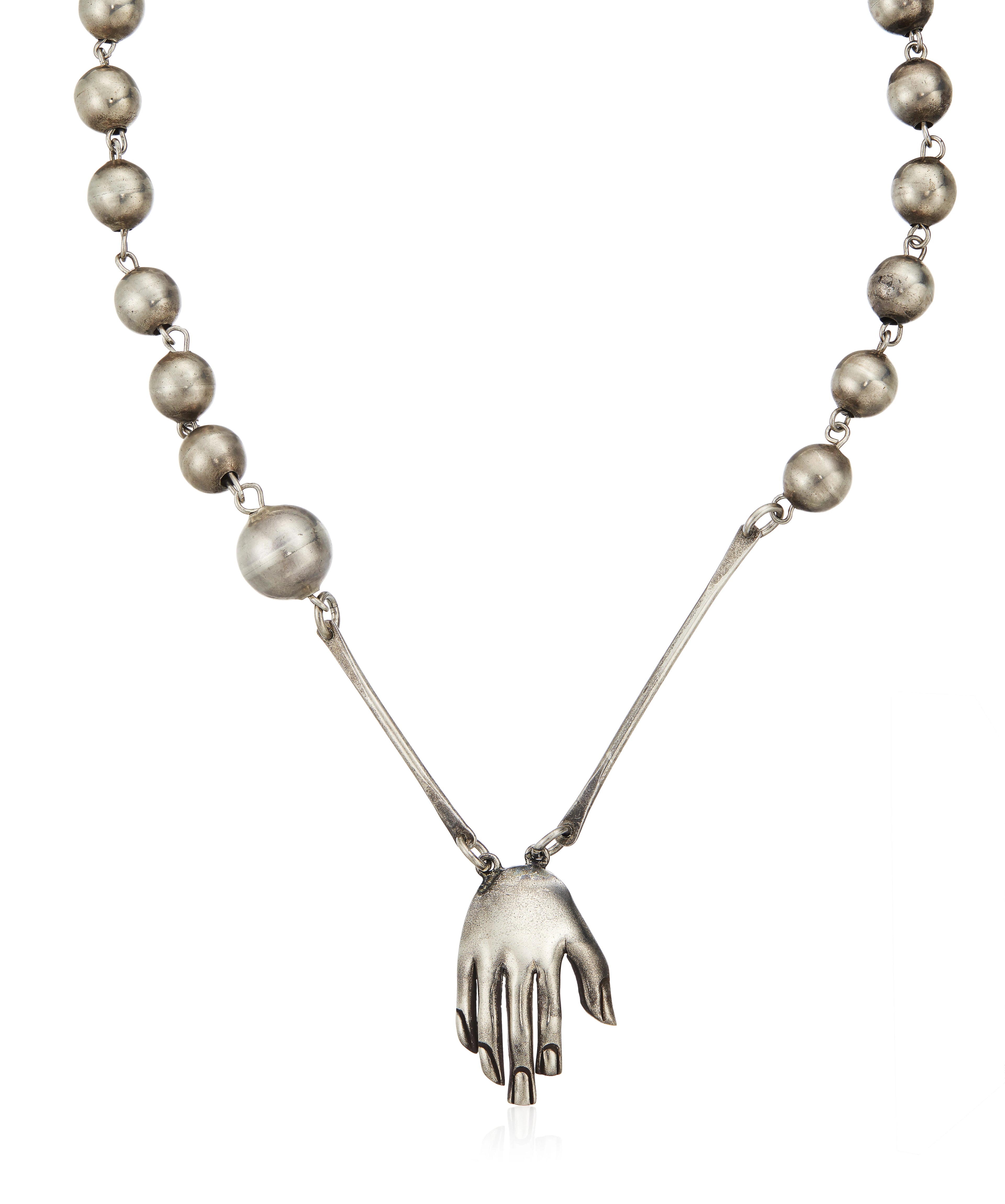
A sculpted human hand, modeled in the round and hung as the single pendant of an otherwise austere bead necklace, is a rare departure from the geometric and gem-set vocabulary on which Antonio Pineda's reputation rests. Where his celebrated work tends toward abstract modernist form and the "ingenious use of gemstones" for which the Fowler Museum's 2008-2009 retrospective Silver Seduction honored him, this piece does its work entirely in silver and entirely through figuration. The naturalistic hand, suspended from two tapering bars off a run of hollow spheres, turns a necklace into a small sculpture worn at the throat, and it is exactly this sculptural instinct, the willingness to let a single representational form carry the design, that distinguishes the object within Pineda's output and within the wider language of Taxco modernism.
The construction reads as mature workshop production rather than early or experimental work. The chain alternates hollow silver beads, graduated and light on the body, with paired faceted links that frame and present the pendant, a careful piece of staging that keeps the eye moving toward the hand. The hand itself is solid in feel, its fingers and palm modeled with restraint, neither caricatured nor overworked. The marks are the standard signature of Antonio's own taller at its height: the ANTONIO TAXCO stamp surmounted by his crown, HECHO EN MEXICO, the 970 fineness he favored over ordinary sterling, and the eagle assay number. This same cluster of marks, the Antonio crown with 970 and the eagle, is the documented signature of his workshop at full command of the medium, the eagle assay system itself instituted in 1948 and the 970 standard being the one he is recorded as favoring (Morrill and Berk, Mexican Silver, 1994), placing this necklace in the years of his fullest control of the form.
Pineda came up through the foundational Taxco lineage, an early apprentice in William Spratling's Taller de las Delicias trained under the master silversmiths Artemio Navarrete and Alfonso Mondragon before opening his own shop in Taxco in 1941. The Fowler called him "one of Taxco's great innovators" and a "Mexican national treasure," and his work is consistently noted for its elegant acknowledgment of the human form. A pendant in the literal shape of a hand is that acknowledgment made explicit, a quiet, slightly surreal gesture that rewards the kind of close looking modernist Mexican silver invites. Figurative pendants of this directness are uncommon in his catalogued work.
The necklace carries substantial weight in the hand for its scale, the heft of the solid pendant balanced against the lightness of the hollow beads, and it presents the full hallmark vocabulary that anchors an attribution to Antonio's own workshop rather than the broader Taxco production.
Museum of Mexican Silver. “Hand Pendant Necklace.” Catalog no. MoMS-002083. https://museumofmexicansilver.com/pieces/antonio-pineda-silver-necklace
See something wrong with this record? Suggest a correction and the piece details fill in automatically.
Antonio Pineda
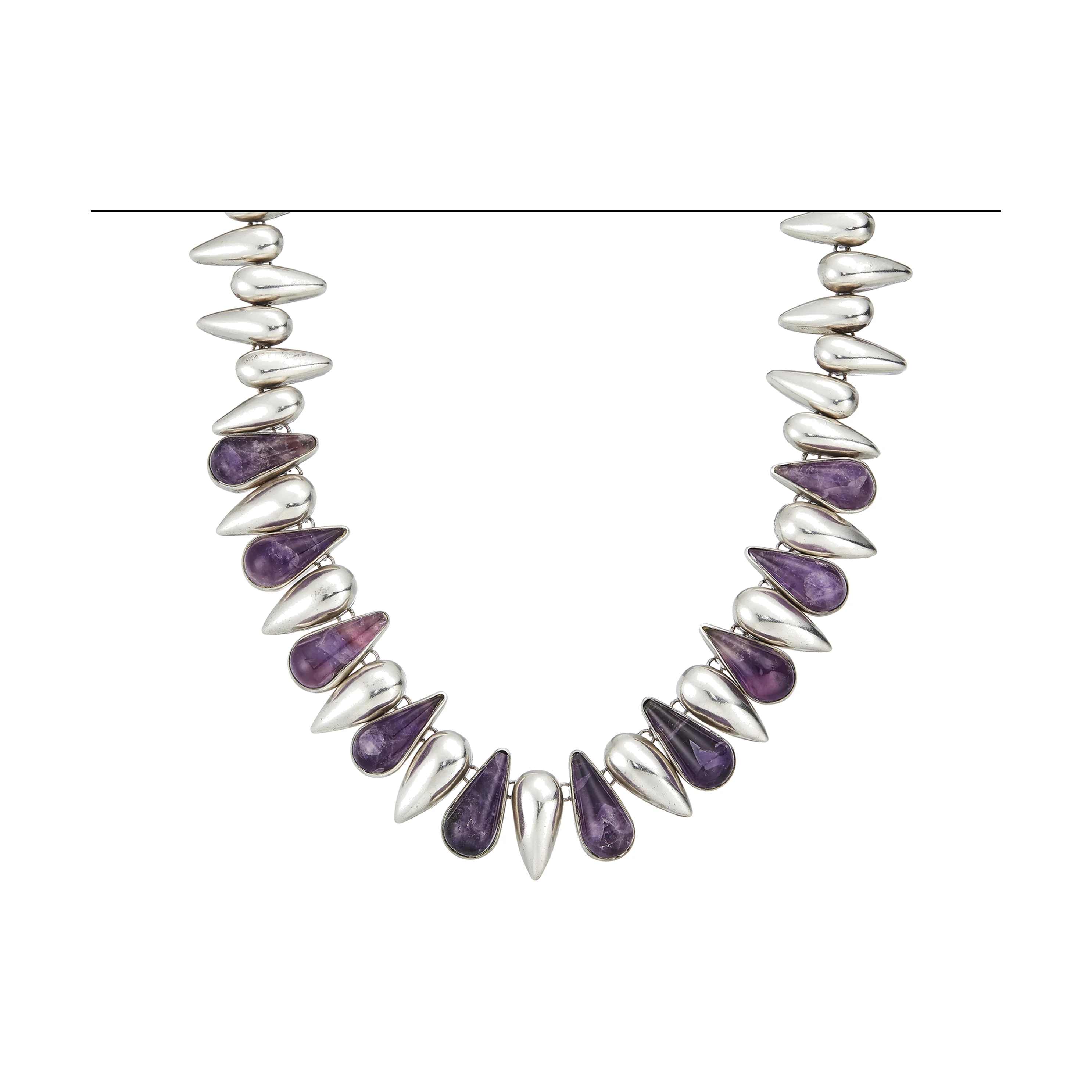
Teardrop-Link Amethyst and Silver Necklace
Silver