Saves instantly, no account needed. Already a member? Sign in.
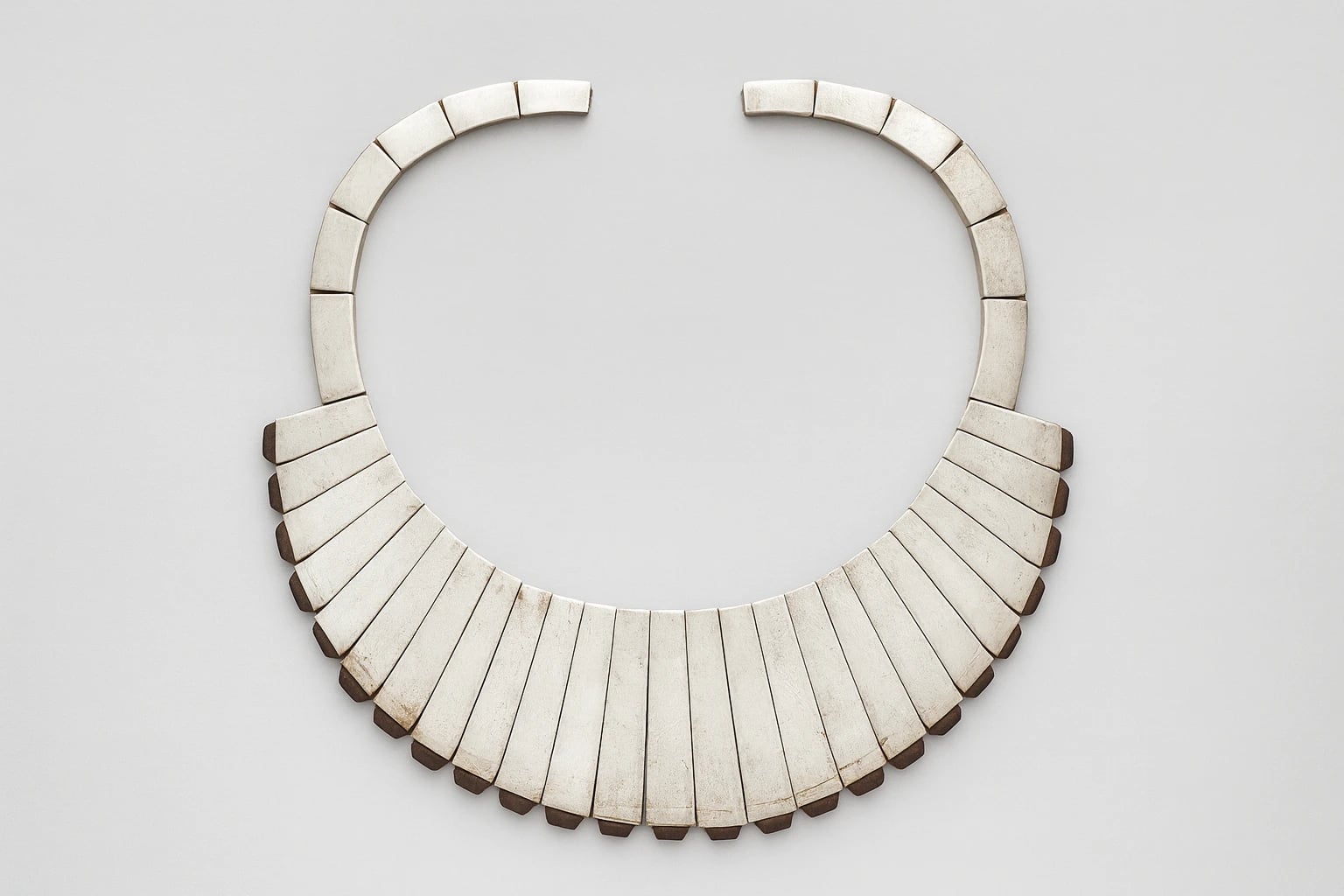
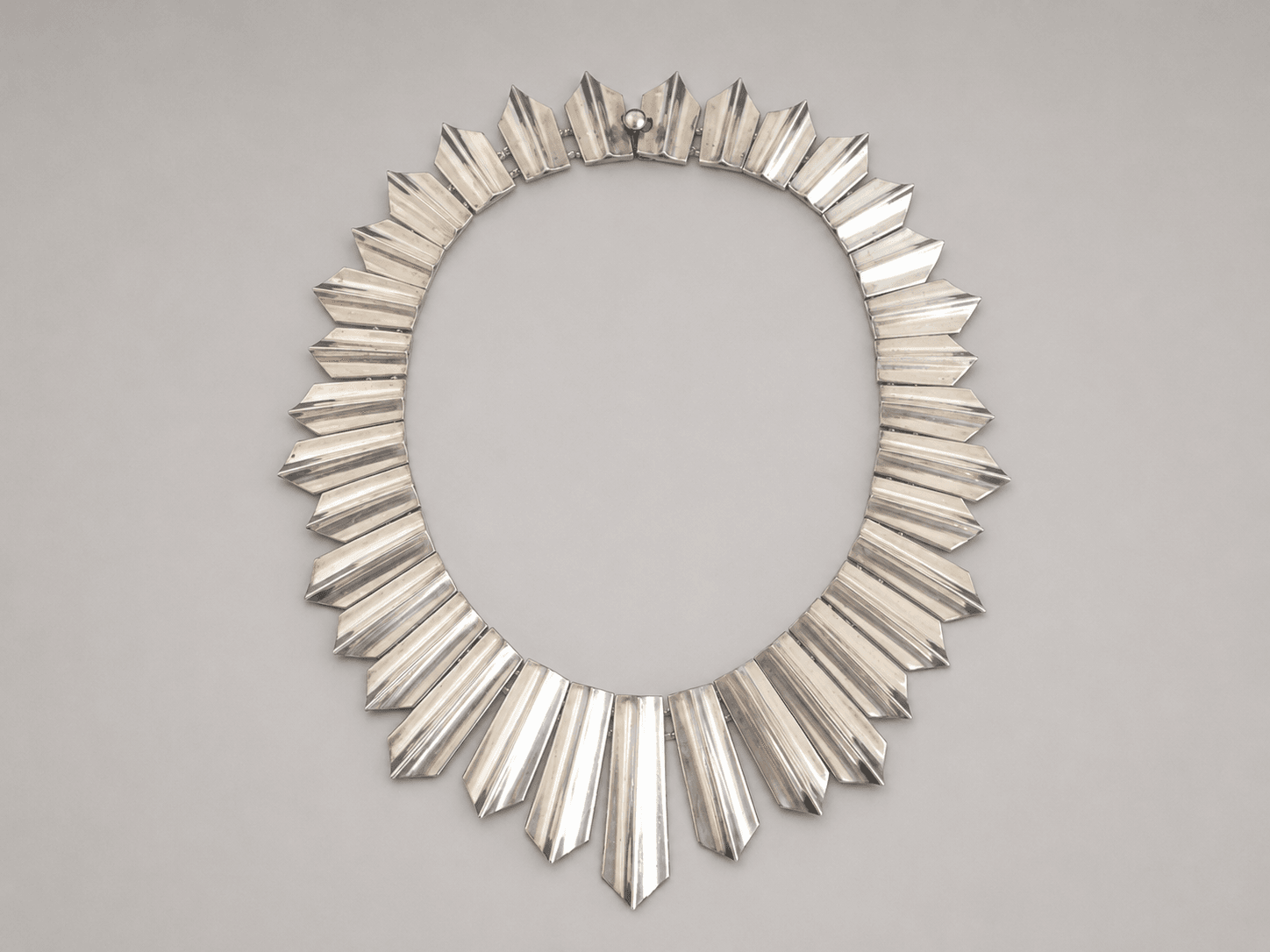
A row of pointed chevrons, graduated in scale and hinged into a continuous band, gives this collar its particular authority: geometry that holds its shape at the throat while bending freely to follow the neck. Each link carries a raised central ridge with angled planes falling away on either side, so that the surface catches light in alternating bright and shadowed facets as the wearer moves. The forms are severe and repetitive, but the graduation from smaller links at the back to larger ones at the front keeps the rhythm from turning mechanical. This is a study in how a single elementary unit, multiplied and articulated, can become a resolved piece of modern ornament.
The construction explains much of the effect. The reverse of the collar runs two parallel fine-link chains that carry the articulated front and let it flex evenly, while a box tongue clasp with a ball push button closes the band. That double-chain backing is a practical answer to a design problem: rigid faceted links need a flexible spine if the whole collar is to sit close and move with the body rather than against it. The faceting itself does the visual work. Because each chevron is raised to a ridge and cut back on its flanking planes, the necklace reads as a band of small three-dimensional prisms rather than a flat printed pattern, and the play of reflection depends entirely on that shallow relief. The marks include SILVER, HECHO EN MEXICO, the Antonio crown, an eagle, the 970 fineness, YY, and the design number 512.
Antonio Pineda worked consistently in 970 silver, a higher fineness than the sterling standard, and his shop favored crisp geometric volumes of exactly this kind. Morrill records related Pineda pieces built on comparable principles, including a Three-D Wave necklace and bracelet in 970 silver carrying the Antonio crown and a YY prefix with the number 525, a set Morrill dates to about 1955 to 1960. The shared YY prefix and the closely neighboring design number place the present chevron collar within the same working sequence, though a design number supports relative chronology rather than an exact year. Pineda's talleres also relied on a network of subcontractors and specialist smiths, with marks documented for makers such as Mota, Hilda, and María Pineda producing under the Antonio crown, so the crown mark identifies the shop and its design authority rather than proving the hand that fabricated this particular collar.
The chevron collar belongs to the strain of Taxco modernism that treated silver as a medium for pure form. Pineda, who helped organize the National Silver Fair and drove the founding of the International Silver Fair in Taxco in 1973, built his reputation on exactly this reduction of ornament to structure. A collar of graduated faceted prisms shows how that sensibility translated into something wearable: architectural in its logic, disciplined in its repetition, and dependent for its life on the reflective behavior of worked silver. It records a designer who understood that a modern necklace could be assembled from a single geometric idea, carried through with precision.
Museum of Mexican Silver. “Zig Zag Chevron Necklace.” Catalog no. MoMS-002052. https://museumofmexicansilver.com/pieces/antonio-pineda-zig-zag-chevron-necklace
See something wrong with this record? Suggest a correction and the piece details fill in automatically.
Record data: the Date field previously read "Taxco modernist," which is a style label rather than a date. It has been replaced with "1953 or later," inferred from the 970 silver standard and Pineda's YY design series, and is labelled as inferred rather than documented. Design No. YY512 is entered as a structured field and Materials are standardised as 970 silver.
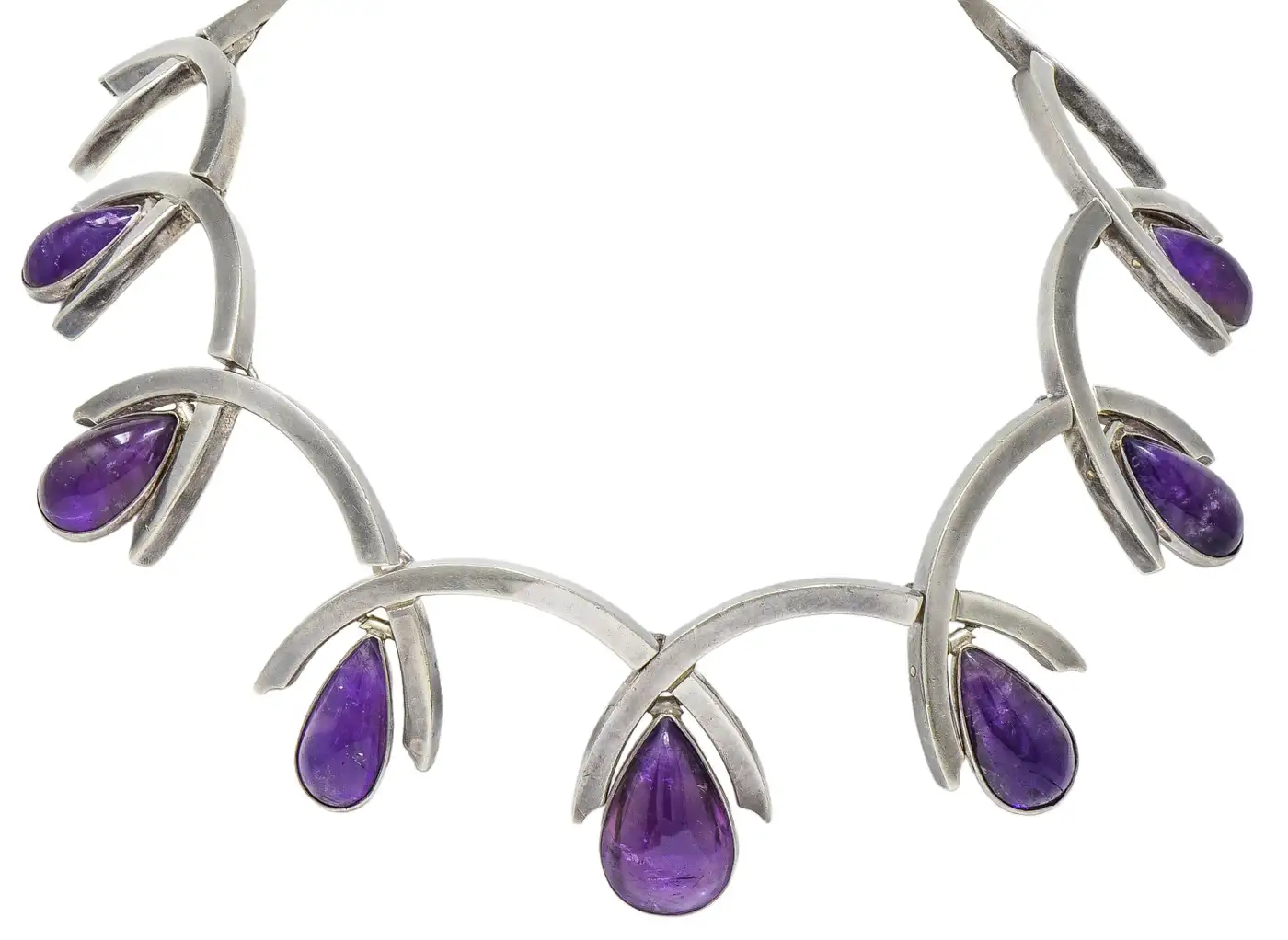
Antonio Pineda
Arched Amethyst Teardrop Necklace
1953 or later
970 silver