Saves instantly, no account needed. Already a member? Sign in.
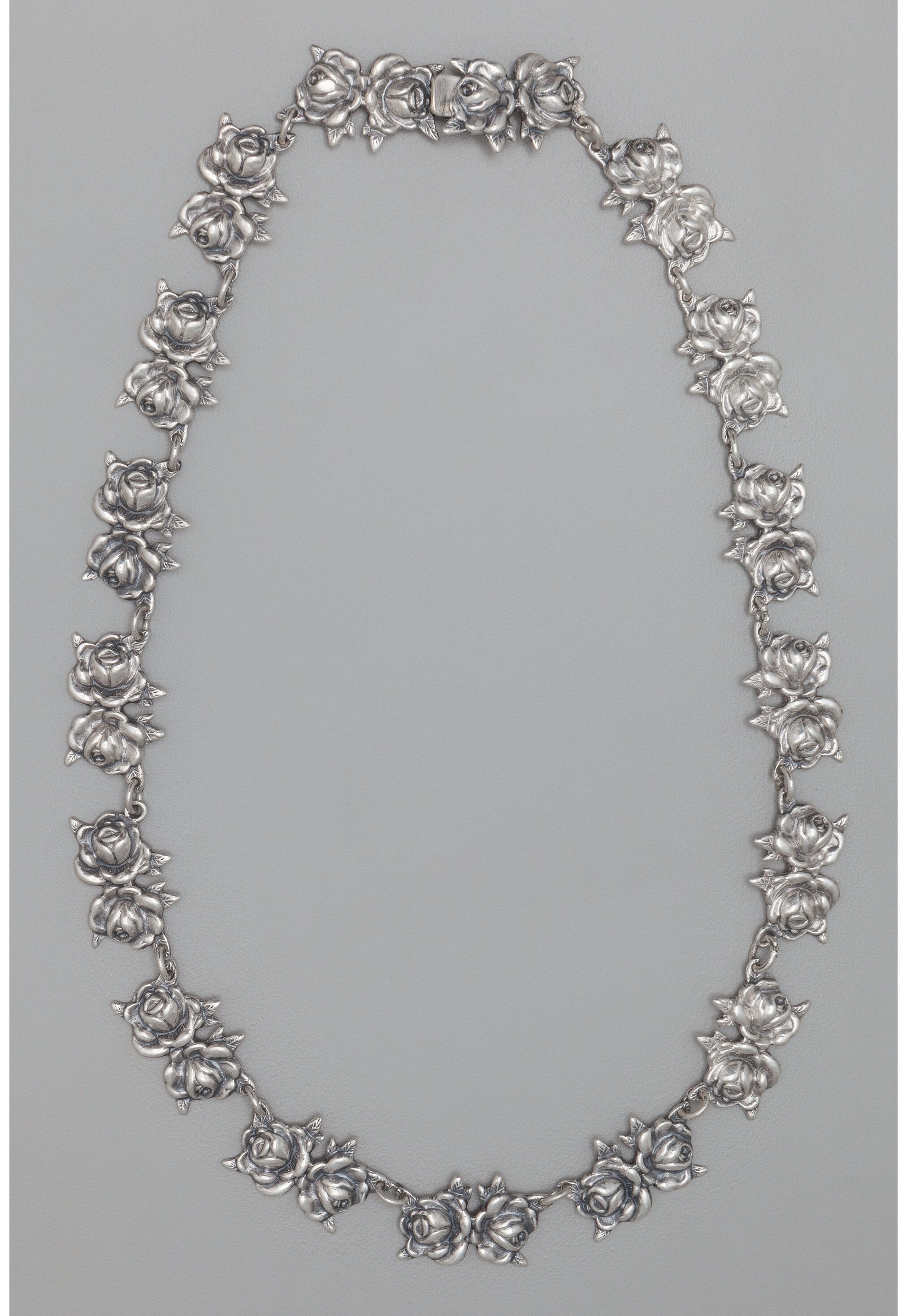
The champlevé enamel necklace was the centerpiece of Margot de Taxco's production and the form through which the workshop earned its particular distinction. Morrill describes these pieces as "glittering displays of color, texture, and technical perfection" — the product of a champlevé technique Margot inherited from her early years at Los Castillo and developed into one of her major jewelry lines (Morrill & Berk, Mexican Silver, 1994, p. 166). Design 5194, a pendant necklace in sterling and vitreous enamel, is a characteristic expression of that sustained practice.
Margot designed each composition herself and maintained a production book with specific instructions for every numbered piece — color choices for the enamel, placement of clasp or loop, notes on assembly — so that workshop enamelers could reproduce each design faithfully (Morrill & Berk, Mexican Silver, 1994, p. 168). Morrill records that this insistence on meticulous production techniques resulted in a high level of workmanship across everything the workshop signed. The pendant, an inch and five-eighths by an inch and a quarter, hangs on a seventeen-inch sterling chain, proportions well calibrated for wear.
On the reverse, two marks authenticate the piece: the workshop's "Margot de Taxco Sterling" die alongside Eagle 22, the Mexican government assay hallmark confirming 925 sterling content. The design number places this composition in the later range of the 1948–1985 output span — Morrill notes that smaller numbers generally indicate earlier work (Morrill & Berk, Mexican Silver, 1994, p. 15), so a five-thousands designation reflects a later phase of the workshop's numbering sequence.
The clean double marking and an identified design number from Margot's documented production system make attribution straightforward.
Museum of Mexican Silver. “Design 5194 Necklace.” Catalog no. MoMS-001045. https://museumofmexicansilver.com/pieces/margot-necklace-5194
See something wrong with this record? Suggest a correction and the piece details fill in automatically.
Design 5210 Necklace
Sterling silver